
Canned sardines,
does it really help with Metabolic-risk markers and one-year diabetes incidence in older adults with prediabetes?
research showsThe grade is D with 34 points. In a one-year trial of 152 older adults with prediabetes, incident diabetes occurred in 4 of 77 controls and 2 of 75 sardine participants, a null and severely imprecise result. FINDRISC and HOMA-IR improvements were separate secondary surrogate outcomes.
ads claimCanned-sardine composition is factual, but a severely imprecise event result plus improved risk markers cannot establish that two cans prevent diabetes. Verdict 1047 is D with 28 points for capsules and incident diabetes; this verdict concerns olive-oil canned sardine meals, one-year events, and metabolic markers.
Useful facts when choosing a product
- The intervention was 100 g olive-oil canned sardines twice weekly, 200 g/week, for 12 months. Species, catch location, wild status, exact can sodium, and bone inclusion were not verified in the article.
- A separate USDA generic entry for Atlantic sardines canned in oil with bone lists 382 mg calcium and 307 mg sodium per 100 g. These are not trial-product measurements and vary by brand.
- The FDA monitoring-table mean for total mercury in sardines is 0.013 ppm, not a direct methylmercury analysis of the trial product.
- Canned and fresh sardines differ in sodium, packing oil, and possible bone intake and are not identical interventions. Whether the cans were drained, the amount of oil actually consumed, and its calories could not be confirmed from the article.
Chamgap Semantic Classification Code
Candidate index · review held
F.olive-oil-canned-sardines.oral.metabolic-risk-markers-and-diabetes-incidence-with-prediabetes.assess.UNKFoods and beverages > Olive-oil canned sardines > Oral > Metabolic-risk markers and diabetes incidence with prediabetes > Association or change assessment > Unknown
An automated migration candidate, not an issued permanent code; exact claim scope remains under review. This machine-generated migration candidate helps retrieval but is not a permanent assignment. The original verdict ID and URL remain authoritative.
What the research actually shows
The trial randomized 77 control and 75 sardine participants and analyzed 122 completers, 59 and 63. Both arms received the same prevention education; sardine participants added 100 g olive-oil canned sardines twice weekly. NCT03557541 was submitted on June 4, 2018, after the 2014-2016 trial. The attached protocol targeted a reduction in diabetes conversion from 20% to 5% and planned 125 per arm, 250 total. The 152 randomized were 60.8% of plan and 122 completers were 48.8%, undermining event power. Funding came from La Caixa Banking Foundation Recercaixa 2013.
Why this is classified as D (34)
A severely imprecise null result based on six diabetes events plus retrospective registration and sample-size failure gives D with 34 points.
Counterpoint. FINDRISC and HOMA-IR signals are preserved without upgrading them to proven diabetes prevention.
Rejudgment record. Cross-check applied — The article, retrospective registry, and 2013 protocol were reconciled to correct planned and analyzed counts and separate composition, surrogates, and diabetes events
| Endpoint | H | Hard endpoint - actual events such as death |
| Replication | R1 | Single confirmatory trial |
| Independence | I2 | Decisive evidence is publicly or non-profit funded |
| Effect size | E0 | Null |
| Precision | C0 | The confidence interval leaves room for benefit |
Stored derived and displayed grades match; this is not a current recalculation or validity check (D).
Sub-claim grades by effect
This ingredient is marketed for several effects. A single overall grade blends strong and weak claims together, so each effect is graded separately here. The overall grade reflects the strongest disconfirming or core claim.
| Effect (sub-claim) | Grade | Basis |
|---|---|---|
| Sardine supplementation improves FINDRISC and HOMA-IR | C | Both surrogates favored sardines in the completer analysis. |
| Sardine supplementation prevents incident type 2 diabetes | D | Only six events occurred, 4/77 control versus 2/75 sardine, producing a severely imprecise null result. |
Cross-check — AI research and Codex final gate
Evidence Table
| Study | Design | Sample | Funding | Endpoint | Result | Weight |
|---|---|---|---|---|---|---|
| Díaz-Rizzolo DA et al. 2021 | Randomized controlled 12-month dietary intervention trial | 152 randomized, control 77 and sardine 75; 122 completers analyzed, 59 and 63 | La Caixa Banking Foundation Recercaixa 2013 | One-year incident diabetes; separate secondary surrogates FINDRISC and HOMA-IR | Incident diabetes 4/77 control versus 2/75 sardine, P=.424; RR 0.513, 95% CI 0.097-2.720; risk difference -2.53 percentage points, -8.68 to +3.63; secondary surrogates FINDRISC P=.035 and HOMA-IR P=.032 | One-year whole-food trial limited by six events, sample-size failure, and completer analysis |
Receipt — 3 References
All 3 cited sources were verified for existence at the original page (as of 2026-08-03).
Final verification and publication gate: Codex · Evidence date: 2026-08-03 · Corrections: none
Cite this verdict
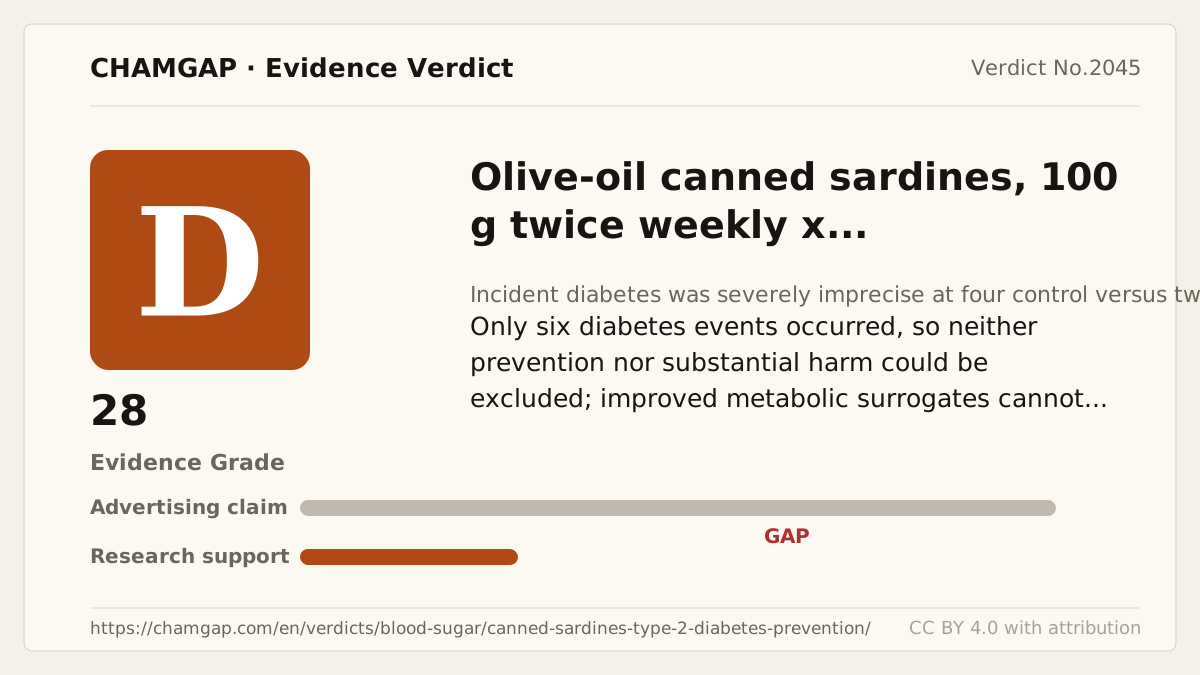
[Chamgap] Canned sardines x metabolic-risk markers and one-year diabetes incidence in older adults with prediabetes — Evidence Grade D·34. 3 cited sources checked. Source: https://chamgap.com/en/verdicts/blood-sugar/canned-sardines-type-2-diabetes-prevention/ · CC BY 4.0CC BY 4.0 — free to use with attribution; do not distort grades, numbers, or verdict meaning.
What this document does and does not do
Chamgap is an information source. It reports what research has and has not confirmed; it does not tell readers what to take or buy. That decision belongs to readers and, when needed, medical or legal professionals. This verdict reflects literature available up to the search date and may change as new research appears. Nothing here is medical advice.