
Baked then chilled potato,
does it really help with Lower post-meal insulin response?
research showsThe grade is C with 50 points. Of the two registered primary endpoints, glucose did not differ and only insulin fell. Insulin area under the curve was 17.7% lower, but no 95% confidence interval was reported; this one-meal surrogate study of 30 completers cannot establish long-term glycemic control or diabetes prevention.
ads claimIt is true that chilling changes resistant-starch content. The experiment did not show improved HbA1c, weight, or diabetes incidence.
Useful facts when choosing a product
- Composition data cited in the paper reported mean resistant starch of 2.3 g/100 g in boiled, baked, or microwaved potatoes and 5.6 g/100 g after cooking and chilling. Retrogradation after cooling is a measurable compositional change.
- The registry specified 200 g of test food, but the paper reported 250 g peeled potato without additives; the chilled condition spent five days at 4 C.
- Potatoes are native to the Andes and entered Joseon around 1824 to 1825. Imwon Gyeongjeji records them briefly as Bukjeo in an appendix to the sweet-potato entry in Manhakji chapter 3.
- Verdict 1964 is C with 54 points for purple potato and blood pressure. This verdict concerns a different preparation and outcome, post-meal insulin.
Chamgap Semantic Classification Code
Candidate index · review held
F.baked-then-chilled-potato.food.post-meal-insulin-response.reduce.UNKFoods and beverages > Baked then chilled potato > Food consumption > post-meal insulin response > Reduction claim > Unknown
An automated migration candidate, not an issued permanent code; exact claim scope remains under review. This machine-generated migration candidate helps retrieval but is not a permanent assignment. The original verdict ID and URL remain authoritative.
What the research actually shows
Thirty-five overweight or obese women met the eligibility criteria, and 30 were enrolled, completed, and were analyzed in a randomized crossover trial. Each ate 250 g hot boiled russet potato and, on another visit, potato baked at 218 C for 90 minutes and chilled at 4 C for five days. The registry specified 200 g of test food, while the paper reported 250 g, a protocol-publication discrepancy. Insulin area under the curve was 17.7% lower, with insulin lower by 25.8% at 15 minutes and 22.6% at 30 minutes, while glucose area under the curve was nonsignificant. No 95% confidence intervals were reported. The Alliance for Potato Research and Education, a potato industry group, funded the study.
Why this is classified as C (50)
Glucose failed while insulin succeeded among the co-primary outcomes. This was a 30-person acute surrogate trial funded by an industry group, limiting the grade to C with 50 points.
Counterpoint. The acute insulin signal was directly measured but needs independent long-term testing for clinical meaning.
Rejudgment record. Cross-check applied — Glucose was null and insulin positive among co-primary endpoints in a 30-person acute surrogate trial funded by a potato industry group
| Endpoint | S | Surrogate marker - laboratory or imaging measures |
| Replication | R1 | Single confirmatory trial |
| Independence | I0 | Evidence comes only from manufacturer studies |
| Effect size | E+ | Meets the clinically important threshold |
| Precision | CX | No pooled confidence interval could be confirmed |
Stored derived and displayed grades match; this is not a current recalculation or validity check (C).
Sub-claim grades by effect
This ingredient is marketed for several effects. A single overall grade blends strong and weak claims together, so each effect is graded separately here. The overall grade reflects the strongest disconfirming or core claim.
| Effect (sub-claim) | Grade | Basis |
|---|---|---|
| Lower postprandial insulin response with chilled potato | C | The acute surrogate was positive, but co-primary glucose was null. |
| Lower postprandial glucose area under the curve with chilled potato | D | The registered glucose primary outcome was nonsignificant. |
Cross-check — AI research and Codex final gate
Evidence Table
| Study | Design | Sample | Funding | Endpoint | Result | Weight |
|---|---|---|---|---|---|---|
| Patterson et al. 2019 | Randomized crossover single-meal trial | 35 met eligibility criteria; 30 enrolled, completed, and were analyzed | Potato industry funding from the Alliance for Potato Research and Education | Registered primary measures of postprandial glucose and insulin concentrations | Glucose null; insulin 17.7% lower; registered test meal 200 g versus 250 g in the paper; no 95% CI reported | Acute surrogate trial with only one co-primary endpoint positive and discrepant test-meal quantities |
Receipt — 2 References
All 2 cited sources were verified for existence at the original page (as of 2026-08-02).
Final verification and publication gate: Codex · Evidence date: 2026-08-02 · Corrections: none
Cite this verdict
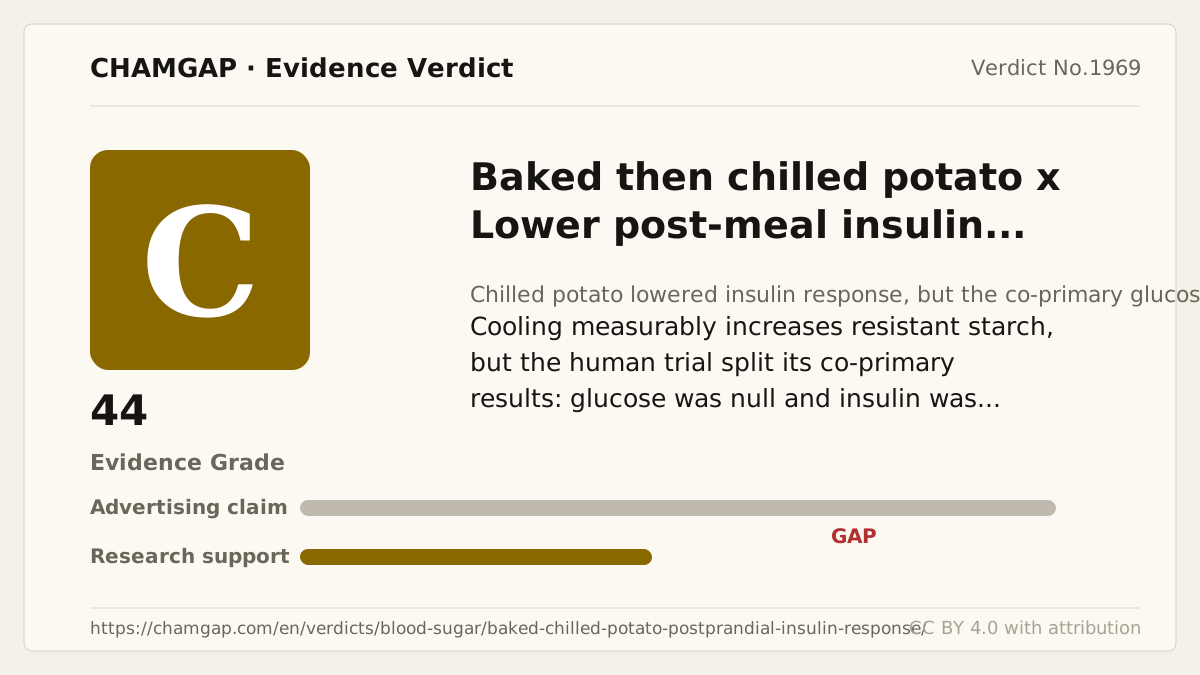
[Chamgap] Baked then chilled potato x post-meal insulin response — Evidence Grade C·50. 2 cited sources checked. Source: https://chamgap.com/en/verdicts/blood-sugar/baked-chilled-potato-postprandial-insulin-response/ · CC BY 4.0CC BY 4.0 — free to use with attribution; do not distort grades, numbers, or verdict meaning.
What this document does and does not do
Chamgap is an information source. It reports what research has and has not confirmed; it does not tell readers what to take or buy. That decision belongs to readers and, when needed, medical or legal professionals. This verdict reflects literature available up to the search date and may change as new research appears. Nothing here is medical advice.