
ACE inhibitor plus ARB,
does it really help with Greater renal protection than monotherapy in chronic kidney disease?
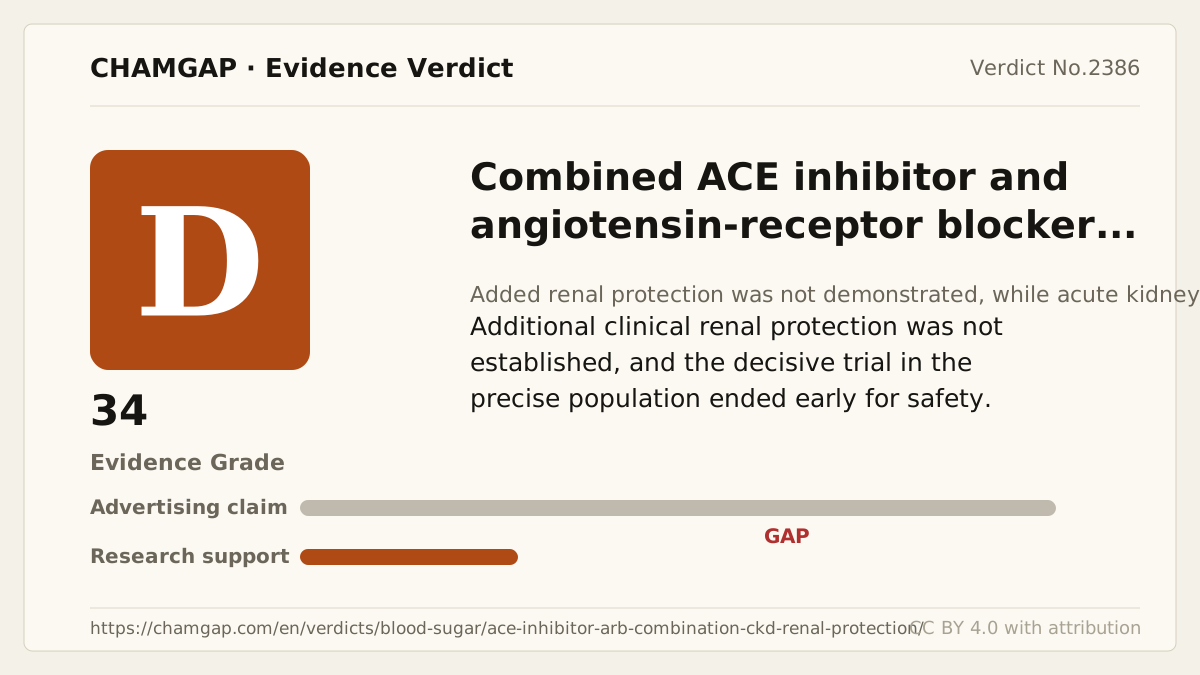
research showsThe grade is D with 34 points. In type 2 diabetic kidney disease with overt albuminuria, adding lisinopril to losartan in VA NEPHRON-D did not reduce the primary renal/death composite and increased prespecified safety outcomes of acute kidney injury and hyperkalemia, prompting early termination.
ads claimLowering proteinuria more is not the same as preventing kidney failure or death. Separate monotherapy verdicts differ: verdict 943 is A with 82 points, verdict 1181 is B with 72 points, and verdict 1443 is B with 76 points. This verdict addresses only added renal protection from combining the two classes.
Useful facts when choosing a product
- VA NEPHRON-D specifically enrolled type 2 diabetes with overt albuminuria; it does not directly answer non-diabetic or mildly albuminuric CKD.
- ONTARGET was a broad high-risk cardiovascular trial with mean eGFR about 73.6, not an all-proteinuric diabetic kidney disease trial.
- VA Cooperative Studies Program funded VA NEPHRON-D and Merck supplied study drugs; Boehringer Ingelheim sponsored ONTARGET.
Chamgap Semantic Classification Code
Candidate index · review held
UNK.combined-ace-inhibitor-and-angiotensin-receptor-blocker-therapy.UNK.greater-renal-protection-than-monotherapy-in-chronic-kidney-disease.assess.MULTIUnknown > Combined ACE inhibitor and angiotensin-receptor blocker therapy > Unknown > Greater renal protection than monotherapy in chronic kidney disease > Association or change assessment > Multiple: primary unresolved
An automated migration candidate, not an issued permanent code; exact claim scope remains under review. This machine-generated migration candidate helps retrieval but is not a permanent assignment. The original verdict ID and URL remain authoritative.
What the research actually shows
VA NEPHRON-D stopped early after a median 2.2 years. Prespecified safety acute kidney injury requiring or occurring during hospitalization affected 130 versus 80 patients, 12.2 versus 6.7 events per 100 person-years, HR 1.7 (1.3 to 2.2), P<0.001. Hyperkalemia was 98 versus 41 events, 6.3 versus 2.6 per 100 person-years, HR 2.8 (1.8 to 4.3), P<0.001. In ONTARGET's prespecified renal analysis, dialysis, doubling of creatinine, or death was 1,233/8,502 versus 1,150/8,576, HR 1.09 (1.01 to 1.18), and acute dialysis was 28/8,502 versus 13/8,576, HR 2.19 (1.13 to 4.22).
Why this is classified as D (34)
One decisive trial matching the precise population had a null primary efficacy endpoint, while its interval did not exclude meaningful benefit. Prespecified safety acute kidney injury affected 130 versus 80 patients, HR 1.7 (1.3 to 2.2), so the result is D with 34 points.
Counterpoint. Combination evidence in other indications such as heart failure was not pooled here. Biomarker changes cannot substitute for renal clinical outcomes.
Rejudgment record. Cross-check applied — The decisive overt-albuminuria diabetic kidney disease trial had a null primary renal/death composite, early stopping, and increased safety events
| Endpoint | H | Hard endpoint - actual events such as death |
| Replication | R1 | Single confirmatory trial |
| Independence | I2 | Decisive evidence is publicly or non-profit funded |
| Effect size | E- | Harm increased in the trials |
| Precision | C0 | The confidence interval leaves room for benefit |
Stored derived and displayed grades match; this is not a current recalculation or validity check (D).
Sub-claim grades by effect
This ingredient is marketed for several effects. A single overall grade blends strong and weak claims together, so each effect is graded separately here. The overall grade reflects the strongest disconfirming or core claim.
| Effect (sub-claim) | Grade | Basis |
|---|---|---|
| Added prevention of renal events in overtly albuminuric diabetic kidney disease | D | The precise trial had a null primary endpoint. |
| Greater proteinuria reduction guarantees prevention of kidney failure | D | The biomarker and clinical event are not the same endpoint. |
Cross-check — AI research and Codex final gate
Evidence Table
| Study | Design | Sample | Funding | Endpoint | Result | Weight |
|---|---|---|---|---|---|---|
| Fried LF et al. 2013 VA NEPHRON-D | Double-blind randomized placebo-controlled add-on trial | 1,448 participants | US Department of Veterans Affairs; drugs supplied by Merck | eGFR decline, end-stage kidney disease, or death; primary efficacy | 132 versus 152 events; HR 0.88 (0.70 to 1.12), P=0.30 | Decisive null trial in the precise population |
| Mann JFE et al. 2008 ONTARGET renal analysis | Prespecified secondary renal analysis of a large randomized active-controlled trial | 25,620 participants; 8,502 combination and 8,576 ramipril | Boehringer Ingelheim | Dialysis, doubling of creatinine, or death | 1,233 versus 1,150 events; HR 1.09 (1.01 to 1.18) | Indirect evidence with different population, drugs, and comparator |
Receipt — 2 References
All 2 cited sources were verified for existence at the original page (as of 2026-08-07).
Final verification and publication gate: Codex · Evidence date: 2026-08-07 · Corrections: none
Cite this verdict
[Chamgap] ACE inhibitor plus ARB x enhanced renal protection in CKD — Evidence Grade D·34. 2 cited sources checked. Source: https://chamgap.com/en/verdicts/blood-sugar/ace-inhibitor-arb-combination-ckd-renal-protection/ · CC BY 4.0CC BY 4.0 — free to use with attribution; do not distort grades, numbers, or verdict meaning.
What this document does and does not do
Chamgap is an information source. It reports what research has and has not confirmed; it does not tell readers what to take or buy. That decision belongs to readers and, when needed, medical or legal professionals. This verdict reflects literature available up to the search date and may change as new research appears. Nothing here is medical advice.