
Liposomal NAD+,
does it really help with Increased cellular energy and mitochondrial vitality?
research showsRENEWAL-NAD+ was published in GeroScience on July 30, 2026. The blood NAD surrogate increased, but this five-day trial does not establish improved vitality from liposomal NAD+ products. Failure to establish a benefit is not proof of no effect.
ads claimAdvertisements combine cellular energy, maximized absorption, mitochondrial activation, and healthy aging. The key leap is treating the intracellular role of NAD+ and general claims about liposomes as proof that the finished product works in humans.
Four separate assessment dimensions
| Effect direction and size | RENEWAL-NAD+ was published in GeroScience on July 30, 2026. The blood NAD surrogate increased, but this five-day trial does not establish improved vitality from liposomal NAD+ products. Failure to establish a benefit is not proof of no effect. |
|---|---|
| Evidence certainty | Publication status is updated. One trial is counted once; short follow-up, sponsor funding and registration/analysis-selection limitations remain. |
| Applicability | Whole-blood results for LathMized NAD+ cannot be directly reassigned to clinical vitality benefits of liposomal products. |
| Safety | The legacy Unknown safety label is retained. Short-term tolerability does not establish long-term or liposomal-product safety. |
D/26 and subgrades C/D are retained legacy values, not newly calculated scores. The historical axis-level calculation and any preprint-specific deduction could not be verified, so no points were inferred or restored. The legacy 26 is not a current fixed anchor and is not represented as a newly validated calculator result.
Useful facts when choosing a product
- Korean cross-border marketplaces sell liposomal capsules and liquids claiming about 100-500 mg NAD+ per daily serving.
- Some products labeled NAD+ actually use NR or NMN as the main ingredient, while others contain NAD+ itself; the chemical name in Supplement Facts matters.
- One Codeage product provides 500 mg NAD+ plus 102.5 mg anhydrous betaine per two capsules, so it is not an NAD+-only product.
- Without product-specific data on liposome size, encapsulation efficiency, stability, and release after digestion, the word liposomal cannot establish comparative absorption.
Chamgap Semantic Classification Code
Candidate index · review held
UNK.liposomal-nad-plus.UNK.cellular-energy-and-mitochondrial-vitality.increase.placeboUnknown > Liposomal NAD+ > Unknown > cellular energy and mitochondrial vitality > Increase claim > Placebo
An automated migration candidate, not an issued permanent code; exact claim scope remains under review. This machine-generated migration candidate helps retrieval but is not a permanent assignment. The original verdict ID and URL remain authoritative.
What the research actually shows
RENEWAL-NAD+ randomized 60 healthy adults aged 45–75 in a short placebo-controlled trial. The dosed analysis set with blood sampling contained 51 participants; the primary analysis excluded one participant and included 50. The published report describes a 53% higher whole-blood NAD level versus placebo after treatment. Plasma NAD and secondary wellbeing, vital-sign, activity and sleep outcomes did not show significant differences after multiplicity correction.
The intervention was LathMized NAD+ powder containing NAD and PEG. Its results cannot be reassigned to a marketed liposomal NAD+ product. Whole-blood NAD predominantly reflects erythrocyte measurements, not a direct measure of muscle or brain mitochondrial function or everyday vitality. Short follow-up and limited power for secondary outcomes mean nonsignificance does not prove the complete absence of benefit.
Publication: GeroScience, July 30, 2026; DOI 10.1007/s11357-026-02399-1. The preprint description and its use as a current limitation have been removed. Sponsor funding, retrospective registration, short follow-up and product/outcome directness are separate issues. The paper states that an analysis plan preceded unblinding, while the exclusion of one participant from the primary analysis was decided after unblinding.
Registration dates are distinct: ClinicalTrials.gov records first submission on December 19, 2025, the first submission meeting quality-control criteria on January 4, 2026, and first public posting on January 13, 2026. The trial was conducted in 2022. The earlier phrase “registered January 4” has been corrected to distinguish these events.
This update checks publication status and related interpretation, citations and dates. Access restrictions prevented a complete text-to-text comparison with the original preprint. No new systematic search of every liposomal product or reassessment of the entire historical evidence base was performed. The earlier search did not identify a direct product trial; that is not a universal claim that no such study exists anywhere.
D/26 and subgrades C/D are retained legacy values, not newly calculated scores. The historical axis-level calculation and any preprint-specific deduction could not be verified, so no points were inferred or restored. The legacy 26 is not a current fixed anchor and is not represented as a newly validated calculator result.
Why this is classified as D (26)
D/26 and subgrades C/D are retained legacy values, not newly calculated scores. The historical axis-level calculation and any preprint-specific deduction could not be verified, so no points were inferred or restored. The legacy 26 is not a current fixed anchor and is not represented as a newly validated calculator result.
Counterpoint. The surrogate C and vitality D subgrades are retained legacy assessments. Publication status does not justify invented point deductions or additions.
Publication update record. Bounded publication update; legacy values retained — D/26 and subgrades C/D are retained legacy values, not newly calculated scores. The historical axis-level calculation and any preprint-specific deduction could not be verified, so no points were inferred or restored. The legacy 26 is not a current fixed anchor and is not represented as a newly validated calculator result.
Sub-claim grades by effect
This ingredient is marketed for several effects. A single overall grade blends strong and weak claims together, so each effect is graded separately here. The overall grade reflects the strongest disconfirming or core claim.
| Effect (sub-claim) | Grade | Basis |
|---|---|---|
| Delivery to circulating or intracellular NAD+ pools (surrogate) | C | Legacy surrogate C retained for the whole-blood NAD signal. Now published; not extrapolated to vitality or tissue function of liposomal products. |
| Improved cellular energy, vitality, or wellbeing | D | Legacy D retained. Corrected secondary clinical benefits were not established in the published report; this is not proof of no effect. |
Review performed and remaining limitations
Full preprint access was restricted; historical axis calculations and any specific point deduction remain unverified. Other historical research records were reused.
Evidence Table
| Study | Design | Sample | Funding | Endpoint | Result | Weight |
|---|---|---|---|---|---|---|
| Kornilov SA et al. 2026 | Randomized double-blind placebo-controlled phase 0/1b RCT; published in GeroScience | 60 randomized; 51 in the dosed analysis set; 50 in the primary analysis | BioNADrx d.b.a. Bryleos; multiple authors had equity or advisory relationships | Whole-blood intracellular NAD, plasma NAD, wellbeing, vital signs, wearable activity, and sleep | Whole-blood NAD +53%; plasma NAD and clinical, wellbeing, activity and sleep secondary endpoints were not significant after correction. This does not prove absence of benefit. | Key |
| Freeberg et al. 2023 | Narrative review | Human NAD+-boosting studies | Academic institutions | NAD+ concentrations and physiological function | Human studies mainly concern precursors, and whether raising NAD+ improves physiological function remains unclear. | Boundary |
| Khan AU et al. 2002 | Caco-2 cell experiment | No human participants; Caco-2 cell experiment | Unknown | Oxygen consumption after immune stimulation | Liposomal NAD+ preserved cellular oxygen consumption, but this was not a human absorption or efficacy trial. | Directness boundary |
| NCT07336836 | Retrospectively registered short phase 0/1b RCT | Registered enrollment: 60 | BioNADrx Holdings, Inc. Bryleos | Intracellular and plasma NAD, multi-omics, and safety | Conducted in 2022; first submitted December 19, 2025; first quality-control-compliant submission January 4, 2026; first posted January 13, 2026. Retrospectively registered; not treated as a marketed liposomal product trial. | Directness boundary |
Receipt — 5 References
Evidence access cutoff: 2026-09-28. Each citation states its actual access level (full-text transcription, abstract, index, or other) and remaining limitations. Bibliographic checking does not certify the study results or treatment efficacy.
Final verification and publication gate: Codex · Evidence date: 2026-09-28 · Corrections: 1
Change history · 2026-09-28
Updated RENEWAL-NAD+ to the published GeroScience report; corrected preprint limitation language, overstatement of nonsignificance and registry dates.
D/26 and subgrades C/D are retained legacy values, not newly calculated scores. The historical axis-level calculation and any preprint-specific deduction could not be verified, so no points were inferred or restored. The legacy 26 is not a current fixed anchor and is not represented as a newly validated calculator result.
Publication status
Before:
Manufacturer-funded preprintAfter: Published in GeroScience: July 30, 2026
Aligned current status with the publisher record. The July 17 review, June 26 acceptance and July 30 publication are distinct; historical availability is not inferred.
Source ↗Grading rationale
Before:
D/26 with preprint status among the limitationsAfter: Preprint limitation removed; D/26 and subgrades C/D retained, not recalculated
D/26 and subgrades C/D are retained legacy values, not newly calculated scores. The historical axis-level calculation and any preprint-specific deduction could not be verified, so no points were inferred or restored. The legacy 26 is not a current fixed anchor and is not represented as a newly validated calculator result.
Source ↗Nonsignificant results
Before:
All null / no effectAfter: No significant corrected difference; not proof of no effect
The published report notes limited power for secondary outcomes. Surrogate change is distinguished from clinical benefit.
Source ↗Registry dates
Before:
Registered January 4, 2026After: First submitted December 19, 2025; QC submission January 4, 2026; first posted January 13, 2026
Distinguished separate date fields in the official registry.
Source ↗Cell-study author
Before:
Rodriguez-Cetina Biefer et al. 2002After: Khan AU et al. 2002
Corrected an evidence-table author mismatch against citation 4 already on the page; no new human evidence added.
Source ↗
This archive is the first captured version before the update, not a verified first publication. Previous evidence cutoff: 2026-07-17
Read the complete previous version ↗ · All corrections and updates
The preprint and published report count as one study. Access restrictions prevented full text-to-text comparison. The request is attributed to a reader report; private contact details are not published.
Cite this verdict
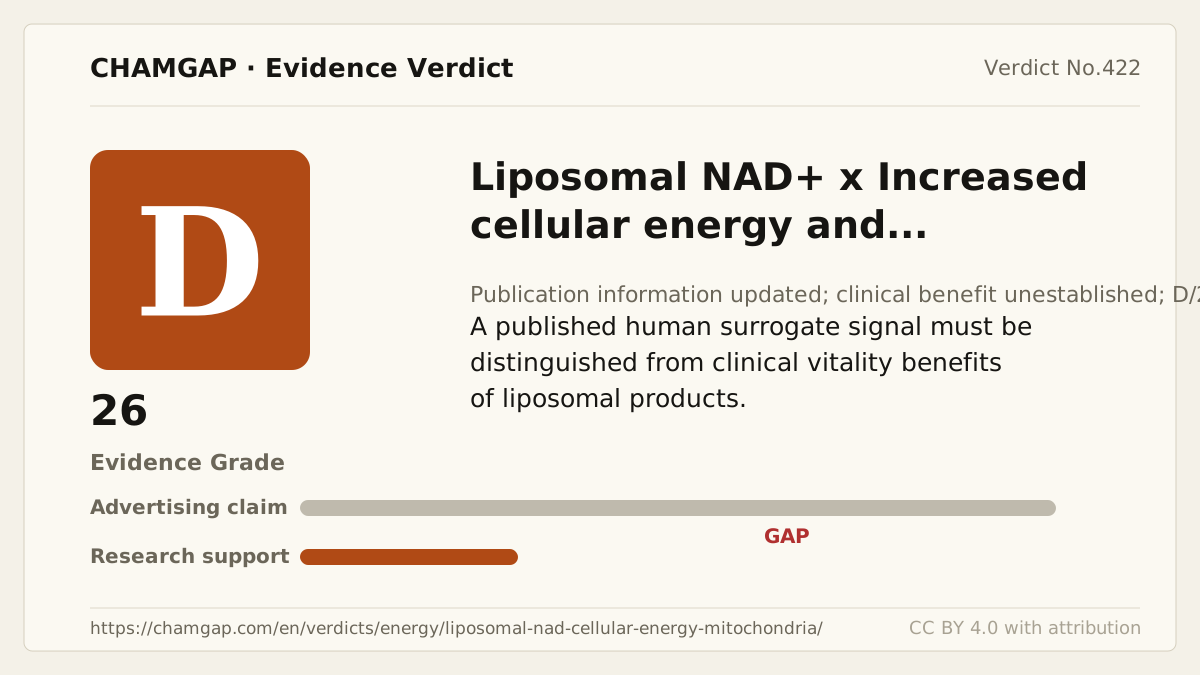
[Chamgap] Liposomal NAD+ x cellular energy and mitochondrial vitality — Evidence Grade D·26. 5 cited sources checked. Source: https://chamgap.com/en/verdicts/energy/liposomal-nad-cellular-energy-mitochondria/ · CC BY 4.0CC BY 4.0 — free to use with attribution; do not distort grades, numbers, or verdict meaning.
What this document does and does not do
Chamgap is an information source. It reports what research has and has not confirmed; it does not tell readers what to take or buy. That decision belongs to readers and, when needed, medical or legal professionals. This verdict reflects literature available up to the search date and may change as new research appears. Nothing here is medical advice.