
Zaleplon,
does it really help with Short-term reduction in objective sleep-onset latency in adults with sleep-onset insomnia?
research showsZaleplon is rated B specifically for sleep initiation because it consistently shortens objective and subjective sleep-onset latency in adults with sleep-onset insomnia. Twelve registration trials involving about 3,435 participants and repeated randomized evidence support the latency benefit. Sleep onset is itself a treatment target, so a patient-reported latency outcome is not a surrogate. Old manufacturer-centered evidence and low certainty remain limitations, but repeated clinically meaningful results and parity with peer hypnotic verdicts support B with 62 points. Sleep maintenance and total sleep time did not improve consistently and are not included in this B rating.
ads claimClaims of falling asleep quickly and sleeping deeply can expand roughly ten minutes less latency into all-night maintenance, longer total sleep, restorative sleep, and better next-day function. The best-fitting evidence is a short course for objective sleep-onset latency in adults with sleep-onset insomnia.
Useful facts when choosing a product
- Zaleplon is a rapidly acting, short-half-life controlled prescription hypnotic used shortly before bedtime for a limited period when adequate time for sleep remains, according to clinician direction.
- Its efficacy centers on sleep initiation and does not consistently increase sleep maintenance or total sleep time, so expected benefit differs when repeated awakenings or early-morning awakening is the main symptom.
- Alcohol, opioids, benzodiazepines, and other central nervous system depressants can increase excessive sedation, respiratory depression, and amnesia, and driving or hazardous work after dosing is unsafe.
- Sleepwalking, sleep-driving, or preparing and eating food while not fully awake requires immediate discontinuation and medical review; older adults also need lower exposure and close monitoring for confusion, imbalance, and falls.
Chamgap Semantic Classification Code
Candidate index · review held
M.zaleplon.UNK.short-term-reduction-in-objective-sleep-onset-latency-with-sleep-onset-insomnia.reduce.MULTIMedicinal interventions > Zaleplon > Unknown > Short-term reduction in objective sleep-onset latency with sleep-onset insomnia > Reduction claim > Multiple: primary unresolved
An automated migration candidate, not an issued permanent code; exact claim scope remains under review. This machine-generated migration candidate helps retrieval but is not a permanent assignment. The original verdict ID and URL remain authoritative.
What the research actually shows
Walsh and colleagues randomized 113 adults with primary insomnia to zaleplon 10 mg or placebo and performed polysomnography during each of five weeks. Sleep latency was significantly shortened every week, while objective and subjective total sleep time changed inconsistently. Elie and colleagues randomized 615 participants to zaleplon 5, 10, or 20 mg, zolpidem 10 mg, or placebo for four weeks; subjective latency fell every week with 10 and 20 mg, but sleep-duration benefit with 10 mg was not consistent. The AASM synthesis found approximately 9.5 minutes less objective latency with 10 mg, rated overall evidence low quality, and weakly recommended zaleplon for adult sleep-onset insomnia.
Why this is classified as B (62)
Twelve registration trials involving about 3,435 participants and repeated polysomnographic and subjective trials consistently shortened sleep-onset latency. Sleep onset is a direct treatment target, so patient reporting does not invoke a surrogate-outcome ceiling. Old manufacturer-centered evidence and low certainty place the result at the low end of B with 62 points. This grade applies only to sleep initiation and excludes the negative sleep-maintenance and total-sleep-time outcomes. Dependence and complex sleep behaviors are separate safety issues.
Counterpoint. The short half-life can make zaleplon a limited-course option for adults whose principal problem is sleep initiation and who have enough time remaining for sleep. Cognitive behavioral therapy is first-line for chronic insomnia, while persistent symptoms call for evaluation of sleep apnea, depression, anxiety, medicines, caffeine, and other causes.
Rejudgment record. Consistency recalibration (rule 1 clarification) — Treated objective and subjective sleep onset as direct treatment-target outcomes rather than surrogates; consistent latency benefits across twelve registration trials involving about 3,435 participants support B restricted to sleep initiation, while negative sleep-maintenance and total-sleep-time outcomes were excluded
Sub-claim grades by effect
This ingredient is marketed for several effects. A single overall grade blends strong and weak claims together, so each effect is graded separately here. The overall grade reflects the strongest disconfirming or core claim.
| Effect (sub-claim) | Grade | Basis |
|---|---|---|
| Short-term reduction in objective sleep-onset latency | B | Objective sleep-onset latency is a treatment target and repeatedly met the clinical-significance threshold across multiple polysomnography trials. |
| Short-term reduction in subjective sleep-onset latency | B | Subjective sleep-onset latency is a treatment target rather than a surrogate and improved repeatedly, including in a large four-week trial. |
| Improvement in sleep maintenance and total sleep time | D | Consistent improvement is absent at 10 mg, and the AASM recommendation is restricted to sleep onset. |
Cross-check — AI research and Codex final gate
Evidence Table
| Study | Design | Sample | Funding | Endpoint | Result | Weight |
|---|---|---|---|---|---|---|
| Walsh JK et al. 2000 | Five-week randomized double-blind placebo-controlled polysomnography trial | 113 adults aged 18 to 65 years with primary insomnia | Conducted in a manufacturer-development context with industry authors | Objective and subjective sleep latency, total sleep time, and sleep architecture | Zaleplon 10 mg shortened sleep latency throughout all five weeks, but did not consistently improve total sleep time. | Key objective sleep-onset randomized evidence |
| Elie R et al.; Zaleplon Clinical Study Group. 1999 | Four-week multicenter randomized double-blind placebo- and active-controlled trial | 615 adult outpatients with insomnia; three zaleplon doses, zolpidem, and placebo | Wyeth-Ayerst development trial with manufacturer investigators | Morning-questionnaire sleep latency, maintenance, and quality | Zaleplon 10 and 20 mg reduced subjective latency throughout four weeks, but sleep-duration benefit with 10 mg was inconsistent. | Large replicated subjective sleep-onset randomized evidence |
| Sateia MJ et al. 2017 AASM guideline | Drug-specific randomized-trial synthesis and review with a clinical practice guideline | One study contributing objective polysomnographic latency data for zaleplon 10 mg (Walsh) within the drug-specific evidence review | American Academy of Sleep Medicine | Objective and subjective sleep latency, maintenance, total sleep time, and sleep quality | The 10-mg dose reduced objective latency by about 9.5 minutes, but evidence quality was low and the recommendation for sleep-onset insomnia was weak. | Key synthesis of magnitude, certainty, and scope |
Receipt — 3 References
All 3 cited sources were verified for existence at the original page (as of 2026-07-23).
Final verification and publication gate: Codex · Evidence date: 2026-07-23 · Corrections: none
Cite this verdict
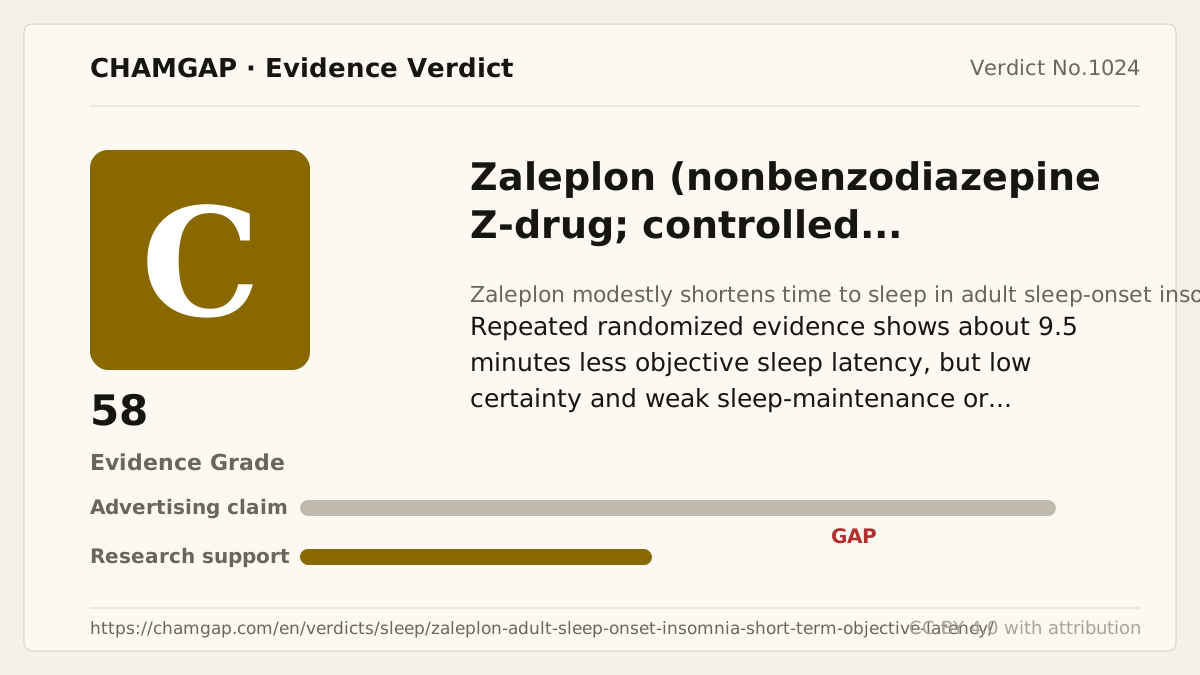
[Chamgap] Zaleplon x short-term reduction in objective sleep-onset latency in adults with sleep-onset insomnia — Evidence Grade B·62. 3 cited sources checked. Source: https://chamgap.com/en/verdicts/sleep/zaleplon-adult-sleep-onset-insomnia-short-term-objective-latency/ · CC BY 4.0CC BY 4.0 — free to use with attribution; do not distort grades, numbers, or verdict meaning.
What this document does and does not do
Chamgap is an information source. It reports what research has and has not confirmed; it does not tell readers what to take or buy. That decision belongs to readers and, when needed, medical or legal professionals. This verdict reflects literature available up to the search date and may change as new research appears. Nothing here is medical advice.