
Work-time control and supervisor support,
does it really help with Improved employee sleep duration and sleep sufficiency?
research showsThe grade is C. In a trial assigning 56 work-study groups at a US technology firm, actigraphic sleep increased by 8.17 minutes per day and sleep insufficiency improved by 0.25 on a five-point scale at 12 months. Wake after sleep onset and insomnia symptoms did not differ. Objective measurement is a strength, but only two of four primary sleep outcomes succeeded and the effectiveness analysis relied on valid actigraphy from 473-474 of 1,171 eligible employees.
ads claimThis was an organizational program changing time control and family-supportive supervision, not individual sleep education. An eight-minute objective increase should not be marketed as insomnia treatment or major sleep restoration.
Useful facts when choosing a product
- The intervention used a three-month participatory organizational-change process and manager training and did not directly teach sleep.
- Actigraphy was worn for about one week at baseline and 12 months; primary analysis required at least three valid days at both assessments.
- Randomization used 56 study groups, analysis used 107 work groups, and correction for the 56 randomized units was not verified. Buxton disclosed external research funding and personal compensation.
- No clinical-trial registration number was identified in the paper or public search. Early-event exclusion is not applicable to this sleep intervention trial.
Chamgap Semantic Classification Code
Candidate index · review held
UNK.organization-level-intervention-increasing-control-over-work-time-and-family-supportive-supervision.UNK.employee-sleep-duration-and-sleep-sufficiency.improve.UNKUnknown > organization-level intervention increasing control over work time and family-supportive supervision > Unknown > employee sleep duration and sleep sufficiency > Improvement claim > Unknown
An automated migration candidate, not an issued permanent code; exact claim scope remains under review. This machine-generated migration candidate helps retrieval but is not a permanent assignment. The original verdict ID and URL remain authoritative.
What the research actually shows
Randomization used 56 study groups of managers and employees, 27 intervention and 29 usual practice. Analysis instead clustered participants in 107 smaller practical work groups, so randomization and analysis units did not match; correction for the 56 randomized units was not verified. Of 1,171 eligible employees, 473-474 had valid actigraphy at baseline and 12 months. Actigraphy showed 8.17 more minutes of total sleep, while wake after sleep onset was null. Self-report showed a 0.25-point improvement in sleep sufficiency, while insomnia symptoms were null. NIH, CDC, and nonprofit foundations funded the work. Buxton disclosed external research funding and personal compensation.
Why this is classified as C (50)
Public and nonprofit funding and actigraphy are strengths, but small split effects, mismatch between 56 randomized and 107 analyzed groups, complete-case analysis, and substantial data exclusion give C with 50 points.
Counterpoint. Perceived sleep sufficiency moved in the same direction as objective total sleep time, but objective wake after sleep onset and self-reported insomnia did not improve.
Rejudgment record. Cross-check applied — Objective actigraphy and cluster adjustment balanced against small effects, partly null primary outcomes, and substantial record exclusion
| Endpoint | P | Symptom or function itself is the target - including patient reports and performance tests |
| Replication | R1 | Single confirmatory trial |
| Independence | I2 | Decisive evidence is publicly or non-profit funded |
| Effect size | E~ | Statistically positive but below the threshold |
Stored derived and displayed grades match; this is not a current recalculation or validity check (C).
Sub-claim grades by effect
This ingredient is marketed for several effects. A single overall grade blends strong and weak claims together, so each effect is graded separately here. The overall grade reflects the strongest disconfirming or core claim.
| Effect (sub-claim) | Grade | Basis |
|---|---|---|
| Increased objective total sleep time | C | The 8.17-minute daily increase was small when standardized. |
| Improved perceived sleep sufficiency | C | The five-point measure improved by 0.25. |
| Improved wake after sleep onset and insomnia symptoms | D | Neither outcome differed significantly. |
Cross-check — AI research and Codex final gate
Evidence Table
| Study | Design | Sample | Funding | Endpoint | Result | Weight |
|---|---|---|---|---|---|---|
| Olson et al. 2015 Work, Family, and Health Study | Work-group cluster-randomized trial | 56 study groups and 1,171 eligible employees; 473-474 in effectiveness analyses | Public and nonprofit funding from NIH, CDC, William T. Grant, Sloan, and others | Twelve-month actigraphic total sleep time and wake after sleep onset, plus self-reported sleep sufficiency and insomnia | Total sleep +8.17 minutes (P=.041), sleep insufficiency improved by 0.25 (P=.002); wake after sleep onset and insomnia were null | Objective measurement but only partly successful primary outcomes |
Receipt — 1 References
All 1 cited sources were verified for existence at the original page (as of 2026-08-05).
Final verification and publication gate: Codex · Evidence date: 2026-08-05 · Corrections: none
Cite this verdict
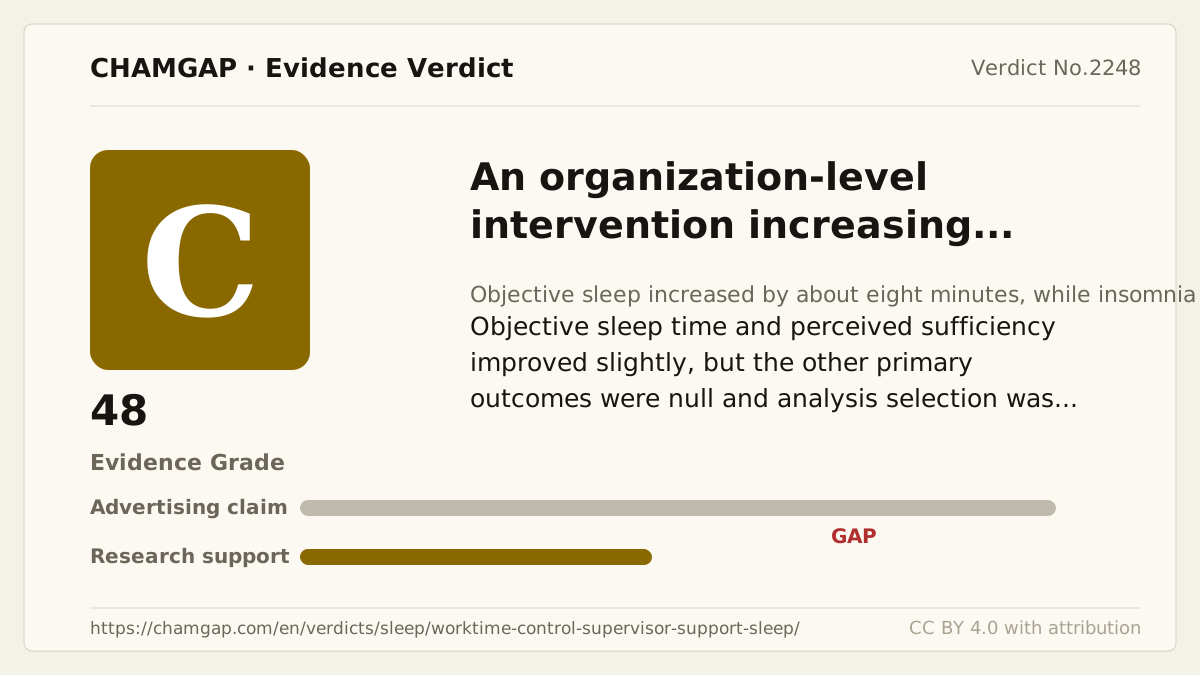
[Chamgap] Work-time control and supervisor support x employee sleep — Evidence Grade C·50. 1 cited sources checked. Source: https://chamgap.com/en/verdicts/sleep/worktime-control-supervisor-support-sleep/ · CC BY 4.0CC BY 4.0 — free to use with attribution; do not distort grades, numbers, or verdict meaning.
What this document does and does not do
Chamgap is an information source. It reports what research has and has not confirmed; it does not tell readers what to take or buy. That decision belongs to readers and, when needed, medical or legal professionals. This verdict reflects literature available up to the search date and may change as new research appears. Nothing here is medical advice.