
White-noise machine or app,
does it really help with Improved sleep onset and subjective sleep quality in adults and older adults?
research showsWhite-noise machines and apps are rated C because positive signals support improved sleep onset and subjective sleep quality in adults and older adults. A 2025 meta-analysis of 12 randomized trials and 1,301 participants found mean PSQI reductions of 3.70 points in adults and 2.71 points in older adults. A 2026 randomized trial of 60 community-dwelling older adults also reported better PSQI scores and self-reported sleep-onset latency after 30 days. An earlier review of 38 studies rated the evidence as very low certainty, however, with results ranging from improvement to sleep disruption. Subjective endpoints, special environments, and inability to blind users prevent a grade above C.
ads claimMarketing can claim that white noise instantly switches off the brain, guarantees deep sleep, or blocks every sound. The evidence best supports masking environmental noise and helping subjective sleep onset or quality in some people; it does not treat the cause of insomnia disorder or sleep apnea.
Useful facts when choosing a product
- White noise uses continuous sound spread broadly across audible frequencies to reduce the contrast of sudden environmental sounds. Actual spectra and output levels differ across machines, speakers, and apps.
- Use the lowest effective volume with the speaker away from the head. Overnight earphone use or prolonged high volume can increase risks of hearing damage and sleep disruption.
- Stop if the sound is irritating, increases awakenings, or causes tinnitus or ear pain. If anxiety or habitual reliance develops around being unable to sleep without it, gradual reduction can be considered.
- For infants and young children, keep devices away from the head and use especially low output. Adult efficacy and safety data cannot be directly applied to children, and some machines can produce high sound levels at close distance.
Chamgap Semantic Classification Code
Candidate index · review held
UNK.white-noise-machine-or-app.UNK.sleep-onset-and-subjective-sleep-quality-and-older-adults.improve.UNKUnknown > White-noise machine or app > Unknown > sleep onset and subjective sleep quality and older adults > Improvement claim > Unknown
An automated migration candidate, not an issued permanent code; exact claim scope remains under review. This machine-generated migration candidate helps retrieval but is not a permanent assignment. The original verdict ID and URL remain authoritative.
What the research actually shows
Ding and colleagues in 2025 synthesized 12 randomized trials with 1,301 infants, adults, and older adults. Mean PSQI differences were -3.70 points in adults and -2.71 in older adults, but adult PSQI heterogeneity was substantial and included-study methodology was limited. Mousavi and colleagues in 2026 randomized 60 community-dwelling older adults to sleep hygiene alone or sleep hygiene plus 30 days of white noise, improving PSQI and self-reported sleep-onset latency; participants could not be blinded and background noise was uncontrolled. The 18-person crossover study by Messineo and colleagues in 2017 shortened N2 latency from 19 to 13 minutes in a transient-insomnia model created by advancing bedtime 90 minutes, but it was not a trial in chronic insomnia. Riedy and colleagues in 2021 reviewed 38 continuous-noise studies and judged overall certainty very low, with findings ranging from benefit to disruption.
Why this is classified as C (55)
A current 12-trial meta-analysis, a 2026 older-adult randomized trial, and a small objective sleep-onset crossover trial all point positively, so the C-versus-D boundary rule supports C. Core adult evidence nevertheless relies on subjective PSQI measures, blinding is difficult, hospital and noisy environments contribute heavily, heterogeneity is substantial, and an earlier review rated certainty very low. The resulting score is 53.
Counterpoint. When environmental noise is the actual problem, a person can try a low-volume one- or two-week test and record sleep latency and next-day functioning. Snoring or apneas, restless legs, depression or anxiety, pain, or insomnia lasting at least three months warrants evaluation and prioritization of cognitive behavioral therapy for insomnia rather than masking the problem with an app.
Rejudgment record. Cross-check applied — Applied C under the C-versus-D boundary rule because a 2025 meta-analysis of 12 randomized trials and a 2026 older-adult randomized trial provide positive PSQI and sleep-onset signals, while limiting the grade for subjective endpoints, inability to blind, setting and measurement heterogeneity, and prior very-low-certainty assessment
Sub-claim grades by effect
This ingredient is marketed for several effects. A single overall grade blends strong and weak claims together, so each effect is graded separately here. The overall grade reflects the strongest disconfirming or core claim.
| Effect (sub-claim) | Grade | Basis |
|---|---|---|
| Shorter sleep-onset latency in adults and older adults | C | A small objective crossover trial and a 2026 older-adult randomized trial are positive, but sample, setting, and measurement limitations are substantial. |
| Improved subjective sleep quality in adults and older adults | C | PSQI was positive in a 12-trial meta-analysis, but heterogeneity and methodological limitations remain. |
| Consistent improvement in objective sleep architecture and sleep efficiency | D | Objective outcomes are sparse and conflicting, so consistent improvement has not been established. |
Cross-check — AI research and Codex final gate
Evidence Table
| Study | Design | Sample | Funding | Endpoint | Result | Weight |
|---|---|---|---|---|---|---|
| Ding Y et al. 2025 | Systematic review and meta-analysis of randomized controlled trials | 12 randomized trials and 1,301 participants, including 648 adults and 297 older adults | Funding source not stated in the PubMed abstract | PSQI, total sleep time, sleep efficiency, awakenings, and wake after sleep onset | PSQI mean difference was -3.70 in adults (95% CI -4.90 to -2.50) and -2.71 in older adults (95% CI -4.98 to -0.44), with substantial adult heterogeneity. | Current key positive synthesis |
| Mousavi SAV et al. 2026 | Parallel randomized controlled trial in community-dwelling older adults | 60 adults aged 65 years or older | No organizational funding; no competing interests reported | PSQI, self-reported sleep-onset latency, and fatigue after 30 days | Intervention-group PSQI improved from 11.5 to 9.2, and sleep-onset latency fell by an average of 8 minutes more than control. | Current independent positive randomized trial in older adults |
| Riedy SM et al. 2021 | Systematic review of continuous white or broadband noise for sleep | 38 studies | Funding source not stated; authors reported no conflicts of interest | Sleep onset, fragmentation, sleep quality, and sleep duration | Findings ranged from improvement to sleep disruption, and GRADE certainty for sleep improvement was very low. | Key limiting and conflicting synthesis |
Receipt — 4 References
All 4 cited sources were verified for existence at the original page (as of 2026-07-24).
Final verification and publication gate: Codex · Evidence date: 2026-07-24 · Corrections: none
Cite this verdict
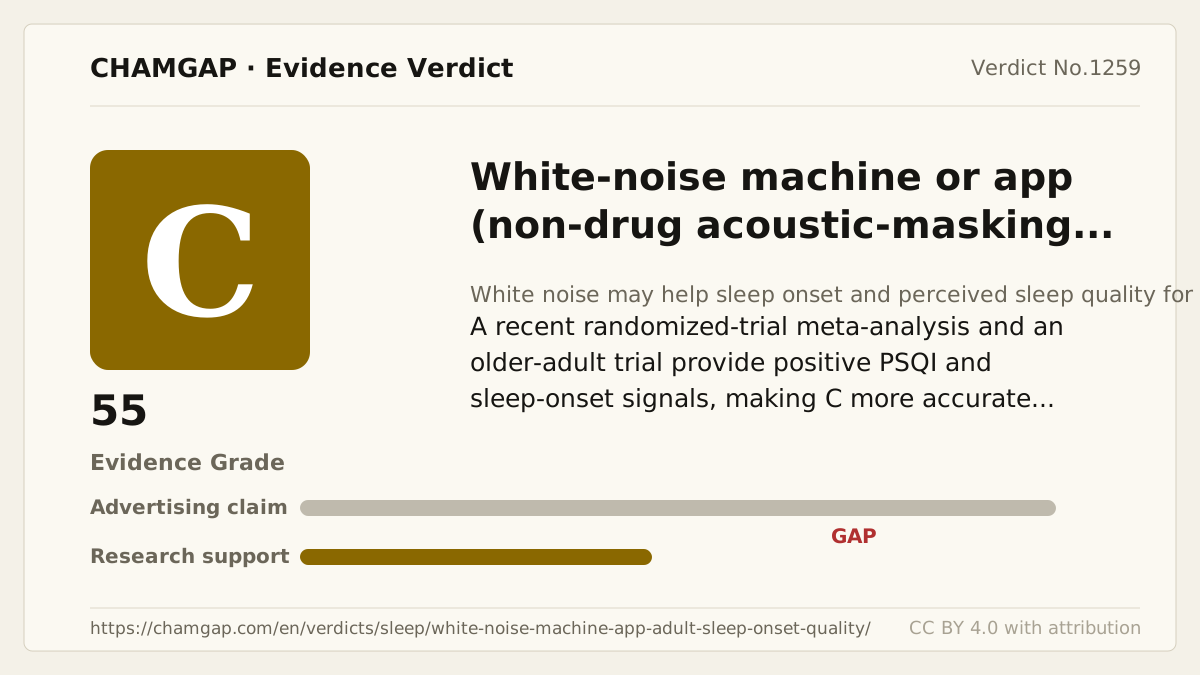
[Chamgap] White-noise machine or app x improved sleep onset and subjective sleep quality in adults and older adults — Evidence Grade C·55. 4 cited sources checked. Source: https://chamgap.com/en/verdicts/sleep/white-noise-machine-app-adult-sleep-onset-quality/ · CC BY 4.0CC BY 4.0 — free to use with attribution; do not distort grades, numbers, or verdict meaning.
What this document does and does not do
Chamgap is an information source. It reports what research has and has not confirmed; it does not tell readers what to take or buy. That decision belongs to readers and, when needed, medical or legal professionals. This verdict reflects literature available up to the search date and may change as new research appears. Nothing here is medical advice.