
Weighted blanket,
does it really help with Improved subjective sleep quality and Insomnia Severity Index scores in adults with insomnia?
research showsWeighted blankets for sleep quality and ISI improvement in adult insomnia are rated C. In a 2024 meta-analysis of eight randomized trials and 426 participants, the overall three-study ISI difference was a nonsignificant -1.92 points, but a significant -2.78-point subjective improvement appeared after removing one heterogeneous study. A 102-person pilot trial also improved one-month PSQI, so the subjective ISI and sleep-quality signals cannot be treated as wholly null. However, -2.78 points falls short of the 6-point minimal clinically important difference, the overall ISI analysis and objective actigraphic sleep continuity were null, and studies were small, heterogeneous, and difficult to blind, giving a low C with 42 points. Heat, pressure discomfort, and suffocation or entrapment risk for people unable to remove the blanket remain separate safety concerns.
ads claimMarketing can turn claims that deep pressure calms the nervous system and guarantees deep sleep from comfort and subjective questionnaire change into objective sleep normalization. Feeling comfortable under a blanket is not the same outcome as clinically meaningful recovery from insomnia or objective improvement in sleep duration and awakenings.
Useful facts when choosing a product
- Weighted blankets add mass with glass beads, plastic pellets, or metal chains, but material, weight distribution, breathability, washability, and perceived pressure vary across products.
- The commonly marketed rule of about 10% of body weight is not an established clinical standard for the optimal weight or duration of adult insomnia treatment.
- Heat, restricted movement, pressure discomfort, anxiety, or pain can occur, and the user must be able to remove the blanket easily while keeping the face and airway clear.
- Infants, frail people or those with limited mobility, and people with severe respiratory disease or sleep apnea should avoid unsupervised use and seek advice because of suffocation or entrapment risk.
Chamgap Semantic Classification Code
Candidate index · review held
M.weighted-blanket.UNK.subjective-sleep-quality-and-insomnia-severity-index-scores-with-insomnia.improve.UNKMedicinal interventions > Weighted blanket > Unknown > subjective sleep quality and Insomnia Severity Index scores with insomnia > Improvement claim > Unknown
An automated migration candidate, not an issued permanent code; exact claim scope remains under review. This machine-generated migration candidate helps retrieval but is not a permanent assignment. The original verdict ID and URL remain authoritative.
What the research actually shows
The Zhao meta-analysis included eight randomized weighted-blanket trials and 426 patients with mental disorders. The overall three-study ISI estimate was nonsignificant, and a -2.78-point estimate required excluding a heterogeneous study. Half the included trials were at high risk of bias because participants could recognize the heavier blanket while reporting their own outcomes. Ekholm and colleagues randomized 120 people with insomnia plus depression, bipolar disorder, anxiety, or ADHD for four weeks to a heavy metal-chain blanket or a light plastic-chain blanket and reported a large ISI effect, but the population was specialized and objective actigraphy findings focused on responder analysis. Yu and colleagues found PSQI change of -4.1 versus -2.0 in 102 adults with insomnia, but ISI was nonsignificant and the objective awakening change had p=0.280.
Why this is classified as C (42)
The -2.78-point ISI sensitivity estimate in the eight-trial synthesis and improved PSQI in a separate pilot provide positive subjective signals, making a wholly null verdict too harsh. However, -2.78 points falls short of the 6-point minimal clinically important difference, the overall ISI analysis and objective actigraphic sleep continuity were null, and studies were small, heterogeneous, difficult to blind, and at high risk of bias, giving a low C with 42 points. Suffocation, heat, and pressure risks remain separate under safety.
Counterpoint. A healthy adult who can remove the blanket safely may try it briefly if cost and discomfort are acceptable. Cognitive behavioral therapy remains first-line for chronic insomnia, with assessment of snoring or apnea, depression or anxiety, pain, medicines, and caffeine.
Rejudgment record. Cross-check applied — Applied a low C because the -2.78-point ISI sensitivity estimate in the eight-trial synthesis and improved PSQI in a general-adult pilot provide positive subjective signals that make a wholly null verdict too harsh, while the effect remains below the 6-point minimal clinically important difference, overall ISI and objective actigraphic sleep continuity are null, and the studies are small, heterogeneous, difficult to blind, and often at high risk of bias
Sub-claim grades by effect
This ingredient is marketed for several effects. A single overall grade blends strong and weak claims together, so each effect is graded separately here. The overall grade reflects the strongest disconfirming or core claim.
| Effect (sub-claim) | Grade | Basis |
|---|---|---|
| Improved subjective sleep quality in adults with insomnia | C | A positive PSQI pilot and a positive special-population trial support a small subjective benefit, but studies were small, short, difficult to blind, and discordant with objective sleep. |
| Improved ISI in adults with insomnia | C | The overall meta-analytic MD of -1.92 was nonsignificant, but the sensitivity MD of -2.78 was positive while remaining below the 6-point minimal clinically important difference. |
| Improved objective sleep continuity in adults with insomnia | D | Actigraphic awakenings and other objective measures were nonsignificant in the pilot, and objective results were inconsistent in the positive trial. |
Cross-check — AI research and Codex final gate
Evidence Table
| Study | Design | Sample | Funding | Endpoint | Result | Weight |
|---|---|---|---|---|---|---|
| Zhao Y et al. 2024 | Systematic review and meta-analysis of randomized weighted-blanket trials | Eight randomized trials and 426 participants; three trials in the insomnia ISI meta-analysis | No external grant and no author conflicts of interest | ISI, anxiety, fatigue, depression, and serious adverse events | Overall ISI MD was -1.92 (95% CI -3.92 to 0.09), p=0.06; leave-one-out sensitivity analysis gave MD -2.78. | Pivotal null synthesis with a small sensitivity signal and half of trials at high risk of bias |
| Yu J et al. 2024 | One-month pilot randomized normal-blanket-controlled trial | 102 adults with clinical insomnia; 95 completed | Supported by Damian Health Tech, Zhejiang Key Laboratory, and Zhejiang University | PSQI, ISI, actigraphic awakenings, and daytime symptoms | PSQI favored weighted blankets, -4.1 versus -2.0, but ISI was nonsignificant and objective awakening change had p=0.280. | Positive subjective sleep quality but null ISI and objective sleep in a pilot trial |
| Ekholm B et al. 2020 | Four-week randomized light-chain-blanket-controlled trial with open extension | 120 patients with insomnia and psychiatric disorders | External funding details were not clearly reported in the article | ISI, sleep diaries, daytime symptoms, and wrist actigraphy | A large subjective four-week ISI benefit was reported, but the population had psychiatric comorbidity, blinding was difficult, and objective evidence was limited. | Positive contrary evidence from a special population with subjective outcomes |
Receipt — 4 References
All 4 cited sources were verified for existence at the original page (as of 2026-07-22).
Final verification and publication gate: Codex · Evidence date: 2026-07-22 · Corrections: none
Cite this verdict
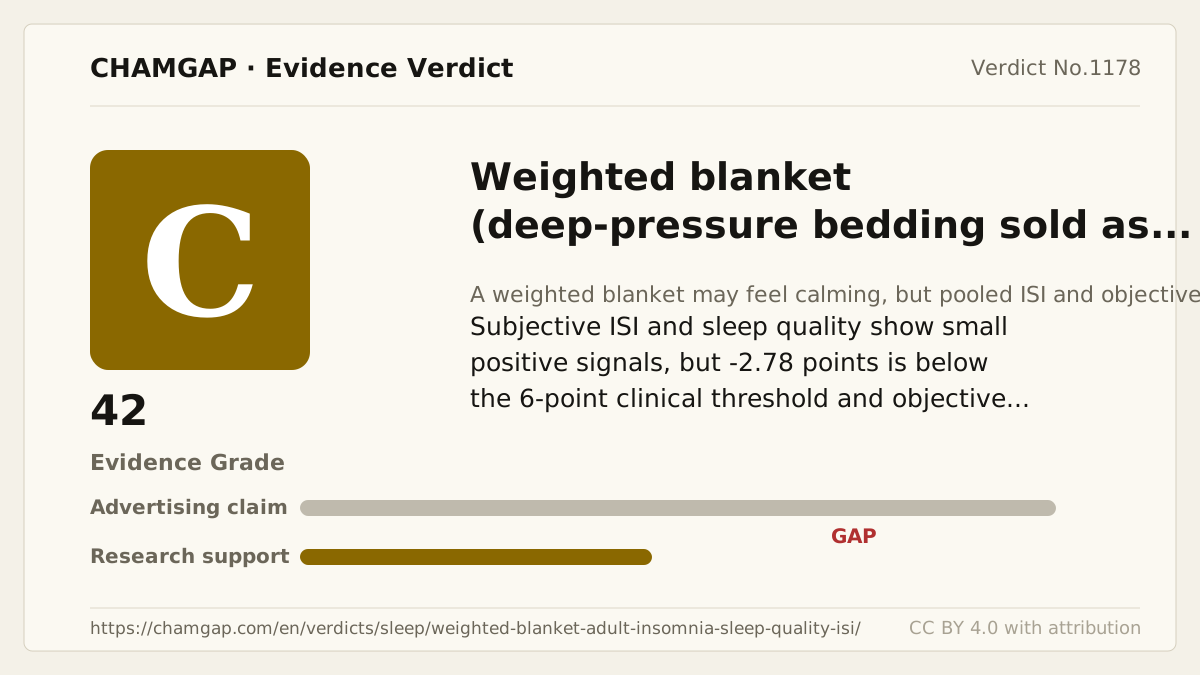
[Chamgap] Weighted blanket x improved subjective sleep quality and Insomnia Severity Index scores in adults with insomnia — Evidence Grade C·42. 4 cited sources checked. Source: https://chamgap.com/en/verdicts/sleep/weighted-blanket-adult-insomnia-sleep-quality-isi/ · CC BY 4.0CC BY 4.0 — free to use with attribution; do not distort grades, numbers, or verdict meaning.
What this document does and does not do
Chamgap is an information source. It reports what research has and has not confirmed; it does not tell readers what to take or buy. That decision belongs to readers and, when needed, medical or legal professionals. This verdict reflects literature available up to the search date and may change as new research appears. Nothing here is medical advice.