
Triazolam,
does it really help with Short-term improvement of sleep onset in adult insomnia?
research showsTriazolam is rated B for short-term improvement of sleep onset in adult insomnia. In placebo-controlled sleep trials, 0.25 mg reduced latency to persistent sleep, and the AASM weakly suggests its use for sleep-onset insomnia in adults. However, only one 28-person study supplied data adequate for the guideline's quantitative assessment; the approximately nine-minute subjective latency reduction did not reach its clinical-significance threshold, and most trials were small and lasted days to weeks. Short-term efficacy cannot be extended to long-term use because of dependence, rebound insomnia, withdrawal, anterograde amnesia, and fall risk.
ads claimA rapid short-term sleep-onset effect must not be interpreted as natural restorative sleep or safe daily long-term therapy without memory or fall effects. Labeling and guidance concern a limited prescription context, and efficacy can coexist with dependence and withdrawal risk.
Useful facts when choosing a product
- Triazolam is a prescription benzodiazepine indicated in United States labeling for short-term treatment of adult insomnia, generally seven to ten days, with a usual recommended dose of 0.25 mg at bedtime.
- Older adults are directed to start at 0.125 mg and are more susceptible to drowsiness, dizziness, anterograde amnesia, confusion, and falls.
- Alcohol, opioids, and other central nervous system depressants can increase profound sedation and respiratory depression, while abrupt discontinuation after continued use can cause rebound insomnia, withdrawal, and seizures and therefore may require a prescribed taper.
Chamgap Semantic Classification Code
Candidate index · review held
M.triazolam.UNK.short-term-improvement-of-sleep-onset-insomnia.improve.placeboMedicinal interventions > Triazolam > Unknown > Short-term improvement of sleep onset insomnia > Improvement claim > Placebo
An automated migration candidate, not an issued permanent code; exact claim scope remains under review. This machine-generated migration candidate helps retrieval but is not a permanent assignment. The original verdict ID and URL remain authoritative.
What the research actually shows
The 2017 Sateia AASM guideline weakly suggested triazolam 0.25 mg for sleep-onset insomnia. In the only study with adequate data, 28 participants had subjective sleep latency reduced by 9.2 minutes versus placebo, with a 95% confidence interval from a 22.3-minute reduction to a 3.9-minute increase, below the clinical-significance threshold. Two multicenter double-blind crossover studies reported by Drake in 2000 included 47 and 36 patients with chronic primary insomnia and found that two nights of triazolam 0.25 mg reduced polysomnographic latency to persistent sleep and increased total sleep time versus placebo. Kales 1991 found rebound insomnia in 18 patients after brief intermittent 0.5-mg exposure, with total wake time 61% and 51% above baseline on the first withdrawal nights. Efficacy and safety have different time horizons.
Why this is classified as B (62)
Placebo-controlled trials and a weak AASM suggestion support short-term sleep-onset efficacy at 0.25 mg, and subjective sleep onset is a direct patient outcome. The key estimate was −9.2 minutes (95% CI −22.3 to +3.9), below the clinical-importance threshold, and the evidence is concentrated in small brief trials, yielding a low-B score of 62. Dependence, rebound insomnia, withdrawal, amnesia, and falls remain separate safety limitations.
Counterpoint. Cognitive behavioral therapy is first-line for chronic insomnia, and triazolam is appropriate only for a brief period when indicated after evaluation and under prescribing supervision.
Rejudgment record. New verdict — Accepted placebo-controlled trials and the weak AASM recommendation supporting short-term sleep-onset improvement with 0.25 mg, but applied B because quantitative evidence is concentrated in small brief studies, the subjective effect is modest, and long-term efficacy data do not meet the independent large and consistent standard required for A
Sub-claim grades by effect
This ingredient is marketed for several effects. A single overall grade blends strong and weak claims together, so each effect is graded separately here. The overall grade reflects the strongest disconfirming or core claim.
| Effect (sub-claim) | Grade | Basis |
|---|---|---|
| Short-term improvement of sleep onset in adult insomnia | B | Placebo-controlled 0.25-mg trials and a weak AASM recommendation support the claim, but effects are modest and trials are brief. |
| Long-term efficacy | ? | Direct evidence is inadequate to judge efficacy during sustained long-term treatment. |
| Dependence, rebound insomnia, and withdrawal | ? | This is a major safety issue rather than an efficacy subclaim and is recorded separately. |
Cross-check — AI research and Codex final gate
Evidence Table
| Study | Design | Sample | Funding | Endpoint | Result | Weight |
|---|---|---|---|---|---|---|
| Sateia MJ et al. 2017 AASM guideline | Drug-specific systematic evidence review and clinical guideline | One triazolam study with adequate quantitative data and 28 completers | American Academy of Sleep Medicine | Subjective sleep latency, total sleep time, and sleep quality | Use was weakly suggested for adult sleep-onset insomnia; subjective latency decreased by 9.2 minutes, but the confidence interval crossed no effect and the change fell below the clinical-significance threshold. | Key guideline with limited quantitative evidence |
| Drake CL et al. 2000 | Two multicenter randomized double-blind Latin-square crossover trials | 47 and 36 participants with chronic primary insomnia | Zaleplon dose-ranging studies in an industry-linked context | Two-night polysomnographic latency to persistent sleep, total sleep time, and subjective sleep | Triazolam 0.25 mg reduced latency to persistent sleep and increased total sleep time versus placebo. | Direct short-term objective efficacy |
| Kales A et al. 1991 | Randomized comparative sleep-laboratory trial | 18 patients with insomnia | Academic sleep research with limited funding detail | Polysomnographic rebound insomnia after intermittent withdrawal | After brief intermittent use, total wake time was 61% and 51% above baseline on the first triazolam withdrawal nights. | Key rebound safety evidence |
Receipt — 4 References
All 4 cited sources were verified for existence at the original page (as of 2026-07-19).
Final verification and publication gate: Codex · Evidence date: 2026-07-19 · Corrections: none
Cite this verdict
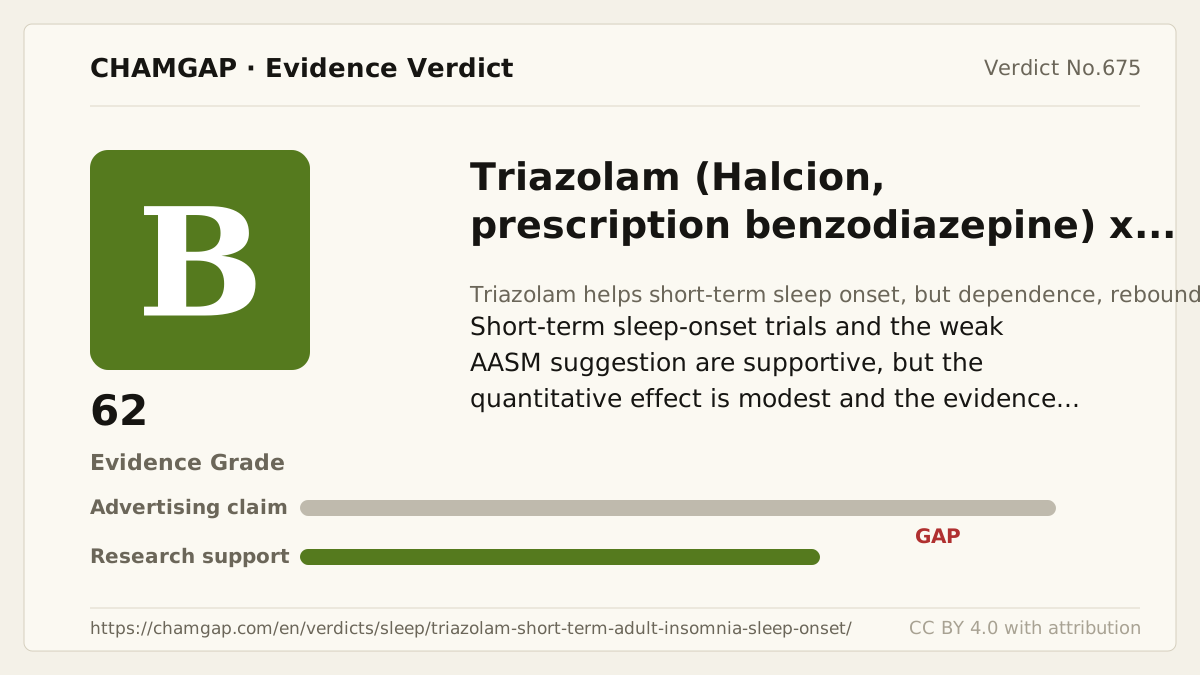
[Chamgap] Triazolam x short-term improvement of sleep onset in adult insomnia — Evidence Grade B·62. 4 cited sources checked. Source: https://chamgap.com/en/verdicts/sleep/triazolam-short-term-adult-insomnia-sleep-onset/ · CC BY 4.0CC BY 4.0 — free to use with attribution; do not distort grades, numbers, or verdict meaning.
What this document does and does not do
Chamgap is an information source. It reports what research has and has not confirmed; it does not tell readers what to take or buy. That decision belongs to readers and, when needed, medical or legal professionals. This verdict reflects literature available up to the search date and may change as new research appears. Nothing here is medical advice.