
Tirzepatide,
does it really help with Reduction of the apnea-hypopnea index and hypoxic burden in adults with obesity and moderate-to-severe obstructive sleep apnea?
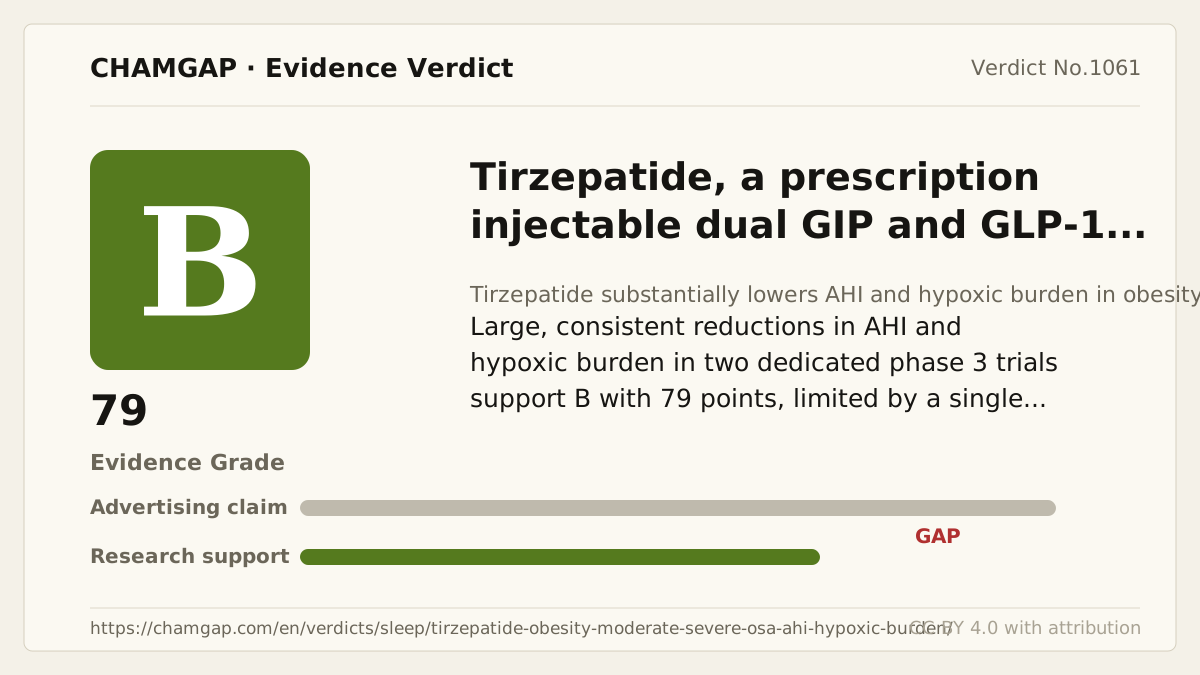
research showsTirzepatide is rated C because it substantially lowers AHI and hypoxic burden in adults with obesity and moderate-to-severe obstructive sleep apnea, but the evidence rests on a surrogate not validated for hard outcomes. Across two 52-week SURMOUNT-OSA randomized trials involving 469 participants, AHI fell by 20.0 and 23.8 more events per hour than with placebo, and hypoxic burden and sleep-related patient-reported outcomes also improved. AHRQ, however, found that whether changes in AHI predict long-term health outcomes has not been validated, and in SAVE, where positive airway pressure normalized AHI, the cardiovascular composite was null at HR 1.10. These were not hard-outcome trials, so rule 1 caps the grade at C; the large, consistent AHI effect supports C with 59 points at the top of the band. FDA approval does not substitute for proof of hard endpoints. Gastrointestinal adverse effects, gallbladder disease, rare pancreatitis, and injection burden remain separate safety issues.
ads claimMarketing can expand a reduction in AHI into a cure for sleep apnea or proof of cardiovascular prevention. The trials enrolled adults with obesity and moderate-to-severe OSA and showed lower disease severity alongside weight loss; they did not establish universal replacement of positive airway pressure or long-term cardiovascular protection for every person with OSA.
Useful facts when choosing a product
- Tirzepatide is a once-weekly prescription subcutaneous injection that activates both GIP and GLP-1 receptors, and its dose is escalated gradually according to gastrointestinal tolerability.
- In the United States, Zepbound is the brand carrying the moderate-to-severe OSA indication, whereas Mounjaro is the diabetes brand containing the same ingredient, so country-specific approvals and labels must be distinguished.
- SURMOUNT-OSA enrolled adults with obesity and without type 2 diabetes, evaluating people unable or unwilling to use positive airway pressure separately from those already using it.
- Nausea, diarrhea, vomiting, and constipation are common; gallbladder disease, dehydration-related kidney injury, and rare pancreatitis require caution, and the drug is contraindicated with a personal or family history of medullary thyroid carcinoma or MEN2.
Chamgap Semantic Classification Code
Candidate index · review held
M.tirzepatide.UNK.the-apnea-hypopnea-index-and-hypoxic-burden-with-obesity-and-moderate-to-severe-obstructive-sleep-apnea.reduce.placeboMedicinal interventions > Tirzepatide > Unknown > the apnea-hypopnea index and hypoxic burden with obesity and moderate-to-severe obstructive sleep apnea > Reduction claim > Placebo
An automated migration candidate, not an issued permanent code; exact claim scope remains under review. This machine-generated migration candidate helps retrieval but is not a permanent assignment. The original verdict ID and URL remain authoritative.
What the research actually shows
Malhotra and colleagues separated adults with obesity and moderate-to-severe OSA into a trial without positive airway pressure and a trial with positive airway pressure, comparing the maximum tolerated dose of tirzepatide, 10 or 15 mg, with placebo for 52 weeks. The AHI treatment difference was -20.0 events per hour in trial 1 (95% CI -25.8 to -14.2) and -23.8 in trial 2 (95% CI -29.6 to -17.9), with P<0.001 in both. Prespecified secondary endpoints including hypoxic burden, body weight, systolic blood pressure, and sleep-related patient-reported measures also improved. A 2025 patient-reported-outcomes analysis reinforced benefits in sleep disturbance, function, and quality of life, but most authors and data remained connected to the same manufacturer program. FDA recognition of the OSA indication confirms the existence and regulatory relevance of these trials but is not itself the basis for an A grade.
Why this is classified as C (59)
Two 52-week SURMOUNT-OSA randomized trials involving 469 participants produced large AHI treatment differences of -20.0 and -23.8 events per hour and consistent improvement in hypoxic burden. AHRQ nevertheless found that AHI change has not been validated to predict long-term health outcomes, and SAVE found a null cardiovascular composite, HR 1.10, despite normalization of AHI with positive airway pressure. Because these were not hard-outcome trials, rule 1 caps the grade at C; the magnitude and consistency of the AHI effect support C with 59 points at the top of the band. FDA approval does not substitute for hard-endpoint evidence, and gastrointestinal, gallbladder, pancreatic, and injection-related risks remain separate safety issues.
Counterpoint. For patients whose obesity is a major driver of OSA, tirzepatide can address weight and sleep-disordered breathing together. Decisions about stopping positive airway pressure or selecting treatment still require a clinician to consider sleep-study results, symptoms, comorbidities, coverage, and local authorization.
Rejudgment record. Consistency recalibration (rule 1 surrogate clarification) — Credited the large, consistent reductions in AHI and hypoxic burden across two 52-week randomized trials but applied the rule 1 ceiling of C because AHRQ found AHI change unvalidated for predicting long-term health outcomes and SAVE found a null cardiovascular composite at HR 1.10 despite AHI normalization with positive airway pressure; placed the effect at the top of C and did not treat FDA approval as proof of hard endpoints
Sub-claim grades by effect
This ingredient is marketed for several effects. A single overall grade blends strong and weak claims together, so each effect is graded separately here. The overall grade reflects the strongest disconfirming or core claim.
| Effect (sub-claim) | Grade | Basis |
|---|---|---|
| Reduction of AHI in adults with obesity and moderate-to-severe OSA | C | Two 52-week phase 3 trials showed large consistent reductions, but they came from one manufacturer-funded program and long-term cardiovascular outcomes remain untested. |
| Reduction of sleep apnea-specific hypoxic burden | C | This prespecified secondary endpoint improved in both trials but remains a surrogate for clinical events. |
| Improvement in sleep-related symptoms, function, and quality of life | C | This was a secondary-endpoint improvement signal that supports the AHI-centered trials, not an independent trial designed around symptom endpoints. |
Cross-check — AI research and Codex final gate
Evidence Table
| Study | Design | Sample | Funding | Endpoint | Result | Weight |
|---|---|---|---|---|---|---|
| SURMOUNT-OSA trial 1, Malhotra et al. 2024 | Fifty-two-week phase 3 randomized double-blind placebo-controlled trial without baseline positive airway pressure | 234 participants; 469 across both trials | Funded by Eli Lilly | Change in AHI at week 52; hypoxic burden and sleep-related patient-reported measures | AHI changed by -25.3 versus -5.3 events per hour, a treatment difference of -20.0 (95% CI -25.8 to -14.2; P<0.001); hypoxic burden also improved significantly. | Key direct disease-severity evidence |
| SURMOUNT-OSA trial 2, Malhotra et al. 2024 | Fifty-two-week phase 3 randomized double-blind placebo-controlled trial with baseline positive airway pressure | 235 participants; 469 across both trials | Funded by Eli Lilly | Change in AHI at week 52; hypoxic burden and sleep-related patient-reported measures | AHI changed by -29.3 versus -5.5 events per hour, a treatment difference of -23.8 (95% CI -29.6 to -17.9; P<0.001); secondary endpoints improved consistently. | Replication in the positive-airway-pressure setting |
| Kanu et al. 2025 patient-reported-outcomes analysis | Prespecified analysis of patient-reported outcomes from SURMOUNT-OSA | Up to 469 SURMOUNT-OSA participants, with measure-specific missing data | Eli Lilly study; several authors were employees and shareholders | Sleep-related impairment, sleep disturbance, daytime sleepiness, function, and quality of life | Multiple sleep, function, and quality-of-life measures improved versus placebo; daytime sleepiness improvement was demonstrated in trial 1. | Supporting symptom and function evidence from the same program |
Receipt — 3 References
All 3 cited sources were verified for existence at the original page (as of 2026-07-23).
Final verification and publication gate: Codex · Evidence date: 2026-07-23 · Corrections: none
Cite this verdict
[Chamgap] Tirzepatide x improvement of moderate-to-severe obstructive sleep apnea in adults with obesity — Evidence Grade C·59. 3 cited sources checked. Source: https://chamgap.com/en/verdicts/sleep/tirzepatide-obesity-moderate-severe-osa-ahi-hypoxic-burden/ · CC BY 4.0CC BY 4.0 — free to use with attribution; do not distort grades, numbers, or verdict meaning.
What this document does and does not do
Chamgap is an information source. It reports what research has and has not confirmed; it does not tell readers what to take or buy. That decision belongs to readers and, when needed, medical or legal professionals. This verdict reflects literature available up to the search date and may change as new research appears. Nothing here is medical advice.