
Theta and delta binaural beats,
does it really help with Improved sleep-onset latency, sleep efficiency, and deep sleep in insomnia when listened to before bedtime?
research showsThe claim that listening to binaural beats before bed improves sleep onset, efficiency, and deep sleep in insomnia is rated at the bottom of C. A small 2025 meta-analysis of three randomized trials and 97 participants reported a borderline benefit for insomnia symptoms (SMD -0.45, 95% CI -0.86 to -0.05). However, the key small trial found no significant between-group difference in the Insomnia Severity Index and showed only EEG changes, and a 15-participant polysomnography study improved sleep efficiency but not sleep latency, N3, or subjective sleep. Because a borderline but real positive signal exists it is not D, but very small samples and inconsistent objective measures place it at the bottom of C.
ads claimMarketing says the frequency difference between the ears directly synchronizes the brain into theta or delta and guarantees deep sleep. The literature is inconsistent even for EEG entrainment, and an EEG-power change is not equivalent to improved sleep onset, sleep efficiency, or N3 deep sleep in insomnia.
Useful facts when choosing a product
- A binaural beat is the perceived difference frequency created when slightly different pure tones are delivered separately to the two ears, usually requiring stereo headphones.
- A theta or delta label on an audio track does not demonstrate that the listener's sleep stage or brain activity has entrained to that frequency.
- The content is generally noninvasive, but high volume and prolonged headphone use can cause auditory fatigue, worsen tinnitus, create ear discomfort, or disrupt sleep.
- Persistent insomnia, severe daytime sleepiness, snoring or apnea, depression, or anxiety warrants evaluation of the cause and prioritization of cognitive behavioral therapy for insomnia rather than reliance on an audio track.
Chamgap Semantic Classification Code
Candidate index · review held
UNK.theta-and-delta-binaural-beats.UNK.sleep-onset-latency-sleep-efficiency-and-deep-sleep-in-insomnia-when-listened-to-before-bedtime.improve.UNKUnknown > Theta and delta binaural beats > Unknown > sleep-onset latency, sleep efficiency, and deep sleep in insomnia when listened to before bedtime > Improvement claim > Unknown
An automated migration candidate, not an issued permanent code; exact claim scope remains under review. This machine-generated migration candidate helps retrieval but is not a permanent assignment. The original verdict ID and URL remain authoritative.
What the research actually shows
Ingendoh et al. 2023 systematically reviewed 14 binaural-beat brainwave-entrainment studies and found heterogeneous methods and results without consistent evidence of entrainment. Bavafa et al. 2023 randomized 31 adults with primary insomnia to 6-Hz theta binaural beats or white noise; absolute theta power increased, but the assessment was a 25-minute morning EEG rather than a clinical sleep outcome. Sharma and Dhaka 2026 conducted a 15-person crossover polysomnography study: sleep efficiency increased by about nine percentage points after two weeks of binaural beats, but sleep latency, N3, and subjective sleep were not significantly improved. Dabiri et al. 2022 reported improved sleep diaries after one week of delta stimulation in 20 students, but the study was an uncontrolled pilot.
Why this is classified as C (42)
A borderline meta-analytic benefit for insomnia symptoms lifts it above D, but 97 participants, a confidence interval reaching -0.05, a nonsignificant between-group result in the key trial, and inconsistent objective sleep measures give C with 42 points.
Counterpoint. A person who finds low-volume audio relaxing may incorporate it into a wind-down routine. Demonstrating efficacy would require adequately powered insomnia trials against identical music without beats or another credible neutral audio control.
Rejudgment record. Cross-check applied — At cross-check the D draft was raised to the bottom of C to reflect a borderline meta-analytic benefit (SMD -0.45, CI -0.86 to -0.05) across three trials and 97 participants, while incorporating the nonsignificant between-group result in the key trial, null sleep latency and N3, and small samples, giving C with 42 points.
Sub-claim grades by effect
This ingredient is marketed for several effects. A single overall grade blends strong and weak claims together, so each effect is graded separately here. The overall grade reflects the strongest disconfirming or core claim.
| Effect (sub-claim) | Grade | Basis |
|---|---|---|
| Shorter sleep-onset latency | C | An uncontrolled pilot signal exists, but there is no reliable replicated controlled effect in patients with insomnia. |
| Improved sleep efficiency | D | Studies are small and heterogeneous, and a controlled effect attributable to the binaural beat itself is unconfirmed. |
| Increased deep sleep | D | EEG power changes cannot be equated with N3 duration, and replicated polysomnographic evidence is inadequate. |
Cross-check — AI research and Codex final gate
Evidence Table
| Study | Design | Sample | Funding | Endpoint | Result | Weight |
|---|---|---|---|---|---|---|
| Ingendoh RM et al. 2023 | Systematic review of brainwave entrainment | Fourteen studies | Inadequately reported | Changes in EEG oscillations after binaural-beat stimulation | Study designs and analyses were highly heterogeneous and results conflicted, preventing a conclusion of consistent brainwave entrainment. | Key mechanistic synthesis |
| Bavafa A et al. 2023 | Randomized trial of theta binaural beats versus white noise | 31 adults with primary insomnia | Kermanshah University of Medical Sciences | Absolute theta power during a 25-minute waking EEG session | Absolute theta power increased, but sleep-onset latency, sleep efficiency, and N3 deep sleep were not assessed. | Direct stimulus evidence with a partial EEG endpoint |
| Dabiri R et al. 2022 | Single-group pilot of delta binaural beats | 20 university students | Inadequately reported | Sleep diary and post-sleep mood | Self-reported sleep onset and awakenings improved after one week, but there was no randomized control group or objective sleep assessment. | Exploratory low-quality clinical signal |
| Sharma K and Dhaka S. 2026 | Counterbalanced within-subject crossover polysomnography study | 15 adults | Inadequately reported | Sleep efficiency, sleep latency, N3 and REM sleep, and subjective sleep | After two weeks, objective sleep efficiency was about nine percentage points higher than control, but sleep latency, N3, REM, and subjective sleep were not significantly improved. | Recent small mixed clinical signal |
Receipt — 5 References
All 5 cited sources were verified for existence at the original page (as of 2026-07-23).
Final verification and publication gate: Codex · Evidence date: 2026-07-23 · Corrections: none
Cite this verdict
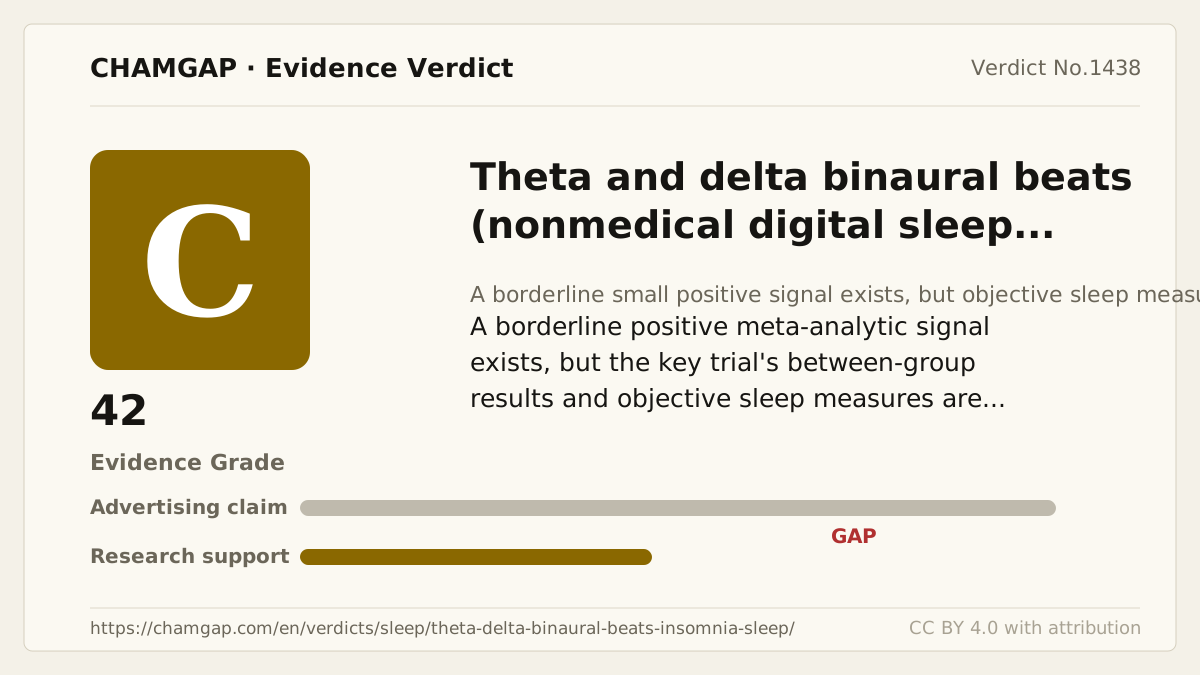
[Chamgap] Theta and delta binaural beats x improved sleep onset, sleep efficiency, and deep sleep in insomnia — Evidence Grade C·42. 5 cited sources checked. Source: https://chamgap.com/en/verdicts/sleep/theta-delta-binaural-beats-insomnia-sleep/ · CC BY 4.0CC BY 4.0 — free to use with attribution; do not distort grades, numbers, or verdict meaning.
What this document does and does not do
Chamgap is an information source. It reports what research has and has not confirmed; it does not tell readers what to take or buy. That decision belongs to readers and, when needed, medical or legal professionals. This verdict reflects literature available up to the search date and may change as new research appears. Nothing here is medical advice.