
Taurine,
does it really help with Shorter sleep-onset latency and better sleep quality after taurine alone at bedtime?
research showsTaurine is rated ? because no placebo-controlled human efficacy trial was identified in which adults took oral taurine alone at bedtime and were assessed for sleep-onset latency or sleep quality. The directly relevant sleep literature found was preclinical: dietary taurine increased sleep in fruit flies, and taurine activated GABA-A and glycine receptors in mouse thalamic neurons. Multi-ingredient amino-acid sleep products and caffeine-taurine beverages cannot isolate taurine's independent effect and were not attributed to it. Human taurine trials mainly address metabolic, cardiovascular, or exercise outcomes. The score is null, and this efficacy axis differs from fatigue verdict 067 and lifespan verdict 464.
ads claimMarketing converts phrases such as GABA-like, calming nerves, or counterbalancing stimulant drinks into faster sleep onset and deeper human sleep. With no standalone human sleep trial, those claims run ahead of clinical validation.
Useful facts when choosing a product
- Taurine is an aminosulfonic acid present in the body and in foods and supplements; it is not a protein-building alpha-amino acid.
- Multi-ingredient sleep products may combine taurine with GABA, theanine, magnesium, or herbs, so any observed effect cannot be assigned to taurine alone.
- A 2008 risk assessment based on human clinical data found strong evidence for absence of adverse effects up to 3 g/day of supplemental taurine in healthy adults, while certainty above that intake and over long periods was lower.
- Taurine is generally tolerated, but high doses may cause gastrointestinal discomfort; people with kidney or liver disease, pregnancy or breastfeeding, or multiple medicines should seek clinical advice.
Chamgap Semantic Classification Code
Candidate index · review held
S.taurine.oral.shorter-sleep-onset-latency-and-better-sleep-quality-after-taurine-alone-at-bedtime.assess.UNKSupplements and nutraceuticals > Taurine > Oral > Shorter sleep-onset latency and better sleep quality after taurine alone at bedtime > Association or change assessment > Unknown
An automated migration candidate, not an issued permanent code; exact claim scope remains under review. This machine-generated migration candidate helps retrieval but is not a permanent assignment. The original verdict ID and URL remain authoritative.
What the research actually shows
Lin and colleagues in 2010 fed fruit flies taurine at 0.1% to 1.5% and observed reduced locomotor activity and, at selected concentrations, increased total sleep. Those outcomes are not human sleep-onset latency or subjective sleep quality. Jia and colleagues in 2008 showed that taurine activated extrasynaptic GABA-A and glycine receptors and reduced excitability in mouse thalamic slices and recombinant receptor systems. A 2008 human-data risk assessment by Shao and Hathcock proposed an observed safe supplemental level of up to 3 g/day for healthy adults but did not assess sleep efficacy. The presence of taurine in a multi-ingredient sleep product therefore cannot substitute for a standalone trial.
Why this is classified as ?
No placebo-controlled efficacy trial of oral taurine alone was identified that assessed sleep-onset latency or sleep quality in adults. Fruit-fly sleep and mouse-neuron GABA-A or glycine receptor findings are preclinical, while combination products do not permit ingredient attribution. The absence of claim-matched human efficacy literature gives ? with a null score. General tolerability is a separate safety matter.
Counterpoint. The verdict can be revisited if a trial gives taurine alone at bedtime to adults with insomnia and measures sleep diaries, actigraphy, or polysomnography. Current insomnia care should prioritize evaluation of causes and cognitive behavioral therapy.
Rejudgment record. New verdict — Assigned ? because no claim-matched placebo-controlled human trial was identified for oral taurine alone at bedtime on adult sleep-onset latency or sleep quality, and fruit-fly, mouse-mechanistic, and multi-ingredient-product findings were not attributed to standalone human efficacy
Sub-claim grades by effect
This ingredient is marketed for several effects. A single overall grade blends strong and weak claims together, so each effect is graded separately here. The overall grade reflects the strongest disconfirming or core claim.
| Effect (sub-claim) | Grade | Basis |
|---|---|---|
| Shorter sleep-onset latency from taurine alone at bedtime | ? | No placebo-controlled adult human efficacy trial was identified. |
| Improved subjective sleep quality from taurine alone at bedtime | ? | Fruit-fly, mouse-mechanistic, and multi-ingredient-product findings cannot be attributed to standalone human sleep-quality efficacy. |
| Improved sleep efficiency and nocturnal awakenings from taurine alone at bedtime | ? | No claim-matched adult trial using actigraphy or polysomnography was identified. |
Cross-check — AI research and Codex final gate
Evidence Table
| Study | Design | Sample | Funding | Endpoint | Result | Weight |
|---|---|---|---|---|---|---|
| Lin FJ et al. 2010 | Fruit-fly sleep-wake behavioral experiment | Drosophila melanogaster; zero humans | Academic preclinical research; not reported as a manufacturer efficacy trial | Locomotor activity, total sleep, and sleep fragmentation | Selected taurine concentrations increased total sleep in fruit flies, but this was not an oral bedtime sleep-onset or sleep-quality outcome in humans. | Direct preclinical sleep evidence that cannot be attributed to humans |
| Jia F et al. 2008 | Mouse thalamic-slice and recombinant-receptor electrophysiology study | Mouse neurons and recombinant receptors; zero humans | U.S. National Institutes of Health grants | Extrasynaptic GABA-A and glycine receptor currents and neuronal excitability | Taurine activated inhibitory receptors and reduced neuronal excitability but did not measure sleep behavior or oral human efficacy. | Mechanistic plausibility, not clinical efficacy |
| Shao A and Hathcock JN. 2008 | Amino-acid safety risk assessment based on human clinical data | Human taurine safety literature across doses; sleep efficacy was not the review question | Authors affiliated with the Council for Responsible Nutrition | Adverse effects by supplemental intake and observed safe level | The review proposed an observed safe level up to 3 g/day for healthy adults but did not assess sleep-onset or sleep-quality efficacy. | Safety context, not efficacy evidence |
Receipt — 3 References
All 3 cited sources were verified for existence at the original page (as of 2026-07-21).
Final verification and publication gate: Codex · Evidence date: 2026-07-21 · Corrections: none
Cite this verdict
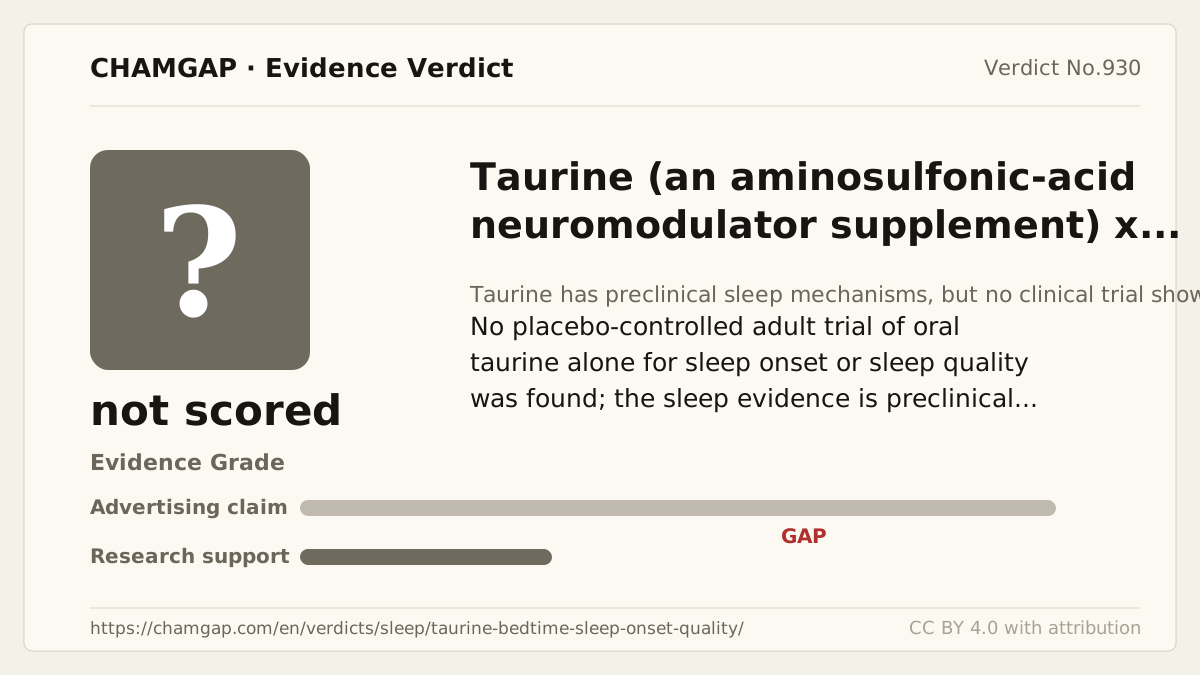
[Chamgap] Taurine x improved sleep onset and quality when taken alone at bedtime — Evidence Grade ?. 3 cited sources checked. Source: https://chamgap.com/en/verdicts/sleep/taurine-bedtime-sleep-onset-quality/ · CC BY 4.0CC BY 4.0 — free to use with attribution; do not distort grades, numbers, or verdict meaning.
What this document does and does not do
Chamgap is an information source. It reports what research has and has not confirmed; it does not tell readers what to take or buy. That decision belongs to readers and, when needed, medical or legal professionals. This verdict reflects literature available up to the search date and may change as new research appears. Nothing here is medical advice.