
Tai chi,
does it really help with Improved sleep in older adults with chronic insomnia?
research showsTai chi is rated B because it improves some objective and subjective sleep outcomes in older adults with chronic insomnia. In a randomized trial analyzing all 320 participants, actigraphy favored tai chi for sleep efficiency by 3.4 percentage points, wake after sleep onset by 13.3 minutes, and awakenings by 2.2, but objective total sleep time and immediate sleep-onset latency failed. A 2025 trial of 200 found tai chi inferior to CBT-I on ISI at three months but non-inferior at 15 months. In an independent trial of 123, subjective sleep quality improved, but primary insomnia remission and polysomnography failed. Endpoint and time-point inconsistency and inability to blind participants support B with 72 points.
ads claimPromotion can present tai chi as an insomnia cure or a proven replacement for sleep medicine. The evidence concerns improved sleep maintenance and subjective insomnia after regular training for at least 12 weeks, not superiority to CBT-I or normalization of every sleep measure.
Useful facts when choosing a product
- The pivotal 320-person trial used 24-form Yang-style tai chi in supervised one-hour sessions three times weekly for 12 weeks.
- The evidence evaluates regular practice over weeks rather than one or two sessions, and conventional exercise produced similar objective sleep improvements.
- Older adults should adapt difficulty to balance and joint status and initially practice near an instructor or stable support.
- Severe daytime impairment, suspected sleep apnea, depression, or persistent insomnia warrants clinical and CBT-I assessment rather than relying on tai chi alone.
Chamgap Semantic Classification Code
Candidate index · review held
X.tai-chi.behavioral.sleep-with-chronic-insomnia.improve.UNKBehaviors, exposures and policies > Tai chi > Behavioral delivery > sleep with chronic insomnia > Improvement claim > Unknown
An automated migration candidate, not an issued permanent code; exact claim scope remains under review. This machine-generated migration candidate helps retrieval but is not a permanent assignment. The original verdict ID and URL remain authoritative.
What the research actually shows
The Hong Kong three-arm trial randomized and analyzed 320 adults aged 60 or older. After 12 weeks, tai chi improved actigraphy sleep efficiency by 3.4 percentage points, wake after sleep onset by 13.3 minutes, and awakenings by 2.2 versus control, while objective total sleep time and immediate sleep-onset latency failed. A 2025 assessor-masked non-inferiority trial randomized 200 adults aged 50 or older equally to tai chi or CBT-I. At three months, ISI fell 6.67 versus 11.19 points and tai chi failed non-inferiority, but at 15 months reductions were 9.51 versus 10.18 points, between-group difference 0.68, within the four-point margin; intention-to-treat results agreed. In the independent 123-person trial, some subjective outcomes improved, but primary insomnia remission failed at 29.7% versus 20.8%, P=0.44, and polysomnography was neutral.
Why this is classified as B (72)
Objective sleep-maintenance outcomes succeeded in the all-participant analysis of 320, and 15-month ISI in a 200-person trial was non-inferior to CBT-I, but tai chi was inferior at three months and the independent 123-person trial failed primary remission and polysomnography. Sleep is not a surrogate; multiple signals plus conflicts support B with 72 points.
Counterpoint. Tai chi is a sustainable low-impact exercise option, but evidence does not establish it as a uniquely superior insomnia treatment over conventional exercise.
Rejudgment record. Cross-check applied — Integrated outcome-specific results in the all-participant actigraphy analysis of 320, failed three-month but successful 15-month non-inferiority in 200, and failed primary remission with neutral polysomnography in the independent 123-person trial, treating sleep symptoms as clinical targets
Sub-claim grades by effect
This ingredient is marketed for several effects. A single overall grade blends strong and weak claims together, so each effect is graded separately here. The overall grade reflects the strongest disconfirming or core claim.
| Effect (sub-claim) | Grade | Basis |
|---|---|---|
| Improved sleep efficiency and fewer or shorter awakenings | B | Actigraphy primary outcomes succeeded in the all-participant analysis of 320 and persisted at 24 months. |
| Longer total sleep time and shorter sleep-onset latency | C | Subjective diaries were positive, but objective total sleep time was neutral and immediate sleep-onset latency failed, producing outcome and time-point inconsistency. |
| Insomnia remission and improved daytime function | C | Remission and response were positive in the 320-person trial, but primary remission failed in the independent 123-person trial and daytime-function evidence is mainly subjective and secondary. |
Cross-check — AI research and Codex final gate
Evidence Table
| Study | Design | Sample | Funding | Endpoint | Result | Weight |
|---|---|---|---|---|---|---|
| Siu PM et al. 2021 | Three-arm parallel assessor-masked randomized trial | All 320 randomized participants analyzed (control 110, exercise 105, tai chi 105); 285 completed postassessment | Hong Kong government Health and Medical Research Fund; no conflicts disclosed | Primary: actigraphy sleep measures | Sleep efficiency +3.4 percentage points, wake after sleep onset -13.3 minutes, and awakenings -2.2 succeeded; objective total sleep time and immediate sleep-onset latency were neutral. | Key large objective-sleep evidence |
| Irwin MR et al. 2014 | Three-arm randomized comparative-efficacy trial of CBT-I, tai chi, and sleep education | 123 older adults with chronic primary insomnia | United States NIH public research support | Primary: clinician-rated remission of insomnia diagnosis; secondary: sleep quality, fatigue, depression, and polysomnography | Primary endpoint failed: tai chi 29.7% versus education 20.8%, P=0.44; some subjective secondary outcomes improved and polysomnography was neutral. | Independent conflicting and boundary evidence |
| Siu PM et al. 2025 | Assessor-masked randomized non-inferiority trial versus CBT-I | 200 randomized (100/100); 166 completed month 3 and 167 completed month 15; primary per-protocol analysis with intention-to-treat sensitivity analyses | Hong Kong government Health and Medical Research Fund; no competing interests | Primary: ISI non-inferiority at months 3 and 15 with a four-point margin | Non-inferiority failed at month 3 and tai chi was inferior to CBT-I; at month 15 the 0.68-point difference met non-inferiority, with consistent intention-to-treat results. | Recent clinically meaningful long-term evidence with time-point conflict |
| Li F et al. 2004 | Randomized trial of tai chi versus low-impact exercise | 118 older adults reporting moderate sleep complaints | Public and academic research support | Primary: PSQI subscales and global score plus daytime sleepiness | Subjective sleep latency improved by about 18 minutes and sleep duration by about 48 minutes, with better PSQI outcomes than low-impact exercise. | Independent subjective-sleep support |
Receipt — 4 References
All 4 cited sources were verified for existence at the original page (as of 2026-07-24).
Final verification and publication gate: Codex · Evidence date: 2026-07-24 · Corrections: none
Cite this verdict
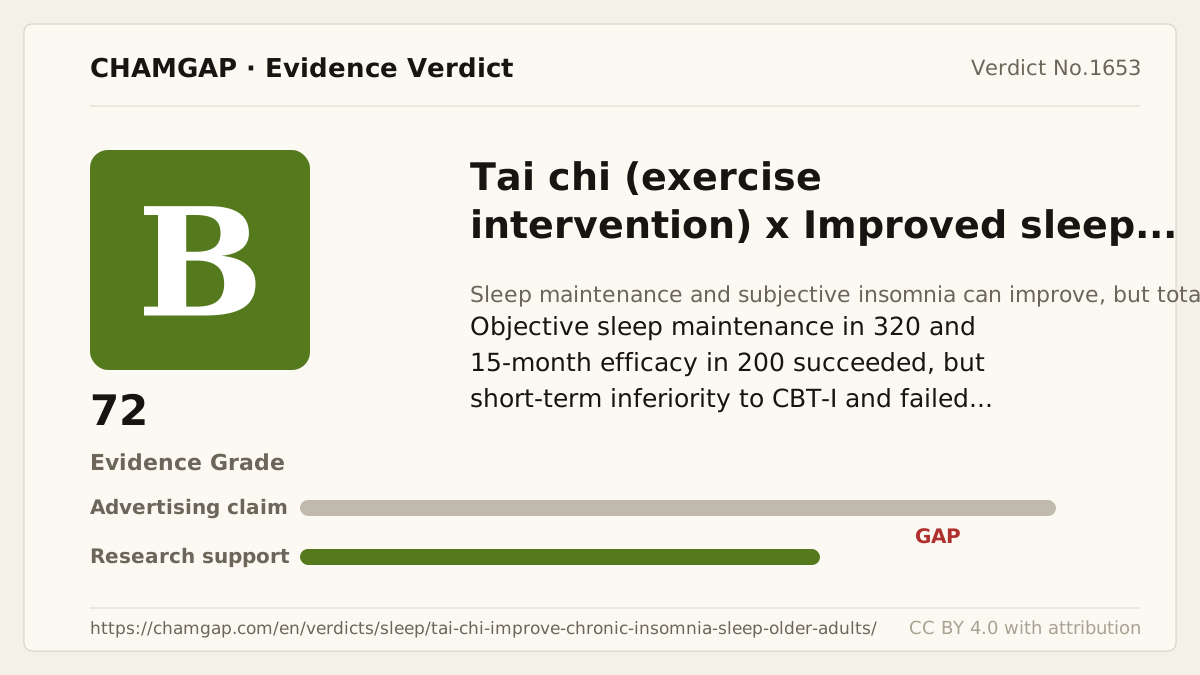
[Chamgap] Tai chi x improved sleep in older adults with chronic insomnia — Evidence Grade B·72. 4 cited sources checked. Source: https://chamgap.com/en/verdicts/sleep/tai-chi-improve-chronic-insomnia-sleep-older-adults/ · CC BY 4.0CC BY 4.0 — free to use with attribution; do not distort grades, numbers, or verdict meaning.
What this document does and does not do
Chamgap is an information source. It reports what research has and has not confirmed; it does not tell readers what to take or buy. That decision belongs to readers and, when needed, medical or legal professionals. This verdict reflects literature available up to the search date and may change as new research appears. Nothing here is medical advice.