
Stopping phone use 30 minutes before bed,
does it really help with Shorter self-reported sleep latency, longer sleep duration, and better sleep quality?
research showsThe grade is C with 54 points. A pilot trial randomized 38 adults with poor sleep quality and more than 30 minutes of bedtime phone use, 19 per arm. After four weeks, diary sleep latency changed from 31.0 to 18.4 minutes with restriction and 29.3 to 26.5 with no-instruction control; sleep duration changed from 6.20 to 6.56 hours versus 6.48 to 6.27. Effects were sizable, but the study was small, short, subjective, and lacked attention control.
ads claimVerdict 1187 is D with 30 points for wearing blue-light-blocking glasses while continuing screen use. This intervention stopped phone use itself rather than filtering a wavelength.
Useful facts when choosing a product
- The restriction arm stopped phone use from 30 minutes before usual bedtime for four weeks; control received no instruction.
- Diary latency changed by -12.6 versus -2.8 minutes, and sleep duration by +0.36 versus -0.21 hours.
- In an objective 79-participant repeated-measures cohort, interactive use after getting into bed was more consistently related to sleep than total screen time in the two hours before bed.
Chamgap Semantic Classification Code
Candidate index · review held
X.stopping-mobile-phone-use-from-before-usual-bedtime.behavioral.shorter-self-reported-sleep-latency-longer-sleep-duration-and-better-sleep-quality.assess.UNKBehaviors, exposures and policies > Stopping mobile phone use from before usual bedtime > Behavioral delivery > Shorter self-reported sleep latency, longer sleep duration, and better sleep quality > Association or change assessment > Unknown
An automated migration candidate, not an issued permanent code; exact claim scope remains under review. This machine-generated migration candidate helps retrieval but is not a permanent assignment. The original verdict ID and URL remain authoritative.
What the research actually shows
After 72 people were screened, 40 were eligible and two left before allocation; all 38 randomized participants were analyzed. The intervention locked apps or turned phones off from 30 minutes before usual bedtime. Researchers sent reminders ten minutes beforehand and made random calls after cutoff, but no numeric adherence percentage was reported. Sleep latency was self-reported each morning in a WeChat diary. Chinese military mental-health research funds and the National Natural Science Foundation supported the trial; no competing interests were declared.
Why this is classified as C (54)
Effects reconstructed from the original table were large by statistical convention and the trial had public funding. A 38-person, four-week, no-attention-control trial with unblinded subjective outcomes has multiple avoidable limitations, giving C with 54 points.
Counterpoint. A larger trial should use attention control and actigraphy and separate emitted light, stimulating content, and bedtime displacement.
Rejudgment record. Cross-check applied — The PLOS One table was checked for the 38-participant denominator, no-instruction control, four-week intervention, diary measurement, standardized effects reconstructed from group-by-time F values, adherence procedures, funding, and conflicts
| Endpoint | P | Symptom or function itself is the target - including patient reports and performance tests |
| Replication | R1 | Single confirmatory trial |
| Independence | I2 | Decisive evidence is publicly or non-profit funded |
| Effect size | E+ | Meets the clinically important threshold |
Stored derived and displayed grades match; this is not a current recalculation or validity check (C).
Sub-claim grades by effect
This ingredient is marketed for several effects. A single overall grade blends strong and weak claims together, so each effect is graded separately here. The overall grade reflects the strongest disconfirming or core claim.
| Effect (sub-claim) | Grade | Basis |
|---|---|---|
| Improved sleep onset and duration after stopping phone use 30 minutes before bed | C | A small four-week randomized trial found subjective improvement and large reconstructed effects. |
| Reducing screen light alone produces the same effect | ? | The trial did not separate light, content, interaction, and bedtime displacement. |
Cross-check — AI research and Codex final gate
Evidence Table
| Study | Design | Sample | Funding | Endpoint | Result | Weight |
|---|---|---|---|---|---|---|
| He JW et al., PLOS One, 2020 | Pilot randomized no-instruction controlled trial | 38 randomized and analyzed, 19 per arm | Mental Health Application Research of PLA and National Natural Science Foundation of China | Diary sleep latency and duration, and PSQI | Latency 30.98 to 18.38 versus 29.32 to 26.54 minutes; sleep 6.20 to 6.56 versus 6.48 to 6.27 hours; F-derived d about 0.84 and 0.79 | Core direct randomized evidence |
| Brosnan B et al., JAMA Pediatrics, 2024 | Repeated-measures cohort with video-recorded screen use and actigraphy | 79 participants and 230 weeknights in the main analysis | Public funding including the Health Research Council of New Zealand | Actigraphic sleep onset and total sleep time | Each 10 minutes of interactive screen use in bed was associated with 10 minutes later sleep onset (95% CI 4-16) | Objective contextual evidence separating screen timing and type |
Receipt — 2 References
All 2 cited sources were verified for existence at the original page (as of 2026-08-04).
Final verification and publication gate: Codex · Evidence date: 2026-08-04 · Corrections: none
Cite this verdict
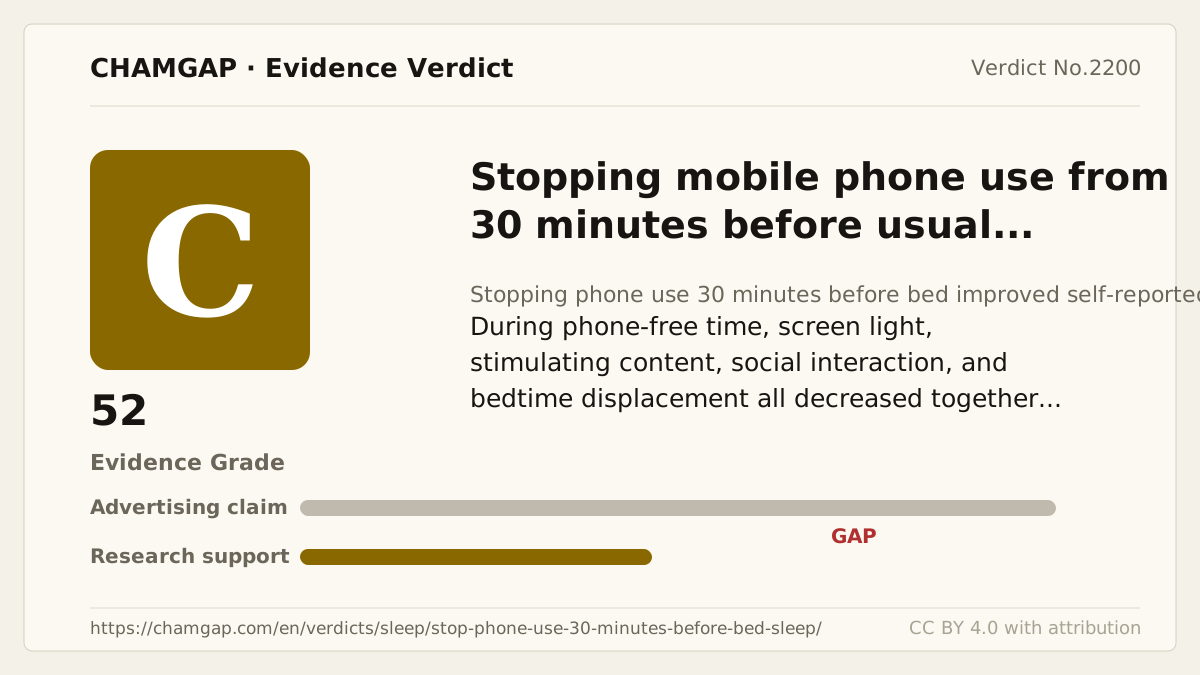
[Chamgap] Stopping phone use 30 minutes before bed x sleep onset and duration — Evidence Grade C·54. 2 cited sources checked. Source: https://chamgap.com/en/verdicts/sleep/stop-phone-use-30-minutes-before-bed-sleep/ · CC BY 4.0CC BY 4.0 — free to use with attribution; do not distort grades, numbers, or verdict meaning.
What this document does and does not do
Chamgap is an information source. It reports what research has and has not confirmed; it does not tell readers what to take or buy. That decision belongs to readers and, when needed, medical or legal professionals. This verdict reflects literature available up to the search date and may change as new research appears. Nothing here is medical advice.