
Rotigotine,
does it really help with Reduction of nighttime symptoms, periodic limb movements, and sleep disturbance in moderate-to-severe primary restless legs syndrome?
research showsThe rotigotine patch is rated B because it consistently improves nighttime symptoms and sleep disturbance in moderate-to-severe primary restless legs syndrome. Across eight randomized trials involving 1,905 participants, IRLS improved by 4.7 points versus placebo with high certainty, and quality of life and sleep quality improved in the same direction. IRLS and sleep disturbance are direct patient outcomes and treatment targets, not surrogates merely because they are reported on scales. The evidence base is at least as large as that for ropinirole B62 and approaches pramipexole B75, supporting B with 70 points. Long-term augmentation, impulse-control disorders, daytime somnolence or sleep attacks, orthostatic hypotension, and application-site reactions remain separate considerations.
ads claimMarketing can expand the convenience of one patch and continuous delivery into a promise of restful sleep or a stable long-term solution. The evidence supports short-term symptom and limb-movement improvement, not protection from symptoms beginning earlier or worsening through augmentation over time.
Useful facts when choosing a product
- Neupro is a prescription patch that delivers rotigotine over 24 hours; United States labeling for RLS starts at 1 mg per 24 hours, allows weekly increases as needed, and sets a maximum of 3 mg per 24 hours.
- The patch is applied at about the same time each day to clean, dry, relatively hairless skin, and the same site should not be reused within 14 days.
- Treatment should not be stopped abruptly without prescriber guidance, and symptoms moving earlier into the afternoon or daytime or becoming more severe should prompt evaluation for augmentation.
- Application-site reactions, nausea, daytime somnolence or sudden sleep, orthostatic hypotension, hallucinations, and impulse-control disorders can occur, so driving, hazardous work, and dopaminergic behavioral changes require separate monitoring.
Chamgap Semantic Classification Code
Candidate index · review held
M.rotigotine.transdermal.nighttime-symptoms-periodic-limb-movements-and-sleep-disturbance-in-moderate-to-severe-primary-restless-legs-syndrome.reduce.placeboMedicinal interventions > Rotigotine > Transdermal > nighttime symptoms, periodic limb movements, and sleep disturbance in moderate-to-severe primary restless legs syndrome > Reduction claim > Placebo
An automated migration candidate, not an issued permanent code; exact claim scope remains under review. This machine-generated migration candidate helps retrieval but is not a permanent assignment. The original verdict ID and URL remain authoritative.
What the research actually shows
Oertel and colleagues randomized 67 people with moderate-to-severe primary RLS to rotigotine or placebo and evaluated polysomnography after a four-week maintenance period. Rotigotine produced much larger improvements in the periodic limb movement index and movements with arousal, and complete IRLS symptom resolution occurred only in the active-treatment group. The 2013 trial by Inoue and the Rotigotine Trial Group randomized 284 participants for 13 weeks; 2 or 3 mg per 24 hours reduced the IRLS total score by approximately 2.8 to 3.1 points more than placebo, while application-site reactions were substantially more frequent. The 2025 AASM evidence review accepted short-term improvements in RLS severity, sleep quality, and quality of life but also weighed augmentation and adverse-event withdrawals, and the guideline conditionally recommended against standard transdermal rotigotine use in adults. Authorization and labeling define conditions of use; they do not establish favorable long-term net benefit or an A grade.
Why this is classified as B (70)
Eight randomized trials involving 1,905 participants found a 4.7-point IRLS benefit with high certainty and consistent improvement in quality of life and sleep quality. IRLS and sleep disturbance are direct patient outcomes and treatment targets, so scale-based reporting does not invoke a surrogate-outcome ceiling. Polysomnographic limitations, manufacturer concentration, and short follow-up remain constraints, but the evidence base is at least as strong as ropinirole B62 and approaches pramipexole B75, supporting B with 70 points. Long-term augmentation and safety limitations independently constrain net benefit and treatment selection.
Counterpoint. Iron deficiency, aggravating medicines, sleep apnea, and behavioral factors should be assessed first. Rotigotine can still be an individualized option when preferred treatments are unsuitable or short-term symptom relief is valued more highly, provided augmentation is checked regularly.
Rejudgment record. Consistency recalibration (rule 1 clarification) — Treated IRLS and sleep disturbance as direct patient outcomes and treatment targets rather than surrogates; a high-certainty 4.7-point IRLS benefit across eight trials involving 1,905 participants, consistent quality-of-life and sleep-quality effects, and evidence at least as strong as ropinirole B62 and approaching pramipexole B75 support B
Sub-claim grades by effect
This ingredient is marketed for several effects. A single overall grade blends strong and weak claims together, so each effect is graded separately here. The overall grade reflects the strongest disconfirming or core claim.
| Effect (sub-claim) | Grade | Basis |
|---|---|---|
| Reduction of nighttime symptoms in moderate-to-severe primary RLS | B | Nighttime symptoms measured by IRLS are a treatment target and improved by 4.7 points across eight trials involving 1,905 participants with high certainty. |
| Reduction of periodic limb movements and associated arousals during sleep | B | A direct polysomnographic randomized trial significantly reduced periodic limb movements and movements with arousal, consistent with the overall clinical efficacy evidence. |
| Improvement of RLS-related sleep disturbance | B | Sleep disturbance and sleep quality are treatment targets and improved consistently across multiple trials, but prevention of augmentation was not established. |
Cross-check — AI research and Codex final gate
Evidence Table
| Study | Design | Sample | Funding | Endpoint | Result | Weight |
|---|---|---|---|---|---|---|
| Oertel WH et al. 2010 | Multicenter randomized double-blind placebo-controlled polysomnographic trial | 67 participants with moderate-to-severe primary RLS; 46 rotigotine and 21 placebo | Schwarz Pharma/UCB manufacturer program | Periodic limb movement index, movements with arousal, IRLS, and sleep-related assessments | The periodic limb movement index fell from 50.9 to 8.1 per hour with rotigotine and from 37.4 to 27.1 with placebo; the adjusted treatment ratio was 4.25 (95% CI 2.48 to 7.28; P<0.0001). | Key objective short-term polysomnographic evidence |
| Inoue Y et al.; Rotigotine Trial Group 2013 | Multicenter phase 3 randomized double-blind placebo-controlled trial | 284 Japanese participants with primary RLS | Manufacturer-led phase 3 program; detailed funding not stated in the PubMed abstract | Thirteen-week IRLS total score and Pittsburgh Sleep Quality Index | Placebo-adjusted IRLS reductions were 2.8 and 3.1 points for 2 and 3 mg per 24 hours, respectively; both were significant, while application-site reactions occurred in 42.1% and 50.0% versus 7.4% with placebo. | Moderate-sized direct symptom evidence |
| Winkelman JW et al. 2025 AASM guideline and evidence review | Systematic review, meta-analysis, GRADE assessment, and clinical guideline | Synthesis of randomized evidence in adults with RLS | American Academy of Sleep Medicine | RLS severity, sleep quality, quality of life, discontinuation, and augmentation | It acknowledged short-term benefit but conditionally recommended against standard transdermal rotigotine use in adults because of long-term augmentation, with low certainty of evidence. | Key evidence on long-term net benefit and limits on standard use |
Receipt — 3 References
All 3 cited sources were verified for existence at the original page (as of 2026-07-23).
Final verification and publication gate: Codex · Evidence date: 2026-07-23 · Corrections: none
Cite this verdict
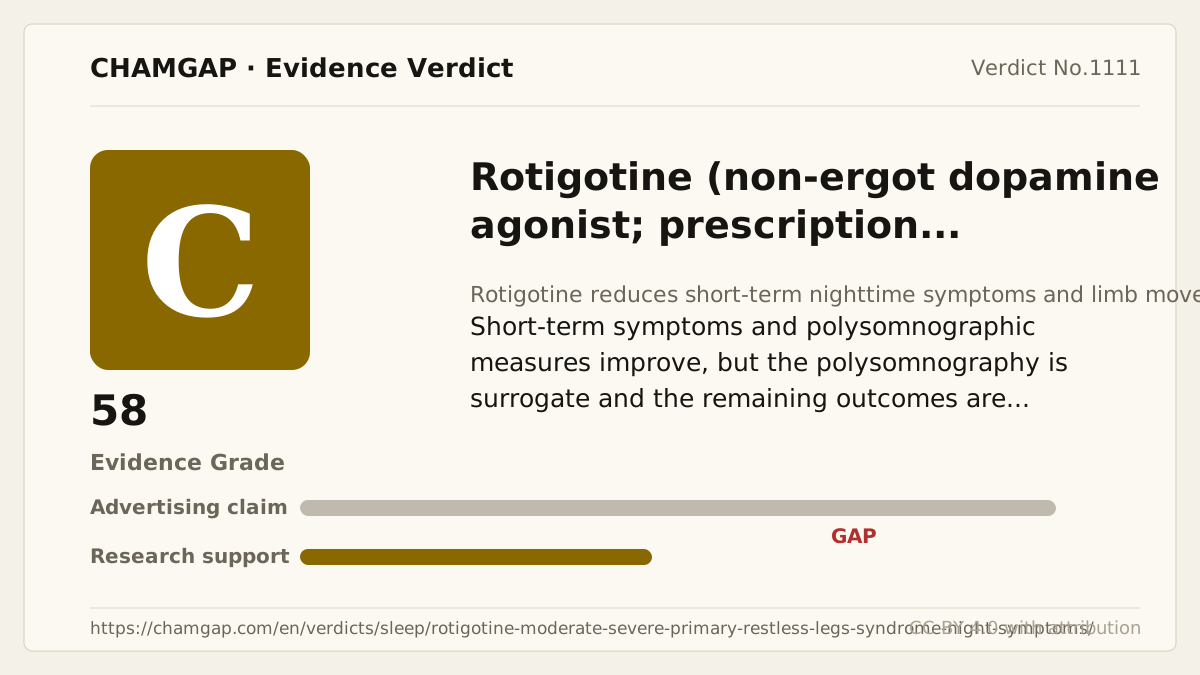
[Chamgap] Rotigotine x reduced nighttime symptoms, periodic limb movements, and sleep disturbance in moderate-to-severe primary restless legs syndrome — Evidence Grade B·70. 3 cited sources checked. Source: https://chamgap.com/en/verdicts/sleep/rotigotine-moderate-severe-primary-restless-legs-syndrome-night-symptoms/ · CC BY 4.0CC BY 4.0 — free to use with attribution; do not distort grades, numbers, or verdict meaning.
What this document does and does not do
Chamgap is an information source. It reports what research has and has not confirmed; it does not tell readers what to take or buy. That decision belongs to readers and, when needed, medical or legal professionals. This verdict reflects literature available up to the search date and may change as new research appears. Nothing here is medical advice.