
Ropinirole,
does it really help with Short-term improvement of nighttime symptoms, sleep, and quality of life in moderate-to-severe primary restless legs syndrome?
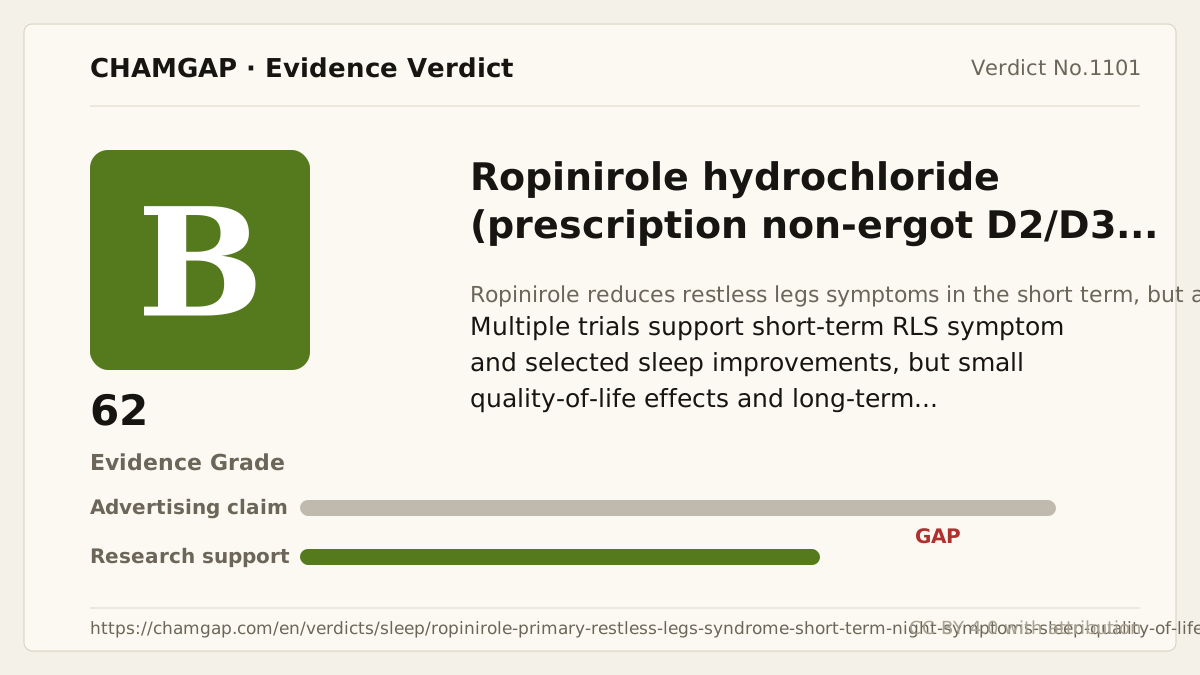
research showsRopinirole is rated B because it produces a clinically meaningful short-term reduction in symptom severity in moderate-to-severe primary restless legs syndrome. The 2025 AASM systematic review identified 12 randomized trials; a meta-analysis of seven trials and 1,314 participants found a 4.0-point greater reduction on the IRLS scale than placebo. An individual-patient-data meta-analysis of six trials and 1,679 participants also improved sleep quantity, adequacy, and disturbance at 12 weeks. However, mean effects on quality of life and sleep quality in the updated analysis did not reach clinical-importance thresholds, and long-term dopaminergic augmentation led AASM to suggest against standard use. The result is therefore a low B with 62 points on a different efficacy axis from B-rated insomnia medicines such as brotizolam and suvorexant; long-term harms remain separate under safety.
ads claimPromotion can present ropinirole as a standard medicine that solves both leg discomfort and insomnia, extending short-term symptom efficacy into long-term disease control. In practice, iron status and exacerbating medicines should be reviewed first, and alternatives such as gabapentinoids should be compared before selecting it for a patient who values short-term benefit over augmentation risk.
Useful facts when choosing a product
- Ropinirole is a prescription non-ergot dopamine agonist used for Parkinson disease and primary restless legs syndrome. For restless legs syndrome, a low dose is usually started before bedtime and adjusted according to response and adverse effects.
- Iron deficiency, caffeine and alcohol, antihistaminergic, serotonergic, or antidopaminergic medicines, and untreated sleep apnea should be assessed as potential exacerbating factors before treatment.
- Nausea, dizziness, orthostatic hypotension, sudden sleep episodes, and daytime somnolence can occur, making driving and hazardous machinery important concerns.
- Long-term use can cause augmentation, in which symptoms begin earlier, intensify, or spread to other body regions, and can also cause impulse-control disorders. Ongoing reassessment is required, and discontinuation should be tapered with the prescriber rather than stopped abruptly.
Chamgap Semantic Classification Code
Candidate index · review held
M.ropinirole-hydrochloride.UNK.short-term-improvement-of-nighttime-symptoms-sleep-and-quality-of-life-in-moderate-to-severe-primary-restless-legs-syndrome.improve.placeboMedicinal interventions > Ropinirole hydrochloride > Unknown > Short-term improvement of nighttime symptoms, sleep, and quality of life in moderate-to-severe primary restless legs syndrome > Improvement claim > Placebo
An automated migration candidate, not an issued permanent code; exact claim scope remains under review. This machine-generated migration candidate helps retrieval but is not a permanent assignment. The original verdict ID and URL remain authoritative.
What the research actually shows
The 2025 AASM systematic review by Winkelman and colleagues identified 12 randomized trials and two observational studies of ropinirole. Across seven trials and 1,314 participants followed for 2 to 26 weeks, IRLS scores improved by 4.0 points more than placebo. In three 12-week trials, a 3.8-point quality-of-life gain and sleep-quality SMD of 0.17 were judged not clinically significant. Hansen and colleagues pooled individual data from six double-blind trials and 1,679 participants, reporting 2.5 more hours of sleep per week, 21% greater improvement in sleep adequacy, and 14% less sleep disturbance. The same AASM assessment integrated augmentation, somnolence, and dizziness, judged harms to outweigh benefits for standard use, and issued a conditional recommendation against ropinirole.
Why this is classified as B (62)
Among 12 short-term randomized trials, seven trials with 1,314 participants supported a clinically significant direct symptom endpoint, and a six-trial individual-data analysis consistently improved sleep measures. Quality-of-life and updated sleep-quality effects were small, however, evidence was mainly short term, and AASM conditionally recommended against standard use because of long-term augmentation. Recognizing short-term efficacy without extending it to long-term standard therapy yields B with 62 points. Augmentation, impulse-control disorders, somnolence, and nausea are independent safety issues.
Counterpoint. For intermittent or severe symptoms that persist after correcting iron deficiency and exacerbating factors, ropinirole may remain an option under specialist monitoring when a patient prioritizes short-term relief and accepts long-term augmentation risk. AASM currently gives stronger recommendations to gabapentin, gabapentin enacarbil, and pregabalin.
Rejudgment record. New verdict — Accepted clinically significant short-term IRLS improvement among the 12 randomized trials in the updated AASM review and sleep improvement in a separate individual-data meta-analysis, while accounting for small quality-of-life and sleep-quality effects, long-term augmentation, the conditional recommendation against standard use, and corpus parity with B-rated brotizolam and suvorexant
Sub-claim grades by effect
This ingredient is marketed for several effects. A single overall grade blends strong and weak claims together, so each effect is graded separately here. The overall grade reflects the strongest disconfirming or core claim.
| Effect (sub-claim) | Grade | Basis |
|---|---|---|
| Short-term reduction of nighttime symptoms in moderate-to-severe primary restless legs syndrome | B | Across seven trials and 1,314 participants, IRLS scores fell 4.0 points more than placebo, a clinically significant effect based mainly on 2-to-26-week data. |
| Short-term improvement in sleep quantity, adequacy, and disturbance | B | Individual data from six trials were positive, but manufacturer concentration and a small updated aggregate sleep-quality effect limit confidence. |
| Improvement in disease-specific quality of life | C | The 3.8-point gain across three trials was statistically positive but did not meet the AASM threshold for clinical importance. |
Cross-check — AI research and Codex final gate
Evidence Table
| Study | Design | Sample | Funding | Endpoint | Result | Weight |
|---|---|---|---|---|---|---|
| Winkelman JW et al. AASM systematic review 2025 | Systematic review, meta-analysis, and GRADE assessment | Twelve ropinirole randomized trials and two observational studies; seven randomized trials and 1,314 participants in the IRLS meta-analysis | Funded by the American Academy of Sleep Medicine; several underlying trials were manufacturer-sponsored | IRLS disease severity, quality of life, sleep quality, augmentation, somnolence, and dizziness | IRLS scores fell 4.0 points more than placebo, but the 3.8-point quality-of-life effect and sleep-quality SMD of 0.17 did not reach clinical-importance thresholds. Harms including long-term augmentation were judged to outweigh benefits for standard use. | Current pivotal synthesis of efficacy and harms |
| Hansen RA et al. 2009 | Individual-patient-data meta-analysis of six randomized double-blind placebo-controlled trials | 1,679 participants with moderate-to-severe primary restless legs syndrome | GlaxoSmithKline data provision and sponsorship involvement | Twelve-week MOS sleep quantity, adequacy, disturbance, daytime somnolence, and CGI-I response | Compared with placebo, sleep increased by 2.5 hours per week, sleep adequacy improved 21% more, sleep disturbance fell 14%, and CGI-I response was 63% versus 47%. | Direct short-term sleep efficacy evidence with manufacturer concentration |
| Winkelman JW et al. AASM guideline 2025 | GRADE-based clinical practice guideline | Companion systematic review screened 3,631 records and used 148 studies in quantitative analyses | American Academy of Sleep Medicine | Balance of short-term patient-important efficacy and harms including long-term augmentation | With moderate certainty, the guideline conditionally suggested against standard ropinirole use in adult RLS while allowing selection by patients who place greater value on short-term symptom reduction. | Current limitation on standard use |
Receipt — 3 References
All 3 cited sources were verified for existence at the original page (as of 2026-07-22).
Final verification and publication gate: Codex · Evidence date: 2026-07-22 · Corrections: none
Cite this verdict
[Chamgap] Ropinirole x short-term nighttime symptoms, sleep, and quality of life in primary restless legs syndrome — Evidence Grade B·62. 3 cited sources checked. Source: https://chamgap.com/en/verdicts/sleep/ropinirole-primary-restless-legs-syndrome-short-term-night-symptoms-sleep-quality-of-life/ · CC BY 4.0CC BY 4.0 — free to use with attribution; do not distort grades, numbers, or verdict meaning.
What this document does and does not do
Chamgap is an information source. It reports what research has and has not confirmed; it does not tell readers what to take or buy. That decision belongs to readers and, when needed, medical or legal professionals. This verdict reflects literature available up to the search date and may change as new research appears. Nothing here is medical advice.