
Ramelteon, an MT1 and MT2 melatonin-receptor agonist and prescription hypnotic marketed as Rozerem,
does it really help with Reduction of objective sleep-onset latency in chronic sleep-onset insomnia?
research showsRamelteon is rated C. The pooled objective reduction in sleep-onset latency was about 9.57 minutes, below the AASM guideline's own threshold for clinical significance, while subjective latency improved by about 4.3 minutes. Its effect is smaller than that of Z-drugs such as zolpidem, which caps the rating at C. Prescription-drug randomized evidence is stronger than the evidence for supplemental melatonin, but the small effect yields 57 points.
ads claimMarketing may suggest that targeting melatonin receptors produces natural sleep, rapid onset, and freedom from addiction concerns. Abuse potential is indeed low, but that is separate from efficacy magnitude and does not guarantee a large perceptible benefit or improved sleep maintenance for every patient.
Useful facts when choosing a product
- Ramelteon is a prescription medicine that acts at brain MT1 and MT2 melatonin receptors and is marketed in the United States as Rozerem.
- The usual adult insomnia dose is 8 mg about 30 minutes before bedtime, and labeling advises against taking it with or immediately after a high-fat meal.
- Evidence for objective sleep-onset reduction is more direct than for supplemental melatonin, but the mean difference is small and most trials were manufacturer-sponsored.
- Ramelteon is not a controlled substance in the United States and has a low abuse signal, but this does not eliminate somnolence, dizziness, or drug interactions.
Chamgap Semantic Classification Code
Candidate index · review held
M.ramelteon.UNK.objective-sleep-onset-latency-in-chronic-sleep-onset-insomnia.reduce.placeboMedicinal interventions > Ramelteon > Unknown > objective sleep-onset latency in chronic sleep-onset insomnia > Reduction claim > Placebo
An automated migration candidate, not an issued permanent code; exact claim scope remains under review. This machine-generated migration candidate helps retrieval but is not a permanent assignment. The original verdict ID and URL remain authoritative.
What the research actually shows
A pooled analysis of four placebo-controlled trials reported objective latency to persistent sleep of 30.2 minutes with ramelteon 8 mg and 43.3 minutes with placebo on nights 1 and 2, a 13.1-minute difference. A meta-analysis of 13 trials involving 5,812 participants found a 4.3-minute mean reduction in subjective sleep latency and judged the overall clinical impact small. The AASM guideline reported an approximately 9.6-minute pooled objective reduction and issued only a weak recommendation for sleep-onset insomnia.
Why this is classified as C (57)
Repeated placebo-controlled trials and an objective polysomnographic endpoint strengthen the evidence, but the pooled objective reduction of 9.57 minutes fell below the AASM guideline's threshold for clinical significance and subjective improvement was only about 4.3 minutes. Prescription-drug randomized evidence is stronger than for supplemental melatonin, but efficacy is smaller than for Z-drugs such as zolpidem, supporting a C ceiling and 57 points. Concentrated manufacturer funding and limited sleep-maintenance benefit were also considered.
Counterpoint. A small average effect does not mean that no individual responds, and the drug may be useful when avoiding abuse liability is important. Conversely, low abuse potential is a safety and use characteristic, not evidence that should raise the sleep-onset efficacy grade.
Rejudgment record. Cross-check revision — The approximately -9.57-minute objective sleep-onset effect fell below the guideline's threshold for clinical significance and was smaller than the efficacy of Z-drugs, supporting a C ceiling
Sub-claim grades by effect
This ingredient is marketed for several effects. A single overall grade blends strong and weak claims together, so each effect is graded separately here. The overall grade reflects the strongest disconfirming or core claim.
| Effect (sub-claim) | Grade | Basis |
|---|---|---|
| It reduces objective sleep-onset latency in chronic sleep-onset insomnia. | C | The pooled objective difference was about -9.57 minutes, below the guideline's own threshold for clinical significance and smaller than the efficacy of Z-drugs. |
| It produces a clinically meaningful reduction in patient-reported sleep-onset latency. | C | The meta-analytic mean reduction was about 4.3 minutes, a small clinical magnitude despite statistical significance, and some trials were nonsignificant. |
| It improves sleep maintenance in chronic insomnia. | D | Consistent efficacy was not established for wake after sleep onset or number of awakenings, and the supported indication is limited to sleep onset. |
Cross-check — AI research and Codex final gate
Evidence Table
| Study | Design | Sample | Funding | Endpoint | Result | Weight |
|---|---|---|---|---|---|---|
| Wang-Weigand et al., 2009, pooled analysis of four randomized placebo-controlled trials | Pooled polysomnographic data from nights 1 and 2 in adults with chronic insomnia randomized to ramelteon 8 mg or placebo | 566 assigned to ramelteon and 556 to placebo | Sponsored by Takeda, with authors employed by Takeda | Objective latency to persistent sleep | The night-1-and-2 mean was 30.2 minutes with ramelteon and 43.3 minutes with placebo, a 13.1-minute reduction with p<0.001. | Large pooled direct objective randomized evidence, downgraded for manufacturer sponsorship and author conflicts |
| Kuriyama et al., 2014, systematic review and meta-analysis | Meta-analysis of 13 randomized trials of ramelteon in adults with insomnia | 5,812 participants | The abstract reported no external funding | Subjective sleep latency, total sleep time, sleep quality, and adverse events | Subjective sleep latency decreased by 4.30 minutes, subjective total sleep time did not significantly improve, and the authors concluded that the overall clinical impact was small. | High weight as an independent meta-analysis that quantifies both the effect and its limitations |
| Sateia et al., 2017, American Academy of Sleep Medicine clinical practice guideline | Systematic evidence assessment and recommendations for pharmacologic treatment of chronic insomnia | Four pivotal placebo-controlled ramelteon trials | Professional-society guideline; the evaluated ramelteon trials were industry-funded | Objective and subjective sleep latency, sleep maintenance, and sleep quality | The pooled objective sleep-latency difference was about -9.57 minutes, below the guideline's clinical-significance threshold, and the recommendation for sleep-onset insomnia was weak. | High weight as an authoritative guideline evaluating both direct evidence and clinical importance |
| De Crescenzo et al., 2022, network meta-analysis of insomnia medications | Systematic review and network meta-analysis of acute and long-term pharmacologic treatments for adult insomnia | 154 double-blind randomized trials with 44,089 participants | Funded by the UK National Institute for Health Research | Efficacy, treatment discontinuation, tolerability, and safety | Benzodiazepines and eszopiclone, zolpidem, and zopiclone were estimated to be more efficacious for acute treatment than melatonin, ramelteon, and zaleplon. | Supportive weight because it compares overall efficacy across a network rather than directly estimating minutes to sleep onset |
Receipt — 4 References
All 4 cited sources were verified for existence at the original page (as of 2026-07-21).
Final verification and publication gate: Codex · Evidence date: 2026-07-21 · Corrections: none
Cite this verdict
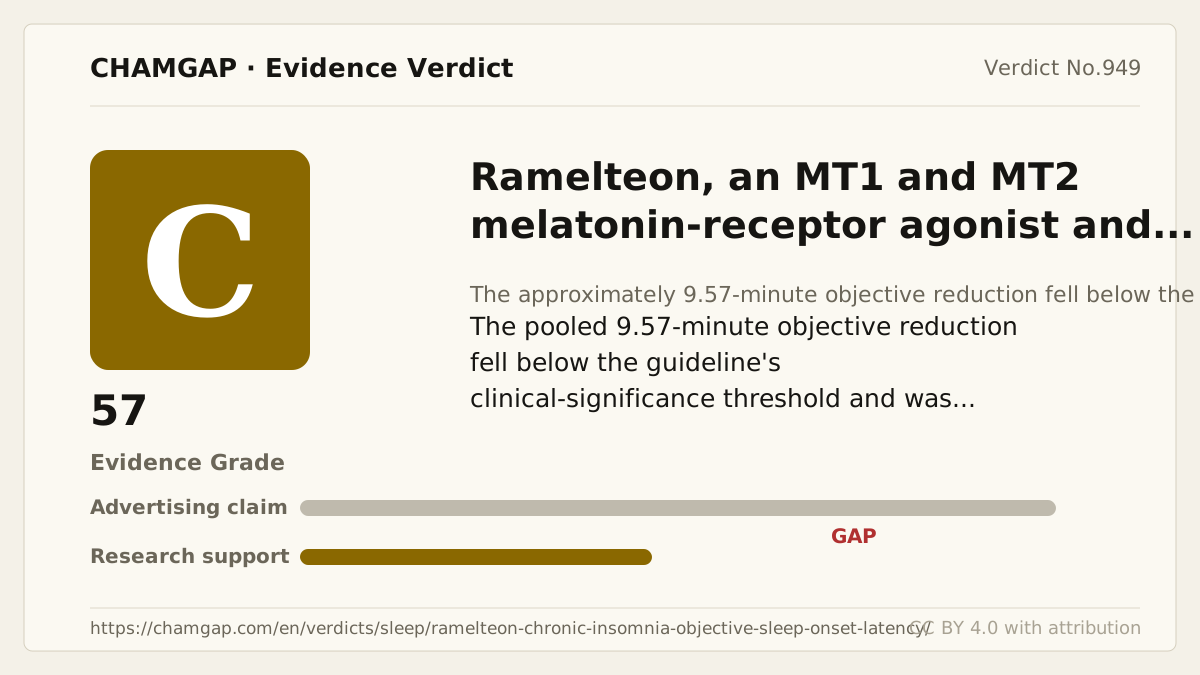
[Chamgap] Does ramelteon reduce objective sleep-onset latency in chronic insomnia? — Evidence Grade C·57. 4 cited sources checked. Source: https://chamgap.com/en/verdicts/sleep/ramelteon-chronic-insomnia-objective-sleep-onset-latency/ · CC BY 4.0CC BY 4.0 — free to use with attribution; do not distort grades, numbers, or verdict meaning.
What this document does and does not do
Chamgap is an information source. It reports what research has and has not confirmed; it does not tell readers what to take or buy. That decision belongs to readers and, when needed, medical or legal professionals. This verdict reflects literature available up to the search date and may change as new research appears. Nothing here is medical advice.