
Provent nasal EPAP,
does it really help with Reduced apnea-hypopnea index versus a sham valve in obstructive sleep apnea?
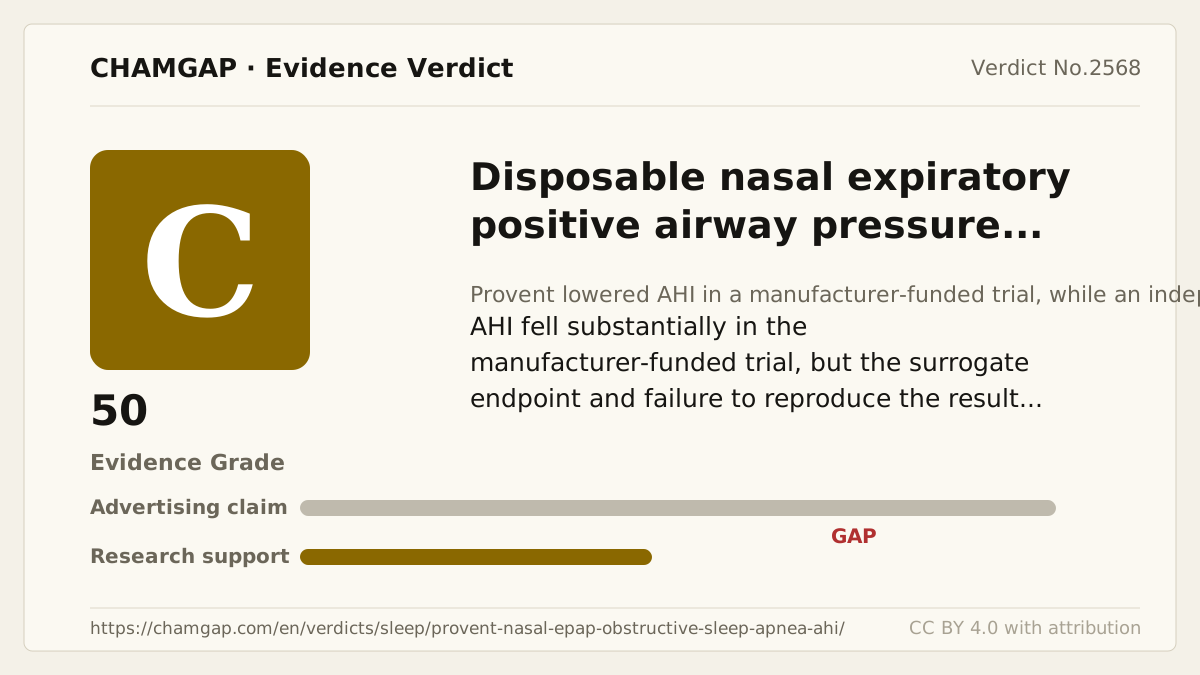
research showsThe grade is C. In a 250-participant manufacturer-funded trial, the three-month analysis included 100 versus 95 and median AHI reduction was 42.7% versus 10.1% (P<.0001). Prespecified success, at least 50% reduction or AHI below 10, occurred in 50.7% versus 22.4% (P=.001). AHI is a surrogate, only 195 of 250 remained in the three-month analysis, and an independent CPAP-withdrawal trial was null in a different population; this gives C with 50 points.
ads claimThe valve genuinely creates greater expiratory than inspiratory resistance. A lower AHI does not establish prevention of cardiovascular events or symptom and safety equivalence to CPAP.
Useful facts when choosing a product
- Provent is a disposable mechanical resistance valve adhered over both nostrils.
- Berry tested nightly use for three months against a similar low-resistance sham.
- Current official Korean availability of the original Provent product was not confirmed.
Chamgap Semantic Classification Code
Candidate index · review held
P.disposable-nasal-expiratory-positive-airway-pressure-valve.intranasal.apnea-hypopnea-index.reduce.MULTIProcedures, devices and tests > Disposable nasal expiratory positive airway pressure valve > Intranasal > apnea-hypopnea index > Reduction claim > Multiple: primary unresolved
An automated migration candidate, not an issued permanent code; exact claim scope remains under review. This machine-generated migration candidate helps retrieval but is not a permanent assignment. The original verdict ID and URL remain authoritative.
What the research actually shows
Berry RB, Kryger MH, Massie CA randomized 127 versus 123; week-one analysis included 119 versus 110 and three-month AHI analysis 100 versus 95. The primary endpoint was the between-group comparison of device-on versus device-off AHI at week one; three-month AHI was secondary. The paper states, “This study was funded by Ventus Medical, Inc.” Rossi VA, Winter B, Rahman NM, Yu LM et al. randomized 67 established CPAP users among continued CPAP, Provent, and sham Provent, analyzing 63 per protocol. The studies differed in population and treatment context and were not counted as direct replication.
Why this is classified as C (50)
A substantial surrogate response in a manufacturer-funded trial, 22% missing from three-month analysis, and an independent null trial in a different clinical context give C with 50 points.
Counterpoint. Some patients clearly responded, but predictors of response were not identified and CPAP substitution was not established.
Rejudgment record. Cross-check applied — We cross-checked populations, analysis denominators, prespecified outcomes, AHI results, allocation method, funding, and registration in both primary reports.
| Endpoint | S | Surrogate marker - laboratory or imaging measures |
| Replication | R1 | Single confirmatory trial |
| Independence | I1 | Mixed funding sources |
| Effect size | E+ | Meets the clinically important threshold |
Stored derived and displayed grades match; this is not a current recalculation or validity check (C).
Sub-claim grades by effect
This ingredient is marketed for several effects. A single overall grade blends strong and weak claims together, so each effect is graded separately here. The overall grade reflects the strongest disconfirming or core claim.
| Effect (sub-claim) | Grade | Basis |
|---|---|---|
| Reduced three-month AHI in previously untreated OSA | C | The manufacturer-funded trial was positive, with a surrogate endpoint and missing data. |
| Short-term replacement for CPAP | D | The CPAP-withdrawal trial found no difference from sham. |
Cross-check — AI research and Codex final gate
Evidence Table
| Study | Design | Sample | Funding | Endpoint | Result | Weight |
|---|---|---|---|---|---|---|
| Berry RB, Kryger MH, Massie CA, 2011 | Nineteen-center randomized double-blind sham-controlled trial | 250 randomized, 127 versus 123; 229 analyzed at week one, 119 versus 110; 195 in three-month AHI analysis, 100 versus 95 | Ventus Medical, Inc. | Week-one between-group AHI difference as primary; three-month AHI as secondary | Median three-month AHI reduction 42.7% versus 10.1%, P<.0001; success 50.7% versus 22.4%, P=.001 | Manufacturer-funded positive surrogate trial |
| Rossi VA, Winter B, Rahman NM, Yu LM et al., 2013 | Three-arm partially blinded randomized placebo-controlled CPAP-withdrawal trial | 67 randomized; 63 in per-protocol analysis | Registry sponsor University of Zurich; article funding statement not verified | AHI, ODI, and ESS at two weeks | Provent versus sham Provent AHI difference +3.2 events/hour (95% CI −7.7 to 14.1), P=.52 | Independent null trial in a different clinical setting |
Receipt — 2 References
All 2 cited sources were verified for existence at the original page (as of 2026-08-14).
Final verification and publication gate: Codex · Evidence date: 2026-08-14 · Corrections: none
Cite this verdict
[Chamgap] Provent nasal EPAP x reduced AHI in obstructive sleep apnea — Evidence Grade C·50. 2 cited sources checked. Source: https://chamgap.com/en/verdicts/sleep/provent-nasal-epap-obstructive-sleep-apnea-ahi/ · CC BY 4.0CC BY 4.0 — free to use with attribution; do not distort grades, numbers, or verdict meaning.
What this document does and does not do
Chamgap is an information source. It reports what research has and has not confirmed; it does not tell readers what to take or buy. That decision belongs to readers and, when needed, medical or legal professionals. This verdict reflects literature available up to the search date and may change as new research appears. Nothing here is medical advice.