
Alcohol before bed,
does it really help with Faster sleep onset and better whole-night sleep quality?
research showsThe grade is D. Alcohol may shorten sleep onset on some nights, but a 30-person crossover trial reduced total REM sleep and delayed the first REM episode. A synthesis of 27 experiments found REM reduction even at doses around two drinks or less, so falling asleep faster and improving the whole night are not the same outcome.
ads claimBreath alcohol and sleep latency are measurable. Faster onset does not mean better REM, slow-wave sleep, later-night continuity, or next-day function. REM suppression was clear here, and sleep can become less stable later as alcohol is metabolized.
Useful facts when choosing a product
- The target 0.08 mg/L is the article's printed notation; it is physically inconsistent with the familiar 0.08% blood-alcohol value and was not silently corrected.
- The observed pre-bed mean was reported as 0.066.
- Dose was individualized by body size and sex, not a fixed one-drink serving.
Chamgap Semantic Classification Code
Candidate index · review held
UNK.presleep-alcohol-targeting-breath-alcohol-l.UNK.faster-sleep-onset-and-better-whole-night-sleep-quality.improve.UNKUnknown > Presleep alcohol targeting breath alcohol /L > Unknown > Faster sleep onset and better whole-night sleep quality > Improvement claim > Unknown
An automated migration candidate, not an issued permanent code; exact claim scope remains under review. This machine-generated migration candidate helps retrieval but is not a permanent assignment. The original verdict ID and URL remain authoritative.
What the research actually shows
McCullar used randomized crossover polysomnography: all 30 healthy adults received alcohol and nonalcoholic mixer for three nights each. The article prints the target breath-alcohol value as 0.08 mg/L. That unit is physically inconsistent with the commonly cited 0.08% blood-alcohol concentration, so it is retained as an explicit original-article notation rather than silently corrected. NIH funding and no financial conflicts were reported.
Why this is classified as D (30)
Objective REM moved opposite to improvement and a 27-study synthesis agreed, but the pivotal experiment involved 30 healthy adults over three nights, giving D with 30 points.
Counterpoint. The feeling of falling asleep faster need not be false. The error is extending that one result to whole-night restoration.
Rejudgment record. Cross-check applied — Presleep alcohol could hasten onset, but the randomized crossover trial and experimental synthesis delayed REM onset and reduced total REM; the pivotal study was only 30 people for three nights
| Endpoint | P | Symptom or function itself is the target - including patient reports and performance tests |
| Replication | R1 | Single confirmatory trial |
| Independence | I2 | Decisive evidence is publicly or non-profit funded |
| Effect size | E- | Harm increased in the trials |
| Precision | C0 | The confidence interval leaves room for benefit |
Stored derived and displayed grades match; this is not a current recalculation or validity check (D).
Sub-claim grades by effect
This ingredient is marketed for several effects. A single overall grade blends strong and weak claims together, so each effect is graded separately here. The overall grade reflects the strongest disconfirming or core claim.
| Effect (sub-claim) | Grade | Basis |
|---|---|---|
| Presleep alcohol shortens sleep latency | C | An early sedative signal exists but differs from whole-night improvement. |
| Presleep alcohol improves REM and whole-night sleep quality | D | Objective REM outcomes moved in the opposite direction. |
Cross-check — AI research and Codex final gate
Evidence Table
| Study | Design | Sample | Funding | Endpoint | Result | Weight |
|---|---|---|---|---|---|---|
| McCullar KS et al. 2024 | Randomized two-condition three-night crossover sleep experiment | All 30 healthy adults crossed over | NIH R01AA025593 | Sleep latency, REM onset, total REM, and architecture | Sedative onset signals accompanied delayed first REM and reduced total REM, without adaptation over three nights. | Direct objective sleep-architecture experiment |
| Gardiner C et al. 2025 | Systematic review and meta-analysis of 27 experiments | 27 studies | Funding for every included experiment could not be verified from publicly accessible material | Sleep architecture after alcohol administration | REM onset was delayed and REM reduced from low doses, with greater disruption at higher doses. | Consistent direction across experiments |
Receipt — 2 References
All 2 cited sources were verified for existence at the original page (as of 2026-08-04).
Final verification and publication gate: Codex · Evidence date: 2026-08-04 · Corrections: none
Cite this verdict
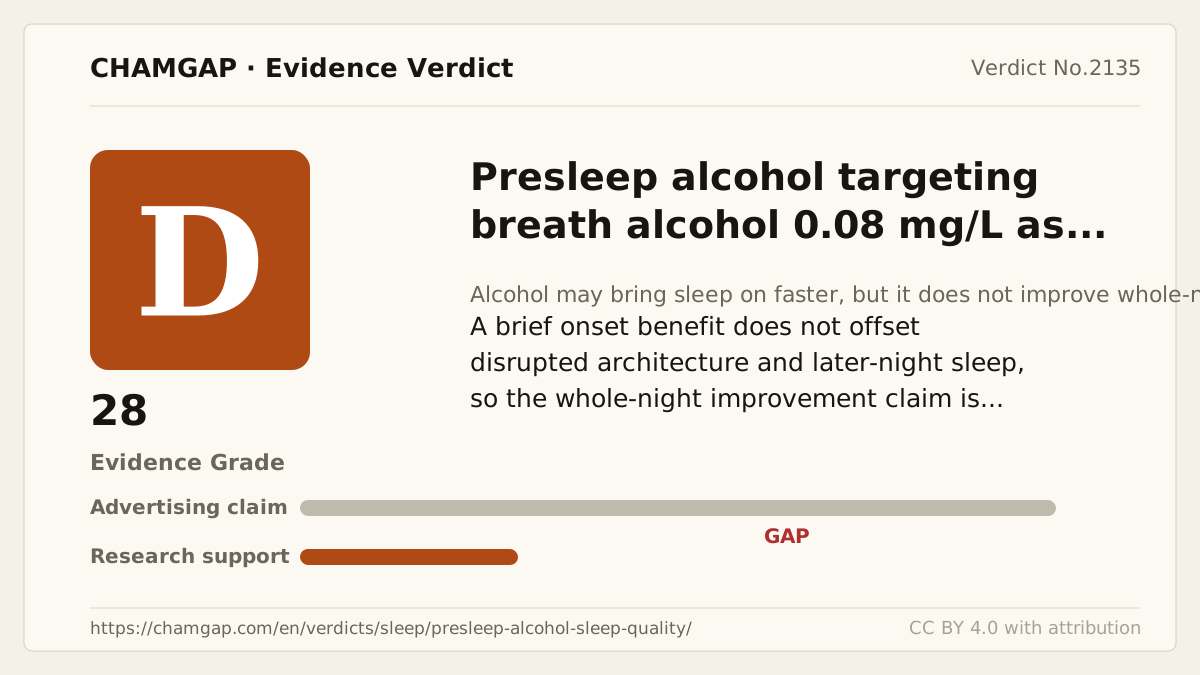
[Chamgap] Alcohol before bed x faster sleep onset and better sleep quality — Evidence Grade D·30. 2 cited sources checked. Source: https://chamgap.com/en/verdicts/sleep/presleep-alcohol-sleep-quality/ · CC BY 4.0CC BY 4.0 — free to use with attribution; do not distort grades, numbers, or verdict meaning.
What this document does and does not do
Chamgap is an information source. It reports what research has and has not confirmed; it does not tell readers what to take or buy. That decision belongs to readers and, when needed, medical or legal professionals. This verdict reflects literature available up to the search date and may change as new research appears. Nothing here is medical advice.