
Pregabalin,
does it really help with Improvement of nocturnal symptoms, periodic limb movements, and sleep disturbance in moderate-to-severe restless legs syndrome?
research showsPregabalin is rated B because it improves nocturnal symptoms and sleep disturbance in moderate-to-severe restless legs syndrome. In a 719-participant randomized double-blind trial, the International Restless Legs Syndrome score fell 4.5 points more than with placebo over 12 weeks, and 71.4% versus 46.8% were rated much or very much improved. A 58-participant placebo-controlled polysomnography trial also improved restless-legs symptoms, the periodic-limb-movement index, and sleep architecture. The 2025 American Academy of Sleep Medicine guideline strongly recommends pregabalin for adult restless legs syndrome, but with moderate certainty. The pivotal large trial was funded by Pfizer and included company employees, direct placebo comparison was mainly 12 weeks, and restless legs syndrome is not an approved indication in Korea, resulting in B with 74 points. This differs completely by indication from the F verdict for pregabalin in sciatica in record 730.
ads claimPromotion can turn an evidence-based restless-legs treatment into a general sleep medicine for unexplained insomnia or any leg discomfort. The evidence applies to diagnosed moderate-to-severe restless legs syndrome and does not replace evaluation of iron deficiency, kidney disease, medication-induced symptoms, or other aggravating factors.
Useful facts when choosing a product
- Restless legs syndrome is not an approved pregabalin indication in Korea, so off-label benefits, risks, and dosing should be discussed before prescribing.
- Dizziness, somnolence, gait instability, blurred vision, weight gain, and peripheral edema are common and can increase driving and fall risks.
- Pregabalin is renally eliminated and requires dose reduction with impaired kidney function, while opioids, alcohol, and other sedatives can amplify sedation and respiratory depression.
- Abrupt discontinuation after longer or higher-dose use can cause insomnia, anxiety, sweating, and other withdrawal symptoms, and misuse or dependence potential favors gradual tapering.
Chamgap Semantic Classification Code
Candidate index · review held
M.pregabalin.UNK.nocturnal-symptoms-periodic-limb-movements-and-sleep-disturbance-in-moderate-to-severe-restless-legs-syndrome.improve.MULTIMedicinal interventions > Pregabalin > Unknown > nocturnal symptoms, periodic limb movements, and sleep disturbance in moderate-to-severe restless legs syndrome > Improvement claim > Multiple: primary unresolved
An automated migration candidate, not an issued permanent code; exact claim scope remains under review. This machine-generated migration candidate helps retrieval but is not a permanent assignment. The original verdict ID and URL remain authoritative.
What the research actually shows
Allen randomized 719 patients with moderate-to-severe restless legs syndrome to pregabalin 300 mg, pramipexole 0.25 mg, pramipexole 0.5 mg, or placebo for 12 weeks followed by active therapy. Pregabalin was superior to placebo on the International Restless Legs Syndrome and Clinical Global Impression outcomes at 12 weeks, and augmentation over 40 to 52 weeks was lower than with pramipexole 0.5 mg. Garcia-Borreguero randomized 58 of 98 patients who had completed a single-blind placebo lead-in to 12 weeks of flexible-dose pregabalin or placebo. Improvement in the symptom score was 63% versus 38.2%, and the periodic-limb-movement index, slow-wave sleep, and wake after sleep onset improved. The 2025 American Academy of Sleep Medicine guideline synthesized this trial set and strongly recommended pregabalin for adults, with moderate certainty.
Why this is classified as B (74)
A large 719-participant trial was positive on direct restless-legs symptoms and clinical response, and a 58-participant polysomnography trial was positive on periodic limb movements and sleep architecture. Pfizer funding and employee involvement in the pivotal trial, a mainly 12-week placebo comparison, a small objective trial, and limited discontinuation data yield B with 74 points. The F verdict for sciatica in record 730 concerns a different indication and was not transferred here.
Counterpoint. Pregabalin can be a reasonable option when dopamine-agonist augmentation is a concern or when pain and insomnia accompany restless legs syndrome. Iron status and aggravating medicines may need correction first, and older adults or people with kidney impairment or fall risk require cautious low-dose titration.
Rejudgment record. New verdict — Accepted direct restless-legs symptom and clinical-response benefits in a 719-participant randomized trial and improvements in periodic limb movements and sleep architecture in a separate polysomnography trial, but applied B because of pivotal-trial industry concentration, mainly 12-week placebo comparison, and limited long-term discontinuation evidence
Sub-claim grades by effect
This ingredient is marketed for several effects. A single overall grade blends strong and weak claims together, so each effect is graded separately here. The overall grade reflects the strongest disconfirming or core claim.
| Effect (sub-claim) | Grade | Basis |
|---|---|---|
| Reduction of nocturnal symptoms in moderate-to-severe restless legs syndrome | B | Direct symptom and global-response endpoints were positive in 719 participants, but pivotal evidence is industry-funded and centered on 12-week placebo comparison. |
| Reduction of periodic limb movements associated with restless legs syndrome | B | The objective polysomnography index fell significantly, but the randomized sample contained only 58 participants. |
| Improvement of sleep disturbance associated with restless legs syndrome | B | Subjective sleep measures and objective slow-wave sleep and wake-after-sleep-onset outcomes improved, but long-term placebo data are limited. |
Cross-check — AI research and Codex final gate
Evidence Table
| Study | Design | Sample | Funding | Endpoint | Result | Weight |
|---|---|---|---|---|---|---|
| Allen RP et al. 2014 | Fifty-two-week randomized double-blind placebo- and active-controlled trial | 719 patients with moderate-to-severe restless legs syndrome | Funded by Pfizer with four employee coauthors | International Restless Legs Syndrome score and Clinical Global Impression response at 12 weeks and augmentation over 40 to 52 weeks | The symptom score fell 4.5 points more than placebo, clinical response was 71.4% versus 46.8%, and augmentation was lower than with pramipexole 0.5 mg. | Pivotal large randomized trial with direct symptom outcomes |
| Garcia-Borreguero D et al. 2010 | Twelve-week double-blind placebo-controlled polysomnography trial | 58 randomized after a 98-patient lead-in | Included authors linked to drug development; detailed funding is reported in the article | International Restless Legs Syndrome, Clinical Global Impression, RLS-6, periodic limb movements, and sleep architecture | Symptom improvement was 63% versus 38.2%, with significant improvements in periodic limb movements, slow-wave sleep, and wake after sleep onset. | Supporting randomized evidence for objective sleep and movement outcomes |
| Winkelman JW et al.; AASM. 2025 | Clinical practice guideline based on systematic evidence review | Synthesis of pharmacologic and nonpharmacologic trials in adult restless legs syndrome and periodic limb movement disorder | American Academy of Sleep Medicine | Restless-legs severity, sleep, quality of life, and adverse events | Strongly recommended pregabalin over no pregabalin in adults, with moderate certainty of evidence. | Evidence synthesis and scope confirmation |
Receipt — 3 References
All 3 cited sources were verified for existence at the original page (as of 2026-07-21).
Final verification and publication gate: Codex · Evidence date: 2026-07-21 · Corrections: none
Cite this verdict
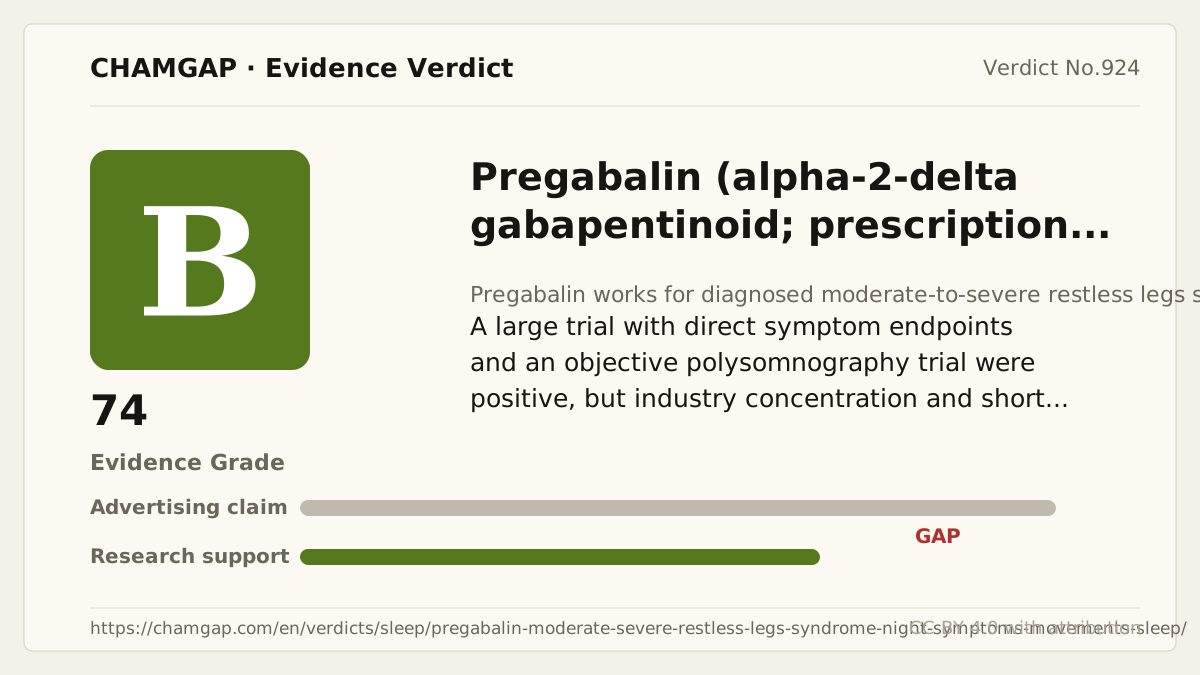
[Chamgap] Pregabalin x improvement of night symptoms, limb movements, and sleep in moderate-to-severe restless legs syndrome — Evidence Grade B·74. 3 cited sources checked. Source: https://chamgap.com/en/verdicts/sleep/pregabalin-moderate-severe-restless-legs-syndrome-night-symptoms-movements-sleep/ · CC BY 4.0CC BY 4.0 — free to use with attribution; do not distort grades, numbers, or verdict meaning.
What this document does and does not do
Chamgap is an information source. It reports what research has and has not confirmed; it does not tell readers what to take or buy. That decision belongs to readers and, when needed, medical or legal professionals. This verdict reflects literature available up to the search date and may change as new research appears. Nothing here is medical advice.