
Pramipexole,
does it really help with Improvement of nocturnal symptoms and sleep satisfaction in moderate-to-severe idiopathic restless legs syndrome?
research showsPramipexole is rated B because it improves short-term nocturnal symptoms and sleep satisfaction versus placebo in moderate-to-severe idiopathic restless legs syndrome. In a 344-participant 12-week randomized trial, every tested dose improved the International Restless Legs Syndrome score and Clinical Global Impression response, with better sleep satisfaction. A meta-analysis of six placebo-controlled trials found a mean symptom-score difference of -5.96 points and a sleep-quality SMD of -0.48. A separate placebo-controlled polysomnography trial also reduced objective periodic limb movements during sleep and wakefulness, so efficacy does not rely on subjective endpoints alone. Evidence is nevertheless mostly limited to 3 to 12 weeks, while longer use can cause augmentation and impulse-control disorders. The 2025 American Academy of Sleep Medicine guideline recognized short-term efficacy but suggested against standard use because of long-term augmentation, yielding B with 75 points. Somnolence, sudden sleep episodes, and orthostatic hypotension remain separate safety concerns.
ads claimMarketing can turn a short-term dopaminergic response into a claim of nightly disease correction or lifelong sleep. The evidence supports improvement over weeks, not continued dose escalation without evaluating iron deficiency, provoking medicines, or augmentation.
Useful facts when choosing a product
- Pramipexole is a prescription D2/D3 dopamine agonist eliminated mainly by the kidneys, and restless-legs dosing differs from Parkinson-disease dosing; clinicians should titrate from a low dose according to diagnosis, kidney function, and symptom timing.
- Nausea, dizziness, somnolence, sudden sleep episodes, and orthostatic hypotension can occur, so driving and hazardous machinery should be avoided until the response is known and alcohol or other sedatives require caution.
- Long-term use can cause augmentation, in which symptoms begin earlier, become more severe, or spread to other body regions. Patients and families should also watch for compulsive gambling, shopping, sexual behavior, or eating.
- Loss of effect or worsening symptoms should not prompt unsupervised dose escalation or abrupt discontinuation; iron status, provoking medicines, and alternative therapy should be reviewed with the prescriber during a taper or switch.
Chamgap Semantic Classification Code
Candidate index · review held
M.pramipexole.UNK.nocturnal-symptoms-and-sleep-satisfaction-in-moderate-to-severe-idiopathic-restless-legs-syndrome.improve.placeboMedicinal interventions > Pramipexole > Unknown > nocturnal symptoms and sleep satisfaction in moderate-to-severe idiopathic restless legs syndrome > Improvement claim > Placebo
An automated migration candidate, not an issued permanent code; exact claim scope remains under review. This machine-generated migration candidate helps retrieval but is not a permanent assignment. The original verdict ID and URL remain authoritative.
What the research actually shows
Winkelman and colleagues in 2006 randomized 344 patients with moderate-to-severe restless legs syndrome to fixed-dose pramipexole or placebo. At 12 weeks, both primary outcomes improved, as did day and night symptoms, sleep satisfaction, and quality of life, while nausea and somnolence were more common. Zhang and colleagues in 2013 synthesized six parallel placebo-controlled trials lasting 3 to 12 weeks and reported a mean symptom-score difference of -5.96 points and a sleep-quality SMD of -0.48. A separate double-blind placebo-controlled polysomnography trial found significant reductions in both the periodic limb movement index during sleep and the index during wakefulness. The 2025 American Academy of Sleep Medicine evidence review confirmed International Restless Legs Syndrome improvement across 10 randomized trials with 2,917 participants, but the clinical guideline suggested against standard use because of augmentation with long-term treatment. Efficacy and long-term safety or treatment preference must be interpreted separately.
Why this is classified as B (75)
A 344-participant trial and a six-trial meta-analysis consistently support improvement in symptom scores, global response, and sleep quality or satisfaction, while placebo-controlled polysomnography also found objective reductions in periodic limb movements during sleep and wakefulness. The evidence is therefore not based on subjective endpoints alone. Pivotal studies are nevertheless mostly 3 to 12 weeks long, many registration trials were industry-sponsored, and long-term augmentation and impulse-control disorders limit net benefit. On the same claim axis as the B-rated pregabalin verdict, clear short-term efficacy but constrained long-term use gives B with 75 points. Somnolence, orthostatic hypotension, and impulse-control disorders are recorded separately under safety.
Counterpoint. Iron deficiency, kidney disease, pregnancy, and medicine-induced secondary causes should be assessed first. In a current user, symptoms beginning earlier in the day or repeated pressure to raise the dose are important clues to augmentation.
Rejudgment record. Cross-check reflected — Accepted consistent improvements in symptom scores, global response, and sleep satisfaction in a 344-participant 12-week trial and a meta-analysis of six placebo-controlled trials, plus objective polysomnographic reductions in periodic limb movements during sleep and wakefulness, while reflecting short-term and industry-centered evidence and long-term augmentation, resulting in B with 75 points
Sub-claim grades by effect
This ingredient is marketed for several effects. A single overall grade blends strong and weak claims together, so each effect is graded separately here. The overall grade reflects the strongest disconfirming or core claim.
| Effect (sub-claim) | Grade | Basis |
|---|---|---|
| Reduction of nocturnal symptoms in moderate-to-severe idiopathic restless legs syndrome | B | Several placebo-controlled trials improved direct symptom, global-response, and day and night outcomes, but pivotal evidence is short-term and industry-centered. |
| Improvement of sleep satisfaction in moderate-to-severe idiopathic restless legs syndrome | B | Sleep satisfaction and quality improved in the 344-participant trial and six-trial meta-analysis, although outcomes were mainly subjective. |
| Sustained long-term improvement of nocturnal restless-legs symptoms and sleep | C | Long-term placebo-controlled efficacy evidence is limited, and augmentation and impulse-control disorders can erode sustained net benefit. |
Cross-check — AI research and Codex final gate
Evidence Table
| Study | Design | Sample | Funding | Endpoint | Result | Weight |
|---|---|---|---|---|---|---|
| Winkelman JW et al. 2006 | Twelve-week multicenter randomized double-blind fixed-dose placebo-controlled trial | 344 patients with moderate-to-severe restless legs syndrome | Pramipexole registration-trial context with company-affiliated coauthors | International Restless Legs Syndrome score, Clinical Global Impression-Improvement, day and night symptoms, sleep satisfaction, and quality of life | Every pramipexole dose outperformed placebo on symptom and global-improvement outcomes and improved day and night symptoms and sleep satisfaction. | Pivotal direct symptom and sleep trial |
| Zhang W et al. 2013 | Systematic review and meta-analysis of placebo-controlled pramipexole trials | Six parallel randomized trials lasting 3 to 12 weeks | Academic meta-analysis with no industry funding reported | International Restless Legs Syndrome score, clinical and patient response, sleep quality, and adverse events | Versus placebo, the mean symptom-score difference was -5.96 points and the sleep-quality SMD was -0.48, while nausea and fatigue increased. | Multi-trial synthesis of symptom and sleep benefit |
| Winkelman JW et al.; AASM. 2025 | Clinical practice guideline based on a systematic evidence review | Ten randomized trials with 2,917 adults in the pramipexole symptom-severity meta-analysis | American Academy of Sleep Medicine | Restless-legs severity, sleep, quality of life, and long-term augmentation | It recognized short-term symptom improvement but conditionally suggested against standard adult use because of long-term augmentation. | Confirms efficacy while limiting long-term net benefit |
Receipt — 3 References
All 3 cited sources were verified for existence at the original page (as of 2026-07-21).
Final verification and publication gate: Codex · Evidence date: 2026-07-21 · Corrections: none
Cite this verdict
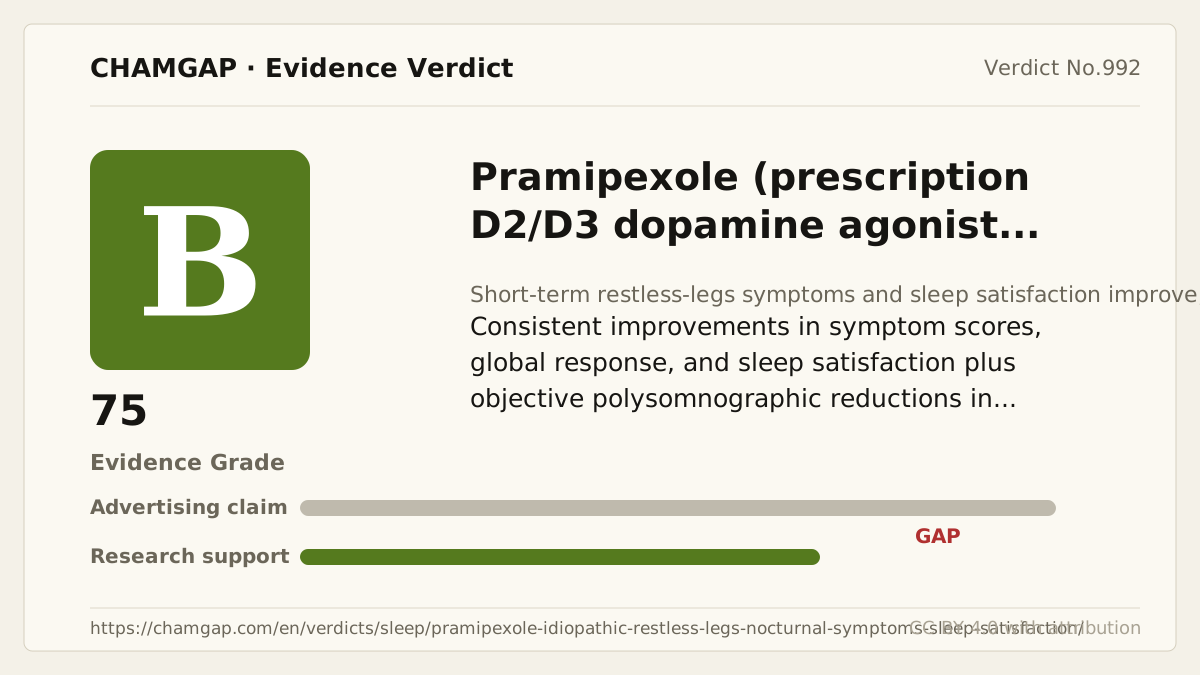
[Chamgap] Pramipexole x improved nocturnal symptoms and sleep satisfaction in moderate-to-severe idiopathic restless legs syndrome — Evidence Grade B·75. 3 cited sources checked. Source: https://chamgap.com/en/verdicts/sleep/pramipexole-idiopathic-restless-legs-nocturnal-symptoms-sleep-satisfaction/ · CC BY 4.0CC BY 4.0 — free to use with attribution; do not distort grades, numbers, or verdict meaning.
What this document does and does not do
Chamgap is an information source. It reports what research has and has not confirmed; it does not tell readers what to take or buy. That decision belongs to readers and, when needed, medical or legal professionals. This verdict reflects literature available up to the search date and may change as new research appears. Nothing here is medical advice.