
Positional therapy device,
does it really help with Reduced apnea-hypopnea index and daytime sleepiness in positional obstructive sleep apnea?
research showsPositional therapy devices are rated C because randomized evidence in positional obstructive sleep apnea found significant short-term improvements in AHI and daytime sleepiness versus inactive control. A 2019 Cochrane review of eight randomized trials and 323 participants found reductions of 7.38 events per hour in AHI and 1.58 points in Epworth Sleepiness Scale score, with moderate certainty for the sleepiness endpoint. However, AHI certainty was low, the sleepiness difference was small, and evidence for long-term adherence, cardiovascular events, or mortality was inadequate.
ads claimShort-term sleep-study improvement from suppressing supine sleep can be expanded into correction of all sleep apnea, durable adherence, or cardiovascular prevention.
Useful facts when choosing a product
- Positional devices detect supine sleep and deliver vibration or use a back support or belt to encourage side sleeping.
- The evidence primarily applies to positional obstructive sleep apnea with a substantially higher supine than nonsupine AHI.
- Sleep disturbance, back or chest discomfort, pressure-related pain, and skin irritation can occur; sensor accuracy and sustained use vary by device.
Chamgap Semantic Classification Code
Candidate index · review held
P.positional-therapy-device.device.apnea-hypopnea-index-and-daytime-sleepiness-in-positional-obstructive-sleep-apnea.reduce.activeProcedures, devices and tests > Positional therapy device > Device delivered > apnea-hypopnea index and daytime sleepiness in positional obstructive sleep apnea > Reduction claim > Active comparator
An automated migration candidate, not an issued permanent code; exact claim scope remains under review. This machine-generated migration candidate helps retrieval but is not a permanent assignment. The original verdict ID and URL remain authoritative.
What the research actually shows
Srijithesh and colleagues included three vibration-alarm trials and five physical-positioning trials. AHI and Epworth scores improved significantly against inactive control, with moderate certainty for sleepiness but low certainty for AHI; quality of life was inadequately assessed and studies were short. Greater AHI reduction with CPAP is a relative active-comparator result and does not negate efficacy versus inactive control. Continuation at two months did not significantly differ from control, while reported discomfort included back or chest pain and sleep disturbance.
Why this is classified as C (44)
Cochrane synthesis found significant AHI and Epworth improvement versus inactive control with moderate certainty for sleepiness, but surrogate and subjective endpoints, low AHI certainty, and limited long-term adherence and hard-outcome evidence give C with 44 points.
Counterpoint. A short-term AHI reduction does not establish fewer cardiovascular events or deaths, and the effect cannot be assumed in nonpositional disease.
Rejudgment record. Cross-check applied — Cochrane synthesis found significant AHI and Epworth improvement versus inactive control, with moderate certainty for sleepiness, so positive randomized evidence supports C. The relative active-comparator result against CPAP was excluded as a reason to deny efficacy, while surrogate and subjective endpoints, low AHI certainty, poor long-term adherence, and absent hard outcomes were reflected in the score
Sub-claim grades by effect
This ingredient is marketed for several effects. A single overall grade blends strong and weak claims together, so each effect is graded separately here. The overall grade reflects the strongest disconfirming or core claim.
| Effect (sub-claim) | Grade | Basis |
|---|---|---|
| Reduction in apnea-hypopnea index | C | AHI decreases significantly versus inactive control, but it is a surrogate endpoint and certainty is low. |
| Improvement in daytime sleepiness and quality of life | C | Epworth scores improved significantly versus inactive control with moderate certainty, but the difference was small and quality-of-life data were inadequate. |
| Reduction in cardiovascular events and mortality | D | Adequate long-term trials evaluating these hard outcomes were not identified. |
Cross-check — AI research and Codex final gate
Evidence Table
| Study | Design | Sample | Funding | Endpoint | Result | Weight |
|---|---|---|---|---|---|---|
| Srijithesh PR, Aghoram R, Goel A, and Dhanya J. 2019 | Cochrane systematic review and meta-analysis of randomized trials | Eight trials and 323 participants; 72 compared with CPAP and 251 with inactive control | Supported by the United Kingdom NIHR through Cochrane Airways | AHI, Epworth score, adherence, quality of life, and adverse effects | Versus inactive control, AHI MD was -7.38 events per hour and Epworth MD was -1.58 points; AHI was 6.4 events per hour higher than with CPAP. | Key synthesis |
| Jackson M, Collins A, Berlowitz D, Howard M, O'Donoghue F, and Barnes M. 2015 | Four-week randomized parallel-group controlled trial | 86 participants with moderate positional obstructive sleep apnea | Australian academic and health research support | Supine sleep time, AHI, sleepiness, quality of life, and blood pressure | AHI fell by 9.9 events per hour in the active group and 5.3 in control (P=0.013), but quality of life, sleepiness, and blood pressure did not significantly improve. | Direct short-term randomized evidence |
Receipt — 2 References
All 2 cited sources were verified for existence at the original page (as of 2026-07-23).
Final verification and publication gate: Codex · Evidence date: 2026-07-23 · Corrections: none
Cite this verdict
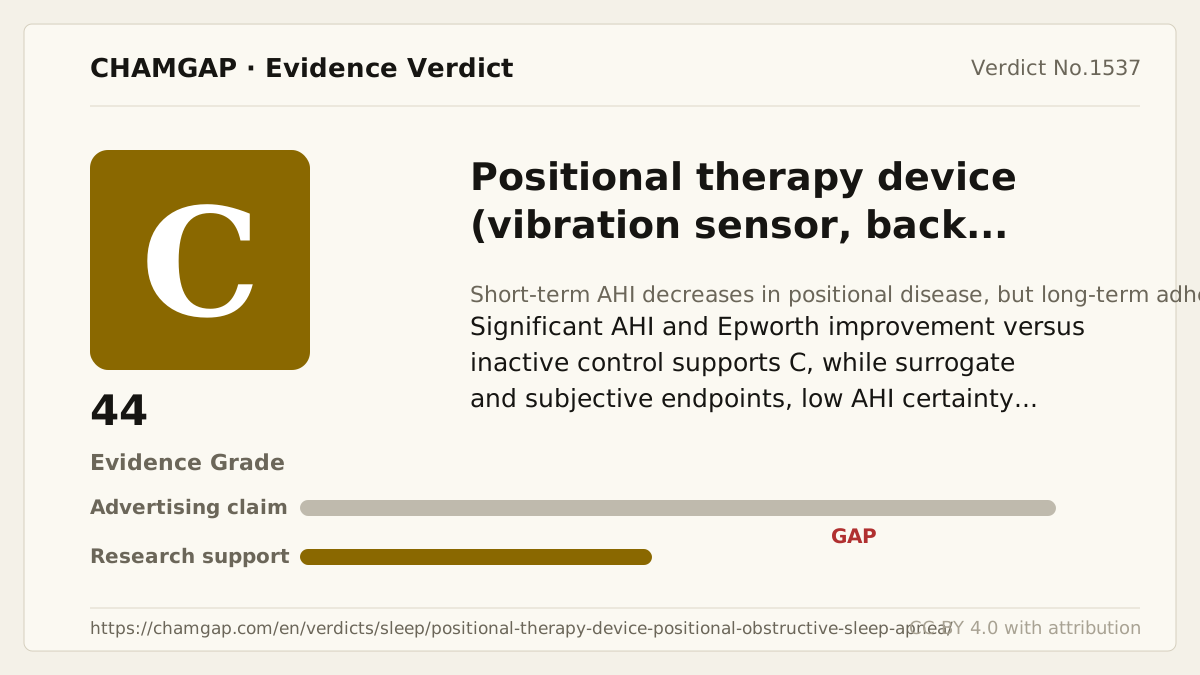
[Chamgap] Positional therapy device x reduced AHI and daytime sleepiness in positional obstructive sleep apnea — Evidence Grade C·44. 2 cited sources checked. Source: https://chamgap.com/en/verdicts/sleep/positional-therapy-device-positional-obstructive-sleep-apnea/ · CC BY 4.0CC BY 4.0 — free to use with attribution; do not distort grades, numbers, or verdict meaning.
What this document does and does not do
Chamgap is an information source. It reports what research has and has not confirmed; it does not tell readers what to take or buy. That decision belongs to readers and, when needed, medical or legal professionals. This verdict reflects literature available up to the search date and may change as new research appears. Nothing here is medical advice.