
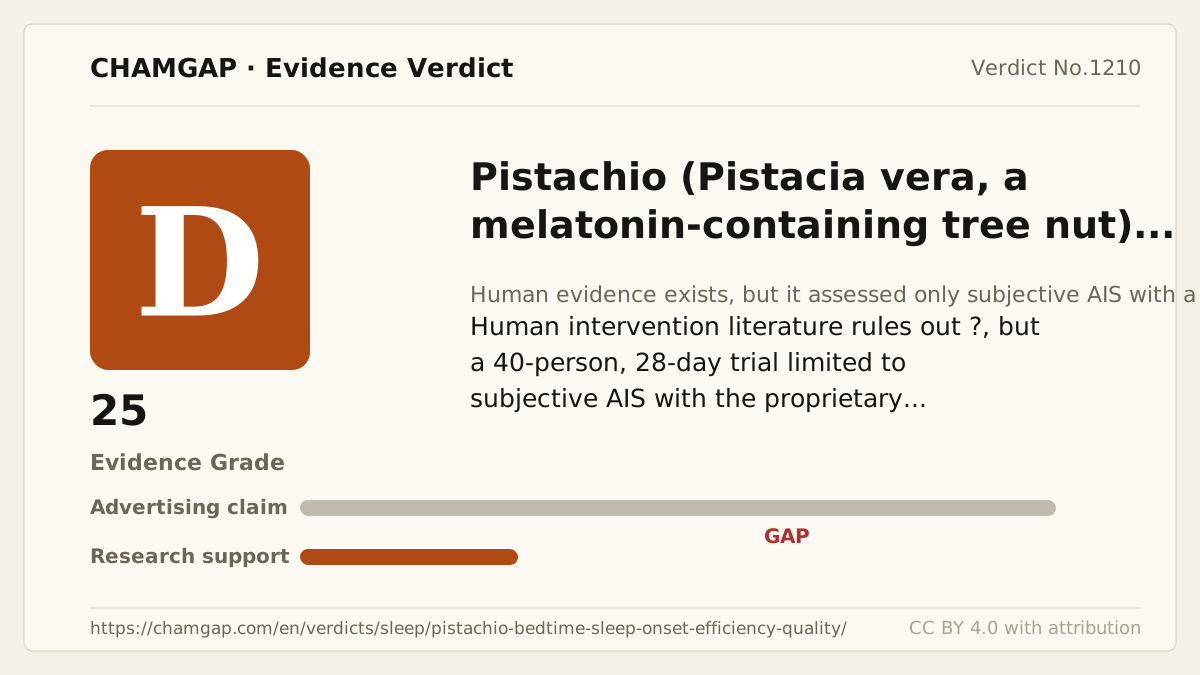
Pistachio,
does it really help with Consumed before bed to shorten sleep onset and improve sleep efficiency and sleep quality?
research showsThe claim has not been demonstrated for ordinary pistachio food. A 2026 RCT of 40 participants over 28 days tested only the manufacturer Botanic Healthcare's proprietary 100-mg Melostacio Gold extract and subjective AIS, with baseline imbalance and no adjusted analysis, so it cannot be generalized to sleep efficacy from whole pistachios. The Columbia whole-pistachio trial NCT07218822 is recruiting and has no results.
ads claimThe claim that a melatonin-containing nut eaten at bedtime directly improves sleep extends a cell mechanism and an unstable subjective result from a branded extract into an objective whole-food effect.
Useful facts when choosing a product
- Ordinary pistachio nuts and a 100-mg branded extract capsule standardized around bioactive content are not equivalent interventions.
- The published extract trial instructed one capsule daily, preferably after dinner, and did not test a bedtime serving of ordinary nuts.
- A trial comparing 56 g/day of whole pistachios with a calorie-matched control food is ongoing, but no efficacy results were available as of 2026-07-23.
- Pistachios are ordinary food, but tree-nut allergy can cause anaphylaxis, and salted products add sodium and calories.
Chamgap Semantic Classification Code
Candidate index · review held
UNK.pistachio.UNK.consumed-before-bed-to-shorten-sleep-onset-and-improve-sleep-efficiency-and-sleep-quality.reduce.placeboUnknown > Pistachio > Unknown > Consumed before bed to shorten sleep onset and improve sleep efficiency and sleep quality > Reduction claim > Placebo
An automated migration candidate, not an issued permanent code; exact claim scope remains under review. This machine-generated migration candidate helps retrieval but is not a permanent assignment. The original verdict ID and URL remain authoritative.
What the research actually shows
A 2026 RCT assigned 40 adults to 100 mg of Melostacio Gold extract or cyclodextrin placebo for 28 days. The reported day-28 AIS total was 11.80 versus 13.80, but baseline AIS was already significantly worse in the treatment group, the analysis compared raw scores at each time point, and separate sleep-onset time, sleep efficiency, and actigraphy outcomes were not reported. A Columbia University crossover RCT of 56 g/day of whole pistachios is recruiting and has no results.
Why this is classified as D (25)
Human intervention literature rules out ?. The only positive evidence is a 40-person, 28-day study of the proprietary Botanic Healthcare extract Melostacio Gold 100 mg, limited to subjective AIS and affected by baseline imbalance, unadjusted raw time-point comparisons, and poor applicability to whole food. NCT07218822 is recruiting with no results, so the grade is D with 25 points.
Counterpoint. Reassessment would be appropriate if the ongoing whole-pistachio crossover trial shows consistent benefit in objective actigraphic sleep efficiency and prespecified subjective scales. The current extract result cannot be restated as faster sleep onset from nuts eaten at bedtime.
Rejudgment record. Cross-check applied — The 2026 human pistachio-extract RCT rules out ?, but the grade is D because it is a single small manufacturer-authored study with baseline imbalance, a subjective composite endpoint, and poor applicability to ordinary pistachios.
Sub-claim grades by effect
This ingredient is marketed for several effects. A single overall grade blends strong and weak claims together, so each effect is graded separately here. The overall grade reflects the strongest disconfirming or core claim.
| Effect (sub-claim) | Grade | Basis |
|---|---|---|
| Shorter sleep-onset time from whole pistachios consumed before bed | D | The extract RCT reported only an AIS total, did not separately or objectively test sleep-onset time, and did not use whole nuts. |
| Improved sleep efficiency | D | The published trial reported no actigraphic or polysomnographic sleep-efficiency result, and the whole-nut trial measuring it is ongoing. |
| Improved sleep quality | D | Only one small subjective composite result from a manufacturer-branded extract was positive, with baseline imbalance and poor applicability to whole food. |
Cross-check — AI research and Codex final gate
Evidence Table
| Study | Design | Sample | Funding | Endpoint | Result | Weight |
|---|---|---|---|---|---|---|
| Shivaprasad et al., Melostacio Gold pistachio-extract sleep RCT (2026) | Randomized double-blind parallel placebo-controlled trial; 100 mg/day for 28 days | 40 adults, 20 per group | All authors were affiliated with the product manufacturer, Botanic Healthcare, which was acknowledged; no separate funding statement was provided | Athens Insomnia Scale total score, stress biomarkers, and quality of life | Baseline AIS was significantly worse in the treatment group (p=0.0003). The raw between-group score was null at day 14 (p=0.466) and 11.80 versus 13.80 at day 28 (P<.0014), but no baseline-adjusted change analysis or objective sleep measure was reported. | Establishes that a human trial exists, but manufacturer linkage, small size, baseline imbalance, analytical limitations, and extract-food mismatch make confidence low. |
| Labani et al., pistachio-extract melatonin-receptor study (2023) | Binding and signaling experiments in HEK293 cells expressing human MT1 and MT2 receptors | Cell study; no human participants | Authors from academic institutions and Sanofi Consumer Healthcare | Melatonin-receptor binding, cAMP and ERK1/2 signaling, and beta-arrestin-2 recruitment | A dried-fruit pistachio extract was active in MT1- and MT2-expressing cells and potentiated exogenous melatonin in selected signaling pathways. | Provides mechanistic plausibility but does not demonstrate effects on human sleep onset, efficiency, or quality. |
| Columbia University whole-pistachio sleep crossover trial (NCT07218822) | Randomized open-label crossover trial; 56 g/day of pistachios versus a calorie-matched control food for four weeks each | Target enrollment 28; recruiting | Led by Columbia University with American Pistachio Growers as collaborator | PSQI, actigraphic sleep fragmentation and efficiency, home sleep testing, and insomnia symptoms | No results were posted as of 2026-07-23, and completion is estimated for August 2027. | The closest direct test of whole pistachios, but pending results cannot support current efficacy. |
Receipt — 3 References
All 3 cited sources were verified for existence at the original page (as of 2026-07-23).
Final verification and publication gate: Codex · Evidence date: 2026-07-23 · Corrections: none
Cite this verdict
[Chamgap] Do bedtime pistachios improve sleep onset and sleep quality? — Evidence Grade D·25. 3 cited sources checked. Source: https://chamgap.com/en/verdicts/sleep/pistachio-bedtime-sleep-onset-efficiency-quality/ · CC BY 4.0CC BY 4.0 — free to use with attribution; do not distort grades, numbers, or verdict meaning.
What this document does and does not do
Chamgap is an information source. It reports what research has and has not confirmed; it does not tell readers what to take or buy. That decision belongs to readers and, when needed, medical or legal professionals. This verdict reflects literature available up to the search date and may change as new research appears. Nothing here is medical advice.