
Oveporexton,
does it really help with Reduced excessive daytime sleepiness and cataplexy in narcolepsy type 1?
research showsOveporexton is rated C because randomized trials show promising reductions in daytime sleepiness and cataplexy in narcolepsy type 1, but the evidence is not yet complete. In the peer-reviewed 112-participant phase 2 trial, the Epworth Sleepiness Scale fell by 8.9 to 13.8 points over eight weeks versus 2.5 points with placebo, and several doses reduced cataplexy. The subsequent FirstLight trial with 168 participants and RadiantLight trial with 105 participants are currently reported in the two-page Sleep 2026 supplement abstract on pages A328 to A329 and a separate conference abstract. No full peer-reviewed phase 3 original article has been identified, and the drug remains unapproved. Rule ①-ⓒ for single, short, or incomplete evidence supports C with 59 points.
ads claimDevelopment messaging may describe a first treatment that corrects the cause of narcolepsy or restores normal wakefulness. The established scope is eight-to-twelve-week improvement in daytime wakefulness, subjective sleepiness, and cataplexy in narcolepsy type 1, not cure, lifelong durability, or absence of long-term risk.
Useful facts when choosing a product
- Oveporexton is an oral selective orexin-2 receptor agonist designed to restore signaling deficient in narcolepsy type 1; it is not a general wellness supplement.
- Trials used protocol-specific once- or twice-daily regimens, and no self-treatment dose outside a clinical or approved setting is established.
- In phase 2, common adverse events were insomnia in 48%, urinary urgency in 33%, and urinary frequency in 32%; insomnia and urinary frequency were also common in phase 3.
- No hepatotoxicity was observed in the phase 2 trial despite concern from an earlier compound in the class, but long-term liver-enzyme and urinary safety still require confirmation.
Chamgap Semantic Classification Code
Candidate index · review held
UNK.oveporexton.oral.excessive-daytime-sleepiness-and-cataplexy-in-narcolepsy-type-1.reduce.placeboUnknown > Oveporexton > Oral > excessive daytime sleepiness and cataplexy in narcolepsy type 1 > Reduction claim > Placebo
An automated migration candidate, not an issued permanent code; exact claim scope remains under review. This machine-generated migration candidate helps retrieval but is not a permanent assignment. The original verdict ID and URL remain authoritative.
What the research actually shows
The peer-reviewed Dauvilliers 2025 phase 2 trial assigned 112 people with narcolepsy type 1 to four oveporexton regimens or placebo for eight weeks. Mean Maintenance of Wakefulness Test latency increased by 12.5 to 25.4 minutes with oveporexton and decreased by 1.2 minutes with placebo; Epworth Sleepiness Scale scores fell by 8.9 to 13.8 points versus 2.5 points. Weekly cataplexy rates were significantly lower at selected doses. FirstLight enrolled 168 participants and RadiantLight enrolled 105 in randomized double-blind twelve-week phase 3 trials. Phase 3 evidence is currently at the conference-abstract stage, comprising the two-page Sleep 2026 supplement abstract on pages A328 to A329 and a separate conference abstract; no full peer-reviewed phase 3 original article has been published. Conference-abstract reported values were placebo-adjusted Maintenance of Wakefulness Test differences of 15.90 and 19.16 minutes, Epworth differences of -8.27 and -9.71 points, and cataplexy rate ratios of 0.28 and 0.32. No independent long-term trial is available.
Why this is classified as C (59)
The peer-reviewed 112-participant phase 2 trial improved wakefulness, sleepiness, and cataplexy, but the FirstLight and RadiantLight phase 3 evidence remains a two-page conference abstract plus a separate conference abstract. With no full peer-reviewed phase 3 article, independent long-term evidence, or approval, rule ①-ⓒ supports C with 59 points.
Counterpoint. For people with narcolepsy type 1, a mechanism aimed at orexin deficiency differs importantly from stimulants and oxybates. Oveporexton remains investigational, and insomnia, urinary urgency or frequency, liver enzymes, concomitant therapies, and long-term outcomes require supervised evaluation.
Rejudgment record. Cross-check applied — Daytime sleepiness and cataplexy are direct treatment targets, but peer-reviewed evidence extends only through the 112-participant eight-week phase 2 trial. FirstLight and RadiantLight phase 3 evidence remains a two-page conference abstract plus a separate conference abstract, with no full peer-reviewed phase 3 article, independent long-term data, or approval; rule ①-ⓒ therefore applies C for single, short, or incomplete evidence
Sub-claim grades by effect
This ingredient is marketed for several effects. A single overall grade blends strong and weak claims together, so each effect is graded separately here. The overall grade reflects the strongest disconfirming or core claim.
| Effect (sub-claim) | Grade | Basis |
|---|---|---|
| Reduced excessive daytime sleepiness in narcolepsy type 1 | C | The Epworth Sleepiness Scale and Maintenance of Wakefulness Test improved in peer-reviewed phase 2 evidence, but both phase 3 trials remain at the conference-abstract stage. |
| Reduced cataplexy in narcolepsy type 1 | C | Selected phase 2 doses and both phase 3 conference abstracts were positive, but no full peer-reviewed phase 3 original article is available. |
| Sustained long-term symptom control | ? | Pivotal placebo-controlled efficacy trials lasted eight to twelve weeks, and confirmatory long-term efficacy literature is not yet available. |
Cross-check — AI research and Codex final gate
Evidence Table
| Study | Design | Sample | Funding | Endpoint | Result | Weight |
|---|---|---|---|---|---|---|
| Dauvilliers Y et al. 2025 | Eight-week randomized double-blind placebo-controlled phase 2 dose-ranging trial | 112 participants; 90 assigned to oveporexton and 22 to placebo | Funded by Takeda Development Center Americas; company employees were coauthors | Week-8 mean sleep latency on the Maintenance of Wakefulness Test, Epworth Sleepiness Scale, weekly cataplexy rate, and adverse events | Wakefulness latency increased by 12.5 to 25.4 minutes versus -1.2 minutes with placebo, and Epworth scores changed by -8.9 to -13.8 points versus -2.5. Weekly cataplexy rates were significantly lower at selected doses. | Key peer-reviewed direct phase 2 evidence |
| Mignot E et al. 2026 FirstLight and RadiantLight pooled analysis | Two-page conference-abstract pooled analysis of two twelve-week randomized double-blind placebo-controlled phase 3 trials | 273 participants; 197 assigned to oveporexton and 76 to placebo | Funded by Takeda Development Center Americas | Week-12 Maintenance of Wakefulness Test, Epworth Sleepiness Scale, and weekly cataplexy rate | Conference-abstract reported values were placebo-adjusted differences of 15.90 and 19.16 minutes for wakefulness and -8.27 and -9.71 points for sleepiness; cataplexy rate ratios were 0.28 and 0.32, all with nominal P<.001. | Positive phase 3 conference abstract, but not a full peer-reviewed original article |
| Takeda FirstLight and RadiantLight topline release. 2025 | Manufacturer phase 3 topline disclosure | 168 participants in FirstLight and 105 in RadiantLight | Takeda development program | All primary and secondary efficacy endpoints and safety at week 12 | The company reported that all primary and secondary endpoints were met at every dose with P<.001. This was a manufacturer disclosure, not an independent peer-reviewed original article. | Initial topline context with source limitations |
Receipt — 3 References
All 3 cited sources were verified for existence at the original page (as of 2026-07-24).
Final verification and publication gate: Codex · Evidence date: 2026-07-24 · Corrections: none
Cite this verdict
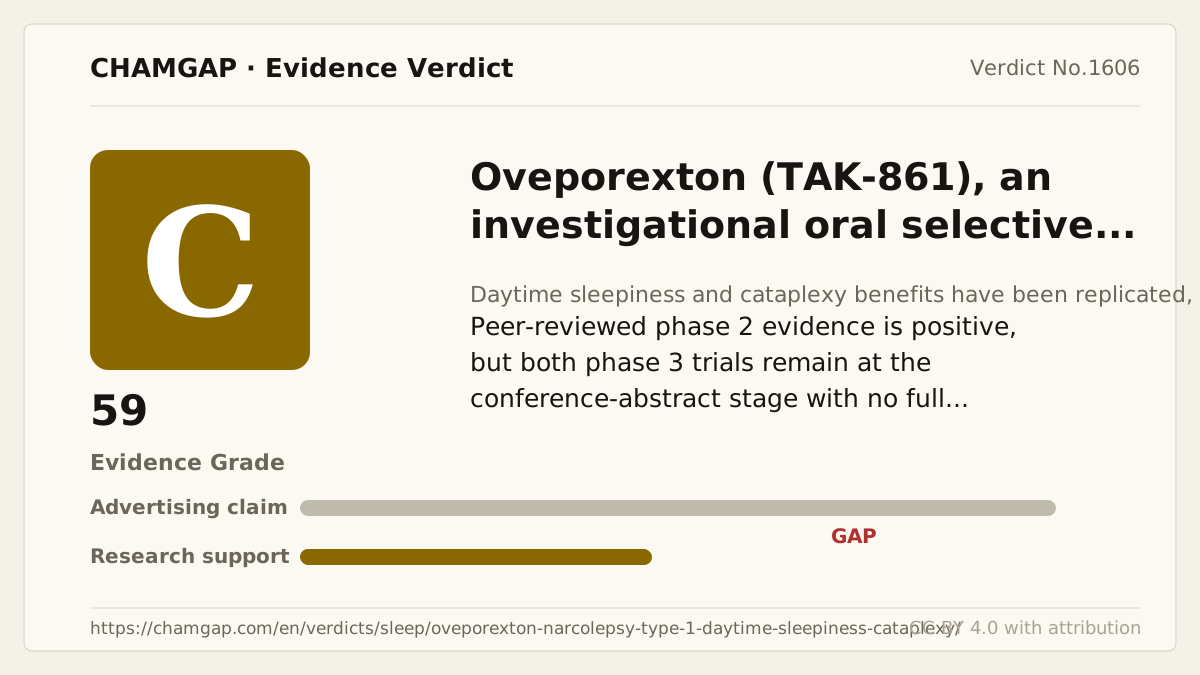
[Chamgap] Oveporexton x reduced daytime sleepiness and cataplexy in narcolepsy type 1 — Evidence Grade C·59. 3 cited sources checked. Source: https://chamgap.com/en/verdicts/sleep/oveporexton-narcolepsy-type-1-daytime-sleepiness-cataplexy/ · CC BY 4.0CC BY 4.0 — free to use with attribution; do not distort grades, numbers, or verdict meaning.
What this document does and does not do
Chamgap is an information source. It reports what research has and has not confirmed; it does not tell readers what to take or buy. That decision belongs to readers and, when needed, medical or legal professionals. This verdict reflects literature available up to the search date and may change as new research appears. Nothing here is medical advice.