
Saffron extract, including affron, sleep-efficacy axis,
does it really help with Improvement of sleep onset and sleep quality?
research showsA 2023 systematic review identified a sleep signal across five RCTs with 379 participants in three countries, and a publicly supported 70-person Tabriz trial also improved PSQI, showing that positive evidence is not entirely manufacturer-funded. A 165-person Safr'Inside trial repeated insomnia and sleep-quality signals. The rating is B because most studies lasted four to eight weeks, emphasized subjective scales, and still showed proprietary-ingredient funding concentration and some null findings.
ads claimDepression or mood evidence for saffron should not be used as direct proof of sleep-onset improvement, and one proprietary extract should not stand for every saffron product.
Useful facts when choosing a product
- Standardized extract doses in sleep trials were generally 14 to 30 mg/day.
- affron and Safr'Inside are different proprietary standardized ingredients and are not equivalent to generic saffron powder.
- Products sold online in Korea vary in extraction, crocin and safranal standardization, and co-ingredients, so equivalence to trial products must be checked.
Chamgap Semantic Classification Code
Candidate index · review held
S.saffron-extract.UNK.sleep-onset-and-sleep-quality.improve.placeboSupplements and nutraceuticals > Saffron extract > Unknown > sleep onset and sleep quality > Improvement claim > Placebo
An automated migration candidate, not an issued permanent code; exact claim scope remains under review. This machine-generated migration candidate helps retrieval but is not a permanent assignment. The original verdict ID and URL remain authoritative.
What the research actually shows
The 2023 systematic review identified five RCTs with 379 participants across three countries. An eight-week trial in 70 patients, supported by Tabriz University of Medical Sciences, reported improved PSQI. A four-week RCT of Safr'Inside at 20 or 30 mg/day in 165 adults repeated insomnia-scale and sleep-quality signals. Other sleep-specific RCTs generally lasted four to six weeks, emphasized subjective scales, and provided limited objective measurement.
Why this is classified as B (64)
Replication across countries and RCTs plus the positive publicly supported Tabriz trial remove the previous C-cap premise. Short duration, subjective scales, proprietary-ingredient funding concentration, and some null findings prevent A, yielding B with 64 points.
Counterpoint. An independent long-term multicenter trial with validated objective sleep measurement is needed for an upgrade.
Rejudgment record. Reassessment (cross-check reflected) — Recognized replication across sleep-specific RCTs including the publicly supported Tabriz trial, with deductions for short subjective outcomes and proprietary-ingredient funding concentration
Sub-claim grades by effect
This ingredient is marketed for several effects. A single overall grade blends strong and weak claims together, so each effect is graded separately here. The overall grade reflects the strongest disconfirming or core claim.
| Effect (sub-claim) | Grade | Basis |
|---|---|---|
| Improvement of subjective sleep quality | B | Repeated signal across short proprietary-ingredient RCTs |
| Shortening of sleep-onset latency | B | Self-report data and a small consumer-EEG pilot |
Cross-check — AI research and Codex final gate
Evidence Table
| Study | Design | Sample | Funding | Endpoint | Result | Weight |
|---|---|---|---|---|---|---|
| Sadat Rafiei et al. (2023), Nutrition and Metabolic Insights | Systematic review of randomized trials | 379 | Reported no financial support and no conflicts of interest | Sleep quality and duration | Most trials showed a positive signal, with limitations from short duration, subjective scales, and between-study differences | Moderate |
| Tajaddini et al. (2021), International Journal of Clinical Practice | Randomized double-blind placebo-controlled trial, eight weeks | 70 | Public support from Tabriz University of Medical Sciences | Pittsburgh Sleep Quality Index | PSQI improved more with saffron 100 mg/day than with placebo | Moderate |
| Lopresti et al. (2020), Journal of Clinical Sleep Medicine | Randomized double-blind placebo-controlled trial, 28 days | 55 | Funded by Pharmactive, which supplied affron | Insomnia Severity Index, Restorative Sleep Questionnaire, and sleep diary | ISI, restorative sleep, and diary sleep quality improved versus placebo; endpoints were primarily subjective | Moderate |
| Lopresti et al. (2021), Sleep Medicine | Randomized double-blind placebo-controlled multidose trial, 28 days | 120 | Pharmactive-linked affron trial | Sleep diaries, sleep questionnaires, cortisol, and melatonin | Some subjective sleep-quality improvement at 14 and 28 mg; several other diary and hormonal outcomes were limited | Moderate |
| Schuster et al. (2025), Sleep Medicine X | Decentralized randomized double-blind placebo-controlled trial, four weeks | 158 | Financially supported by and conducted with collaboration from Activ'Inside | Primary Athens Insomnia Scale endpoint | The pooled saffron groups showed a small significant difference versus placebo; separate 20 mg and 30 mg comparisons were nonsignificant after multiplicity control | Moderate |
| Lang et al. (2025), Food & Function | Randomized double-blind placebo-controlled pilot, four weeks | 52 | Public UKRI support; Activ'Inside employees were authors and supplied the ingredient | Pittsburgh Sleep Quality Index and consumer EEG-based sleep measures | Signals in subjective sleep quality and selected objective sleep-onset latency measures; small pilot | Moderate-low |
| Lopresti and Smith (2026), Frontiers in Nutrition | Randomized double-blind placebo-controlled trial with mood as the primary endpoint, 12 weeks | 86 | Funded by Pharmactive, which participated in initial concept and design | Primary mood endpoint and secondary sleep-disturbance endpoint | Mood improved, but the sleep-disturbance secondary endpoint was null at p=0.786; it was not repurposed as positive sleep evidence | Low |
Receipt — 7 References
All 7 cited sources were verified for existence at the original page (as of 2026-07-16).
Final verification and publication gate: Codex · Evidence date: 2026-07-16 · Corrections: none
Cite this verdict
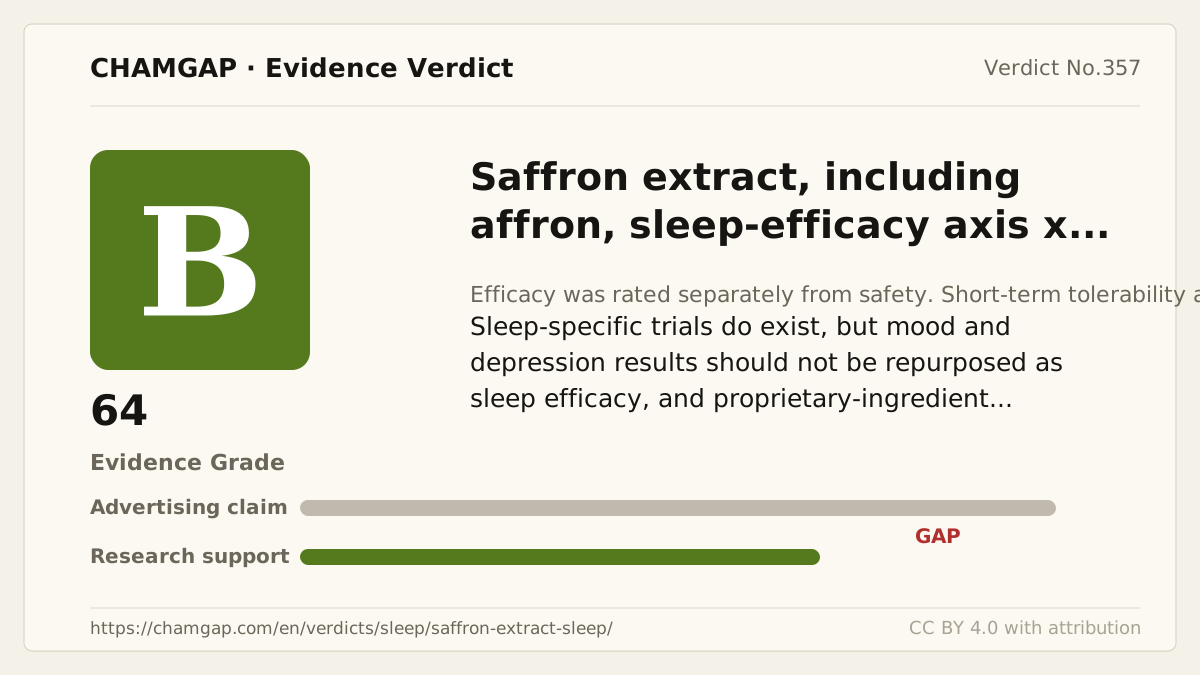
[Chamgap] Does saffron extract improve sleep onset and sleep quality? — Evidence Grade B·64. 7 cited sources checked. Source: https://chamgap.com/en/verdicts/sleep/saffron-extract-sleep/ · CC BY 4.0CC BY 4.0 — free to use with attribution; do not distort grades, numbers, or verdict meaning.
What this document does and does not do
Chamgap is an information source. It reports what research has and has not confirmed; it does not tell readers what to take or buy. That decision belongs to readers and, when needed, medical or legal professionals. This verdict reflects literature available up to the search date and may change as new research appears. Nothing here is medical advice.