
Mandibular advancement device,
does it really help with Improvement of apnea, daytime sleepiness, and snoring in mild-to-moderate obstructive sleep apnea?
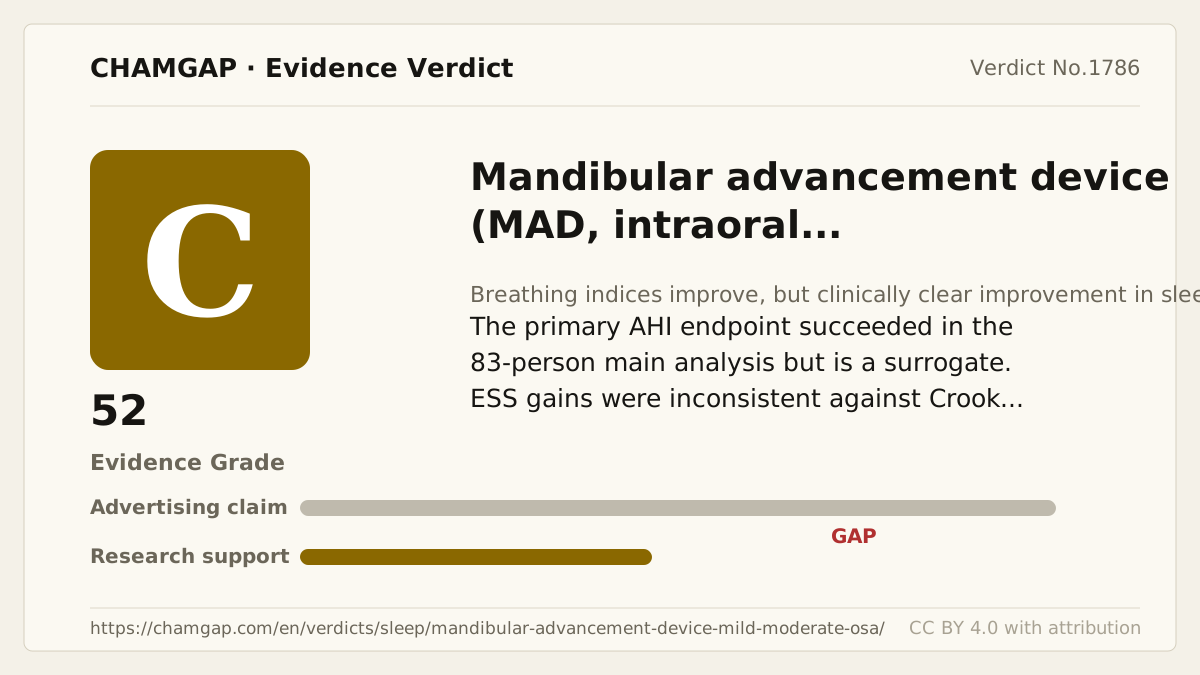
research showsMandibular advancement devices lower AHI, but AHI is a surrogate for clinical benefit, so rule 1-a caps the grade at C. TOMADO randomized 90 participants; seven had no data, 83 with at least one period formed the main analysis, and 74 complete cases were used in additional sensitivity analysis. The primary AHI endpoint succeeded. ESS gains of 1.51 to 2.37 points were inconsistent against the 2-point OSA MID from Crook 2019 and the 2-to-3-point estimate from Patel 2018.
ads claimMarketing can expand a lower AHI into cure, deeper sleep, and cardiovascular protection. The verified scope is short-term respiratory improvement and small or borderline improvement in sleepiness.
Useful facts when choosing a product
- Custom titratable devices hold the mandible forward to reduce upper-airway collapse during sleep.
- Temporomandibular discomfort, dental pain, salivary changes, and long-term bite changes can occur and warrant dental follow-up.
Chamgap Semantic Classification Code
Candidate index · review held
P.mandibular-advancement-device.device.apnea-daytime-sleepiness-and-snoring-in-mild-to-moderate-obstructive-sleep-apnea.improve.MULTIProcedures, devices and tests > Mandibular advancement device > Device delivered > apnea, daytime sleepiness, and snoring in mild-to-moderate obstructive sleep apnea > Improvement claim > Multiple: primary unresolved
An automated migration candidate, not an issued permanent code; exact claim scope remains under review. This machine-generated migration candidate helps retrieval but is not a permanent assignment. The original verdict ID and URL remain authoritative.
What the research actually shows
TOMADO randomized 90 people in a crossover trial; seven had no data, 83 with at least one period formed the main analysis, and 74 complete cases were used for additional sensitivity analysis. The primary AHI endpoint succeeded for all three devices. The ESS benchmark prioritizes Crook 2019's 2-point OSA MID while also reporting Patel 2018's 2-to-3-point estimate. Chamgap CPAP verdicts also differ by endpoint: verdict 1179, which is F with 9 points, addresses recurrent cardiovascular events; verdict 1212, which is B with 72 points, addresses sleepiness, function, and quality of life; and verdict 1764, which is C with 56 points, addresses 24-hour blood pressure. Nondevice interventions also differ: verdict 1128, which is D with 35 points, concerns sleep mouth tape, while verdict 1188, which is D with 28 points, concerns nasal strips.
Why this is classified as C (54)
The primary AHI endpoint succeeded in the main analysis of 83 participants with available data, while 74 complete cases were used in additional sensitivity analysis. AHI is a surrogate and rule 1-a caps the grade at C. ESS gains of 1.51 to 2.37 points were inconsistent against Crook 2019's preferred 2-point OSA MID and Patel 2018's 2-to-3-point estimate, resulting in C with 54 points.
Counterpoint. A custom device can be a reasonable option for patients with mild-to-moderate disease who cannot tolerate or prefer not to use CPAP, with post-treatment sleep testing to verify response.
Rejudgment record. Cross-check applied — Applied the surrogate ceiling to the successful primary AHI endpoint in the 83-person available-data main analysis and assessed ESS against Crook 2019's 2-point MID plus Patel 2018's 2-to-3-point estimate
| Endpoint | S | Surrogate marker - laboratory or imaging measures |
| Replication | R2 | Independently replicated across trials |
| Independence | I2 | Decisive evidence is publicly or non-profit funded |
| Effect size | E~ | Statistically positive but below the threshold |
Stored derived and displayed grades match; this is not a current recalculation or validity check (C).
Sub-claim grades by effect
This ingredient is marketed for several effects. A single overall grade blends strong and weak claims together, so each effect is graded separately here. The overall grade reflects the strongest disconfirming or core claim.
| Effect (sub-claim) | Grade | Basis |
|---|---|---|
| Reduction of AHI in mild-to-moderate obstructive sleep apnea | C | The signal is replicated, but AHI is a surrogate. |
| Improvement in daytime sleepiness | C | ESS is a direct symptom outcome, but TOMADO did not consistently reach the MCID. |
| Improvement in snoring | C | Short-term signals exist, but measurements and devices are heterogeneous. |
Cross-check — AI research and Codex final gate
Evidence Table
| Study | Design | Sample | Funding | Endpoint | Result | Weight |
|---|---|---|---|---|---|---|
| Quinnell TG et al. 2014 | Open-label randomized controlled crossover trial | 90 randomized; seven with no data; 83 in the available-data main analysis; 74 complete cases in additional sensitivity analysis | Public funding from the United Kingdom NIHR Health Technology Assessment programme | Primary AHI; secondary ESS and quality of life | Primary AHI succeeded with reductions of 26%, 33%, and 36%; ESS gains of 1.51 to 2.37 points were inconsistent against Crook 2019's 2-point MID and Patel 2018's 2-to-3-point estimate. | Key direct trial |
| Petri N et al. 2008 | Parallel randomized trial with a sham oral appliance | 93 randomized; 81 completed | Funding source not reported in the abstract | AHI, ESS, and SF-36 | The advancement appliance improved AHI and ESS versus sham and no intervention. | Independent replication |
Receipt — 2 References
All 2 cited sources were verified for existence at the original page (as of 2026-07-24).
Final verification and publication gate: Codex · Evidence date: 2026-07-24 · Corrections: none
Cite this verdict
[Chamgap] Mandibular advancement device x mild-to-moderate obstructive sleep apnea — Evidence Grade C·54. 2 cited sources checked. Source: https://chamgap.com/en/verdicts/sleep/mandibular-advancement-device-mild-moderate-osa/ · CC BY 4.0CC BY 4.0 — free to use with attribution; do not distort grades, numbers, or verdict meaning.
What this document does and does not do
Chamgap is an information source. It reports what research has and has not confirmed; it does not tell readers what to take or buy. That decision belongs to readers and, when needed, medical or legal professionals. This verdict reflects literature available up to the search date and may change as new research appears. Nothing here is medical advice.