
Light-blocking eye mask,
does it really help with Improved sleep onset, sleep maintenance, and subjective sleep quality in adults by blocking light?
research showsLight-blocking eye masks are rated D for improving sleep in adults. Small hospital and ICU studies and meta-analyses show signals in subjective sleep scores, but many combine masks with earplugs and address unusually bright or noisy inpatient environments. A 100-participant postoperative trial found no improvement in sleep quality, and objective evidence for sleep onset and maintenance in adults sleeping at home is sparse.
ads claimClaims that complete blackout guarantees immediate sleep, prevents all awakenings, or treats insomnia exceed the evidence. Short-term subjective scores in hospitals are not equivalent to treatment of chronic insomnia at home.
Useful facts when choosing a product
- A light-blocking eye mask physically reduces ambient light reaching the eyes. It is a nonmedical accessory and is not approved as an insomnia treatment.
- Actual light blocking, fit, comfort, and whether the mask stays in place during sleep can strongly affect adherence and any benefit.
- Systemic harm is unlikely, but excessive pressure, skin irritation, heat or sweating, headache, and facial discomfort can occur.
- Persistent insomnia, loud snoring or apnea, or excessive daytime sleepiness requires evaluation rather than concealment with a mask.
Chamgap Semantic Classification Code
Candidate index · review held
UNK.light-blocking-eye-mask.UNK.sleep-onset-sleep-maintenance-and-subjective-sleep-quality-by-blocking-light.improve.UNKUnknown > Light-blocking eye mask > Unknown > sleep onset, sleep maintenance, and subjective sleep quality by blocking light > Improvement claim > Unknown
An automated migration candidate, not an issued permanent code; exact claim scope remains under review. This machine-generated migration candidate helps retrieval but is not a permanent assignment. The original verdict ID and URL remain authoritative.
What the research actually shows
Fang and colleagues synthesized 13 studies with 797 ICU patients and reported improved sleep quality with eye masks or earplugs, but single and combined interventions were mixed and subjective scales predominated. The 60-person cardiac-unit trial by Babaii and colleagues reported improvements after three nights in subjective quality, latency, duration, efficiency, and disturbances. In a 100-person abdominal-surgery trial by Leong and colleagues, eye masks plus earplugs did not improve Richards-Campbell sleep scores, and adherence was 60% to 65%. A 2023 study in healthy adults mainly evaluated memory and next-day alertness and does not directly confirm the sleep-onset and maintenance claim assessed here.
Why this is classified as D (32)
Subjective positive signals in inpatient settings are acknowledged, but eye-mask isolation, populations, scales, and outcomes are heterogeneous, and a 100-person postoperative trial was negative. Objective evidence for sleep onset and maintenance at home is sparse, resulting in D with 32 points.
Counterpoint. A person unable to darken the bedroom adequately can try a comfortable mask as a low-risk environmental measure.
Rejudgment record. New verdict — Acknowledged short-term subjective inpatient signals but applied D for combined eye-mask and earplug interventions, special-population indirectness, measurement heterogeneity, a negative 100-person postoperative trial, and sparse direct objective evidence in adults at home
Sub-claim grades by effect
This ingredient is marketed for several effects. A single overall grade blends strong and weak claims together, so each effect is graded separately here. The overall grade reflects the strongest disconfirming or core claim.
| Effect (sub-claim) | Grade | Basis |
|---|---|---|
| Improved sleep onset through light blocking | D | Some inpatient subjective latency signals exist, but direct objective evidence in adults at home is sparse. |
| Improved sleep maintenance | D | Most evidence uses combined inpatient interventions, and awakenings or objective maintenance outcomes are inconsistent. |
| Improved subjective sleep quality | D | Small positive studies exist, but meta-analytic heterogeneity and a negative 100-person trial limit confidence. |
Cross-check — AI research and Codex final gate
Evidence Table
| Study | Design | Sample | Funding | Endpoint | Result | Weight |
|---|---|---|---|---|---|---|
| Fang CS et al. 2021 | Systematic review and meta-analysis of ICU studies | 13 studies and 797 patients | Academic review; funding varied among included studies | Subjective and selected objective sleep-quality measures | Eye masks and/or earplugs produced an overall signal of improved sleep quality. | Synthesis limited by combination interventions, heterogeneity, and inpatient indirectness |
| Babaii A et al. 2015 | Randomized controlled trial | 60 cardiac-unit patients | University research support | PSQI and component scores after three nights | The mask group improved in subjective quality, latency, duration, efficiency, and disturbance scores. | Positive mask-only study limited by size, special population, and subjective outcomes |
| Leong RW et al. 2021 | Randomized controlled trial | 100 abdominal-surgery patients | No reported commercial intervention | Richards-Campbell Sleep Questionnaire | Combined earplugs and eye masks did not significantly improve sleep scores. | Direct negative inpatient randomized trial |
Receipt — 3 References
All 3 cited sources were verified for existence at the original page (as of 2026-07-23).
Final verification and publication gate: Codex · Evidence date: 2026-07-23 · Corrections: none
Cite this verdict
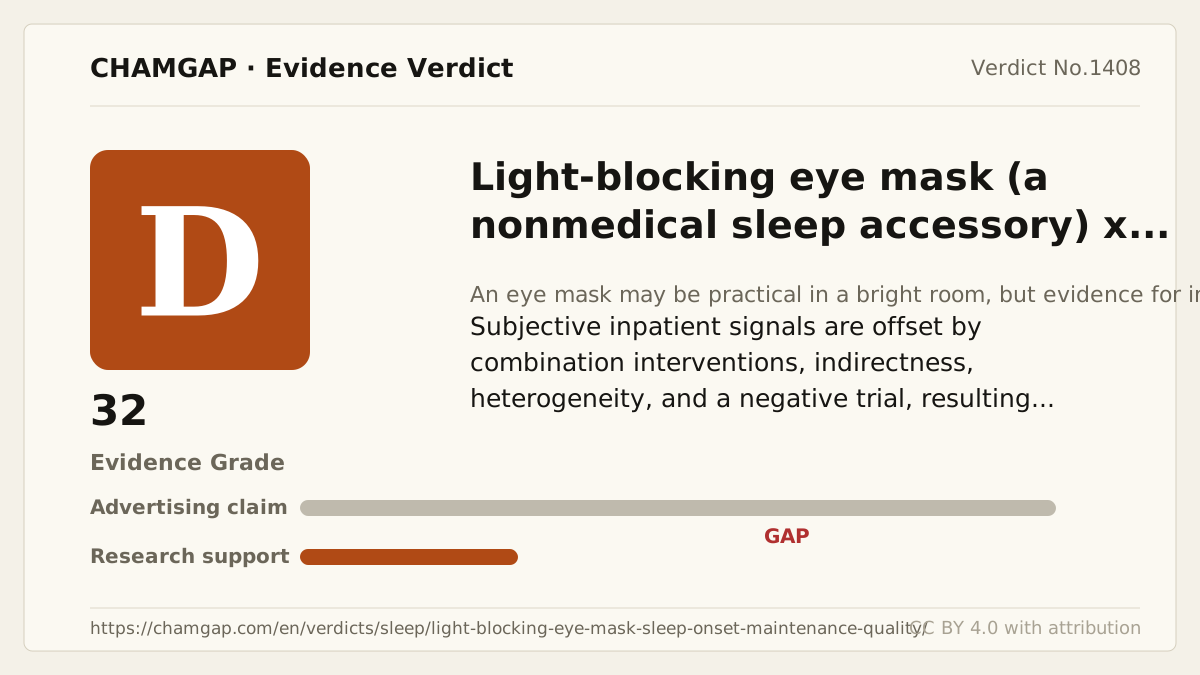
[Chamgap] Light-blocking eye mask x improved sleep onset, maintenance, and subjective quality in adults — Evidence Grade D·32. 3 cited sources checked. Source: https://chamgap.com/en/verdicts/sleep/light-blocking-eye-mask-sleep-onset-maintenance-quality/ · CC BY 4.0CC BY 4.0 — free to use with attribution; do not distort grades, numbers, or verdict meaning.
What this document does and does not do
Chamgap is an information source. It reports what research has and has not confirmed; it does not tell readers what to take or buy. That decision belongs to readers and, when needed, medical or legal professionals. This verdict reflects literature available up to the search date and may change as new research appears. Nothing here is medical advice.