
Later school start time,
does it really help with Longer total sleep on school nights in adolescents?
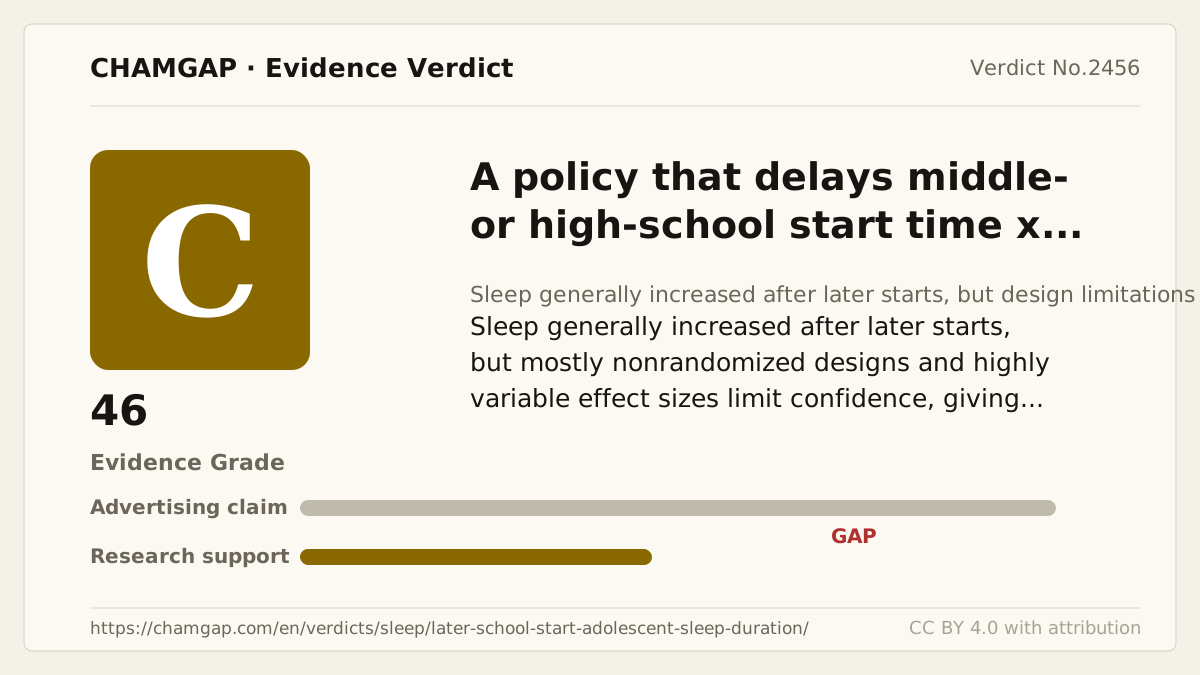
research showsThe grade is C. The Cochrane-Campbell review covered 11 studies and about 298,000 students, but only one was cluster randomized; most were controlled before-after comparisons or policy natural experiments. Two comparable studies found 1.39 more hours of self-reported school-night sleep (95% CI 0.38 to 2.39), with extreme heterogeneity, I-squared 96% to 97%.
ads claimKorean debates over 9 a.m. starts concern whole-school scheduling, transport, care, and after-school activities. An optional late arrival or weekend sleep-in is not the same intervention. Recommendations were not used as grading evidence.
Useful facts when choosing a product
- Interventions delayed school start by 15 to about 90 minutes.
- Only one of 11 studies was cluster randomized; most were policy natural experiments or nonrandomized comparisons.
- School-night sleep was mainly self-reported.
Chamgap Semantic Classification Code
Candidate index · review held
X.policy-that-delays-middle-or-high-school-start-time.policy.longer-total-sleep-on-school-nights.assess.UNKBehaviors, exposures and policies > policy that delays middle- or high-school start time > Policy implementation > Longer total sleep on school nights > Association or change assessment > Unknown
An automated migration candidate, not an issued permanent code; exact claim scope remains under review. This machine-generated migration candidate helps retrieval but is not a permanent assignment. The original verdict ID and URL remain authoritative.
What the research actually shows
The review included 17 reports of 11 unique studies and 297,994 students. Delays ranged from 15 to about 90 minutes over two weeks to one year. Two studies with 1,022 students pooled to 1.39 additional hours of school-night sleep. Another comparison reported at least eight hours of sleep in 58.7% versus 49.7%, and each 30-minute delay before 8:00 was associated with OR 1.52 (95% CI 1.16 to 1.98) for at least eight hours. Daytime sleepiness was OR 0.48 (0.30 to 0.75) in one study but Epworth mean difference 0.00 (-0.56 to 0.56) in another. Consistent absolute wake-time and tardiness data were not available. No trial registration number was confirmed. The acknowledgements state editorial and financial support from the Campbell Education Group, salary support from the Canadian Institutes of Health Research and Population Health Improvement Research Network, and in-kind assistance from the Toronto District School Board.
Why this is classified as C (46)
Most studies were observational or natural experiments, and funding for all pivotal studies could not be confirmed, giving C with 46 points.
Counterpoint. C does not mean no effect. It means the positive average cannot be assigned a precise, broadly causal magnitude from this evidence.
Rejudgment record. Cross-check applied — A systematic review dominated by nonrandomized policy natural experiments with extreme heterogeneity in sleep duration
| Endpoint | P | Symptom or function itself is the target - including patient reports and performance tests |
| Replication | R1 | Single confirmatory trial |
| Independence | I1 | Mixed funding sources |
| Effect size | EX | The clinical size of the effect could not be judged |
Stored derived and displayed grades match; this is not a current recalculation or validity check (C).
Sub-claim grades by effect
This ingredient is marketed for several effects. A single overall grade blends strong and weak claims together, so each effect is graded separately here. The overall grade reflects the strongest disconfirming or core claim.
| Effect (sub-claim) | Grade | Basis |
|---|---|---|
| Longer school-night sleep | C | The pooled MD was 1.39 hours, with I-squared 96% to 97%. |
| Reduced daytime sleepiness | C | One study was positive and another null. |
| Reduced tardiness or absence | C | Results varied and no consistent pooled absolute estimate was available. |
Cross-check — AI research and Codex final gate
Evidence Table
| Study | Design | Sample | Funding | Endpoint | Result | Weight |
|---|---|---|---|---|---|---|
| Marx et al. Cochrane-Campbell systematic review 2017 | One cluster randomized trial, three controlled before-after studies, and seven nonrandomized comparisons or natural experiments | 11 unique studies and 297,994 participants; sleep-duration pooling used two studies and 1,022 participants | Editorial and financial support from the Campbell Education Group; salary support from the Canadian Institutes of Health Research and Population Health Improvement Research Network; in-kind support from the Toronto District School Board | School-night sleep duration, wake time, daytime sleepiness or alertness, absence and tardiness | Sleep-duration MD 1.39 hours (95% CI 0.38 to 2.39), I-squared 96% to 97%; other outcomes were unpooled or mixed | Pivotal systematic review |
Receipt — 2 References
All 2 cited sources were verified for existence at the original page (as of 2026-08-08).
Final verification and publication gate: Codex · Evidence date: 2026-08-08 · Corrections: none
Cite this verdict
[Chamgap] Later school start time x longer adolescent sleep — Evidence Grade C·46. 2 cited sources checked. Source: https://chamgap.com/en/verdicts/sleep/later-school-start-adolescent-sleep-duration/ · CC BY 4.0CC BY 4.0 — free to use with attribution; do not distort grades, numbers, or verdict meaning.
What this document does and does not do
Chamgap is an information source. It reports what research has and has not confirmed; it does not tell readers what to take or buy. That decision belongs to readers and, when needed, medical or legal professionals. This verdict reflects literature available up to the search date and may change as new research appears. Nothing here is medical advice.