
L-ornithine,
does it really help with Improvement of sleep quality related to stress and fatigue?
research showsA 52-person trial in healthy workers found improvements in selected OSA-MA sleep domains and stress-hormone markers after 400 mg/day for eight weeks. The rating is C because this is one small study concentrated among Kirin and Kyowa investigators, relies on questionnaires and cortisol-related measures, and provides no objective sleep-architecture data such as polysomnography.
ads claimMarketing can turn phrases such as 'sleep amino acid,' 'deeper sleep by lowering cortisol,' and 'fatigue-recovery sleep' into claims of objective sleep improvement. Direct evidence is concentrated in one 52-person trial in a selected population.
Useful facts when choosing a product
- Korean online and cross-border retail listings include standalone 500 mg L-ornithine capsules and arginine-ornithine combinations.
- The pivotal sleep trial used 400 mg/day of L-ornithine before bedtime for eight weeks.
- Standalone L-ornithine, L-ornithine-L-aspartate, and arginine-ornithine blends are not equivalent products.
- No prominent serious safety signal appeared in the short 52-person trial, but long-term data and data in patients and during pregnancy or lactation are limited.
Chamgap Semantic Classification Code
Candidate index · review held
UNK.l-ornithine.UNK.sleep-quality-related-to-stress-and-fatigue.improve.placeboUnknown > L-ornithine > Unknown > sleep quality related to stress and fatigue > Improvement claim > Placebo
An automated migration candidate, not an issued permanent code; exact claim scope remains under review. This machine-generated migration candidate helps retrieval but is not a permanent assignment. The original verdict ID and URL remain authoritative.
What the research actually shows
The 2014 trial by Miyake and colleagues randomized 52 Japanese workers with mild stress and fatigue to L-ornithine at 400 mg/day or placebo before bedtime for eight weeks. It assessed serum cortisol and DHEA-S, POMS, AIS, and OSA-MA and reported positive signals in selected OSA-MA domains and the cortisol-to-DHEA-S ratio. Author affiliations included Kirin laboratories, Kyowa Hakko Bio, and academic institutions. No trial directly measuring objective sleep stages or nocturnal awakenings was identified.
Why this is classified as C (40)
The existence of a randomized trial prevents a deferred rating, and a positive signal prevents D. A single small manufacturer-linked study, subjective outcomes, stress surrogates, no objective sleep testing, and absent independent replication support C with 40 points.
Counterpoint. An adequately powered independent trial combining actigraphy or polysomnography with validated insomnia scales is needed to judge objective sleep efficacy.
Rejudgment record. New verdict — Accepted subjective sleep and stress signals from the 52-person manufacturer-linked trial but applied rules ① and ②-b because objective sleep architecture and independent replication are absent
Sub-claim grades by effect
This ingredient is marketed for several effects. A single overall grade blends strong and weak claims together, so each effect is graded separately here. The overall grade reflects the strongest disconfirming or core claim.
| Effect (sub-claim) | Grade | Basis |
|---|---|---|
| Subjective sleep quality and stress | C | A 52-person manufacturer-linked trial was positive for selected OSA-MA domains and the cortisol-to-DHEA-S ratio |
| Objective sleep duration and architecture | ? | No human efficacy trial using polysomnography or actigraphy was identified |
Cross-check — AI research and Codex final gate
Evidence Table
| Study | Design | Sample | Funding | Endpoint | Result | Weight |
|---|---|---|---|---|---|---|
| Miyake M et al. 2014 | Randomized double-blind placebo-controlled trial | 52 | Kirin and Kyowa Hakko Bio investigators with a Kyowa ingredient | Cortisol, DHEA-S, POMS, AIS, and OSA-MA | Selected OSA-MA domains and the cortisol-to-DHEA-S ratio improved after 400 mg/day for eight weeks, but no objective sleep test was used. | Key |
| Kokubo T et al. 2013 | Randomized double-masked placebo-controlled crossover trial | 16 | Kirin investigators and a Kyowa product | Next-morning fatigue, mood, OSA-MA perceived sleep length, and salivary cortisol | Selected next-morning fatigue, perceived sleep-length, and cortisol signals were reported, but this was not an objective sleep-efficacy trial. | Indirect |
Receipt — 2 References
All 2 cited sources were verified for existence at the original page (as of 2026-07-18).
Final verification and publication gate: Codex · Evidence date: 2026-07-18 · Corrections: none
Cite this verdict
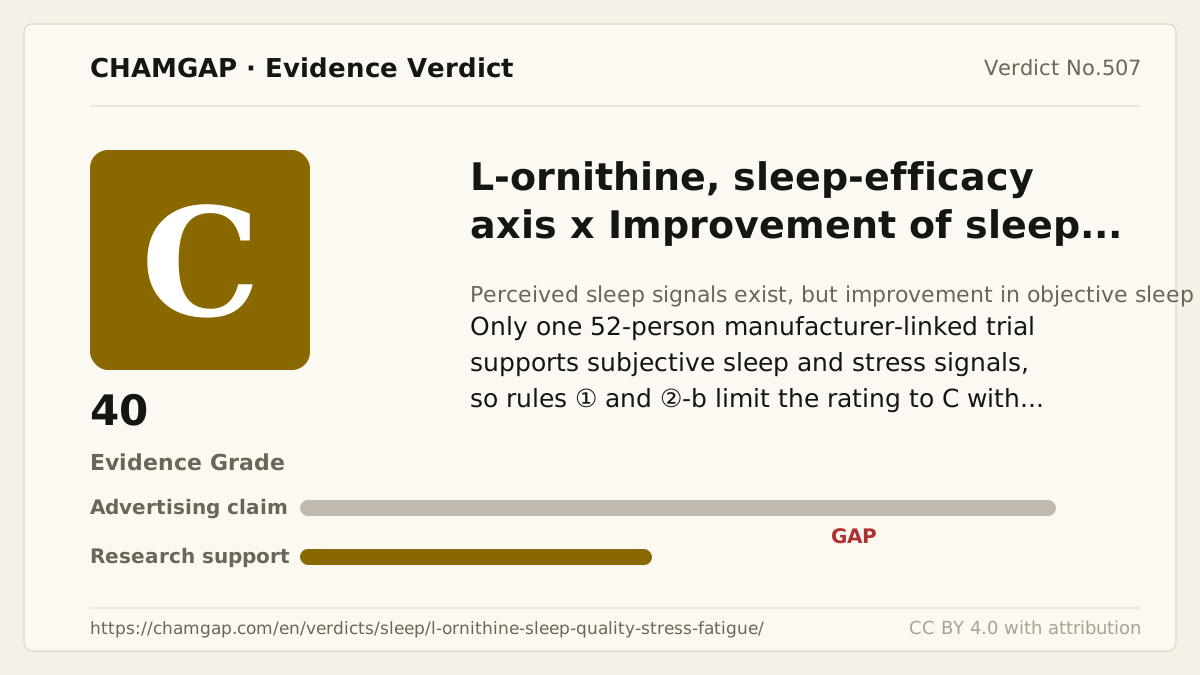
[Chamgap] L-ornithine x stress- and fatigue-related sleep quality — Evidence Grade C·40. 2 cited sources checked. Source: https://chamgap.com/en/verdicts/sleep/l-ornithine-sleep-quality-stress-fatigue/ · CC BY 4.0CC BY 4.0 — free to use with attribution; do not distort grades, numbers, or verdict meaning.
What this document does and does not do
Chamgap is an information source. It reports what research has and has not confirmed; it does not tell readers what to take or buy. That decision belongs to readers and, when needed, medical or legal professionals. This verdict reflects literature available up to the search date and may change as new research appears. Nothing here is medical advice.