
A three-step bedtime routine,
does it really help with Improved sleep onset and night waking in children aged 7-36 months?
research showsThe grade is C with 46 points. The studies randomized 209 infant and 210 toddler families, with complete data from 206 and 199, respectively. Two weeks of bathing, massage or lotion, and quiet activity improved parent-recorded sleep onset and night waking versus usual bedtime practice. Parents knew the assignment and recorded every outcome, no actigraphy or video was used, and the sole short program was sponsored and partly authored by the consumer-products company.
ads claimA consistent sequence may help, but the trial does not establish that Johnson products are necessary or that a quoted percentage faster sleep is an objective device-measured effect.
Useful facts when choosing a product
- Infants received bath then massage; toddlers received bath then lotion; quiet activity followed, with lights out within 30 minutes of bath completion.
- The design used one baseline week followed by two intervention weeks.
- Complete data were available for 206/209 infant and 199/210 toddler families.
- Verdict 1886 is C with 56 points for music before bed; this verdict concerns a full sequence in young children and parent-reported sleep.
Chamgap Semantic Classification Code
Candidate index · review held
UNK.nightly-bath.UNK.sleep-onset-and-night-waking-aged.improve.UNKUnknown > nightly bath > Unknown > sleep onset and night waking aged > Improvement claim > Unknown
An automated migration candidate, not an issued permanent code; exact claim scope remains under review. This machine-generated migration candidate helps retrieval but is not a permanent assignment. The original verdict ID and URL remain authoritative.
What the research actually shows
Among 206 infant families with complete data, 134 were assigned to routine and 72 to control; 199 of 210 toddler families had complete data. Parents completed weekly BISQ and daily diaries; no video, actigraphy, or polysomnography was used. A numerical adherence rate was not found in the article. Johnson & Johnson Consumer Companies supported the work, three authors were employees, and Mindell disclosed consulting and speaking for the company. Registration and a single prespecified primary endpoint were not confirmed.
Why this is classified as C (46)
Randomization and high data completion are strengths, but evidence is manufacturer-only, two weeks long, unblinded and parent-reported without attention control, and a defensible baseline-adjusted between-arm effect cannot be reconstructed. This gives C with 46 points.
Counterpoint. An independent trial lasting at least 12 weeks should standardize or remove products and combine actigraphy with parent reports.
Rejudgment record. Cross-check applied — Primary tables, methods, and disclosure were cross-checked for randomized and complete-data counts, usual-practice control, parent reporting, duration, analysis, and Johnson & Johnson conflicts
| Endpoint | P | Symptom or function itself is the target - including patient reports and performance tests |
| Replication | R1 | Single confirmatory trial |
| Independence | I0 | Evidence comes only from manufacturer studies |
| Effect size | EX | The clinical size of the effect could not be judged |
Stored derived and displayed grades match; this is not a current recalculation or validity check (C).
Sub-claim grades by effect
This ingredient is marketed for several effects. A single overall grade blends strong and weak claims together, so each effect is graded separately here. The overall grade reflects the strongest disconfirming or core claim.
| Effect (sub-claim) | Grade | Basis |
|---|---|---|
| Improved parent-recorded sleep onset and night waking | C | Positive in two-week randomized studies without attention control or objective measurement. |
| Increased objectively measured total sleep time | ? | No actigraphy or polysomnography was used. |
Cross-check — AI research and Codex final gate
Evidence Table
| Study | Design | Sample | Funding | Endpoint | Result | Weight |
|---|---|---|---|---|---|---|
| Mindell JA et al., Sleep, 2009 | Two age-stratified parallel randomized trials | 419 families randomized; 405 with complete data | Supported by Johnson & Johnson Consumer Companies; three employee authors and consulting disclosed | Parent BISQ and daily-diary sleep onset, night waking, and consolidation | Infant diary latency 19.9 to 13.4 minutes versus 19.8 to 16.7; waking duration 25.4 to 13.3 versus 20.9 to 18.6 | Direct positive but manufacturer-funded subjective short-term evidence |
Receipt — 1 References
All 1 cited sources were verified for existence at the original page (as of 2026-08-04).
Final verification and publication gate: Codex · Evidence date: 2026-08-04 · Corrections: none
Cite this verdict
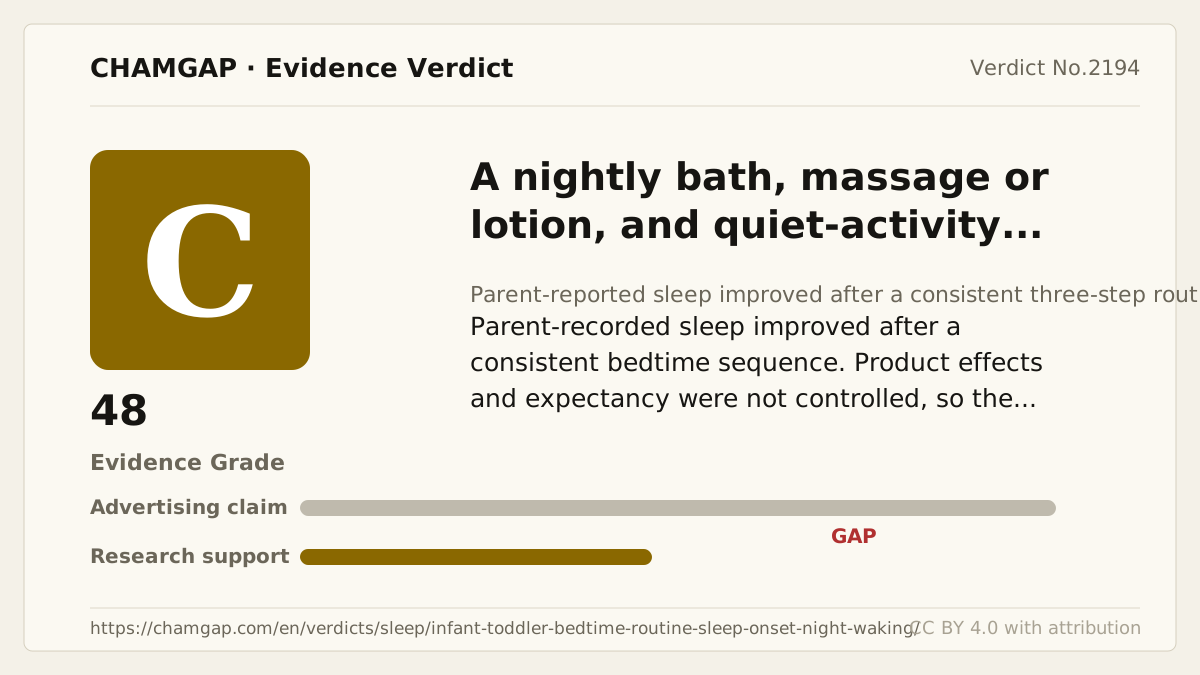
[Chamgap] A three-step bedtime routine x infant and toddler sleep — Evidence Grade C·46. 1 cited sources checked. Source: https://chamgap.com/en/verdicts/sleep/infant-toddler-bedtime-routine-sleep-onset-night-waking/ · CC BY 4.0CC BY 4.0 — free to use with attribution; do not distort grades, numbers, or verdict meaning.
What this document does and does not do
Chamgap is an information source. It reports what research has and has not confirmed; it does not tell readers what to take or buy. That decision belongs to readers and, when needed, medical or legal professionals. This verdict reflects literature available up to the search date and may change as new research appears. Nothing here is medical advice.