
Infant sleep education,
does it really help with Reduced objective night waking measured by actigraphy?
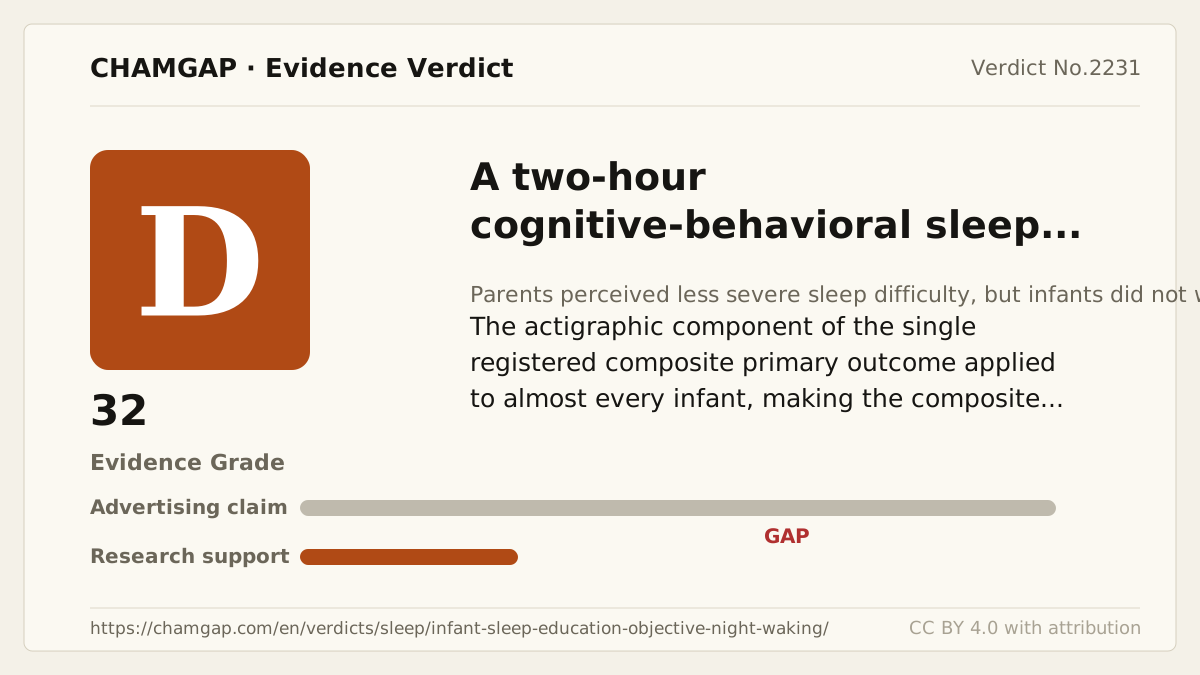
research showsThe grade is D. The registered primary outcome was one composite met when a parent reported a severe sleep problem or the five-day mean actigraphic waking count was at least twice nightly. The actigraphic criterion applied to 93/96 (96.9%) versus 94/96 (97.9%), nearly every infant. Parent-rated severe problems fell from 15/107 (14%) to 4/108 (4%), but an infant actually waking less and a parent feeling less burdened are different claims, giving D with 30 points.
ads claimMarketing must not convert parents feeling less burdened into infants objectively waking less. Both can matter, but they are not interchangeable outcomes.
Useful facts when choosing a product
- ISRCTN42169337 was registered on 2009-07-14 before recruitment began in September 2009.
- The actigraphic criterion was 93/96 (96.9%) versus 94/96 (97.9%), a simple difference of -1.0 percentage point without a valid reported confidence interval.
- Adjusted mean nightly wakes differed by -0.2 wakes (95% CI -1.32 to 0.91, P=.72), while the parent-rating risk difference was -10 percentage points (-16.8 to -2.2).
Chamgap Semantic Classification Code
Candidate index · review held
X.cognitive-behavioral-sleep-class-plus-of-telephone-support.behavioral.objective-night-waking-measured-by-actigraphy.reduce.UNKBehaviors, exposures and policies > cognitive-behavioral sleep class plus of telephone support > Behavioral delivery > objective night waking measured by actigraphy > Reduction claim > Unknown
An automated migration candidate, not an issued permanent code; exact claim scope remains under review. This machine-generated migration candidate helps retrieval but is not a permanent assignment. The original verdict ID and URL remain authoritative.
What the research actually shows
Hall and colleagues randomized 235 families to sleep education, 117, or infant-safety education, 118. ISRCTN42169337 was registered on 2009-07-14, before recruitment began in September 2009. The primary outcome was a single composite met by either parent-rated severe sleep difficulty or at least two mean nightly actigraphic wakes over five days; the individual measures were also listed as major secondary outcomes. Parent ratings were 4/108 versus 15/107, unadjusted RR 0.26 (95% CI 0.09 to 0.77), baseline-adjusted RR 0.30 (0.11 to 0.84), and risk difference -10 percentage points (-16.8 to -2.2). The actigraphic criterion occurred in 93/96 versus 94/96, a simple difference of -1.0 percentage point for which the paper gives no valid confidence interval. Adjusted mean nightly wakes differed by -0.2 wakes (95% CI -1.32 to 0.91, P=.72). The abstract and body internally mislabel this mean difference as a risk difference of -0.2%.
Why this is classified as D (30)
The actigraphic component of the composite primary outcome applied to nearly every infant and objective waking was null. The positive finding was an unblinded parent rating, with attrition from actigraphy analysis, giving D with 30 points.
Counterpoint. This verdict does not deny improvements in parental coping, fatigue, or mood. It addresses only the narrow claim of reduced objective infant night waking.
Rejudgment record. Cross-check applied — Uninformative single composite primary outcome, null objective waking count, positive unblinded parent rating, and actigraphy attrition
| Endpoint | P | Symptom or function itself is the target - including patient reports and performance tests |
| Replication | R1 | Single confirmatory trial |
| Independence | I2 | Decisive evidence is publicly or non-profit funded |
| Effect size | E0 | Null |
| Precision | C0 | The confidence interval leaves room for benefit |
Stored derived and displayed grades match; this is not a current recalculation or validity check (D).
Sub-claim grades by effect
This ingredient is marketed for several effects. A single overall grade blends strong and weak claims together, so each effect is graded separately here. The overall grade reflects the strongest disconfirming or core claim.
| Effect (sub-claim) | Grade | Basis |
|---|---|---|
| Reduced actigraphic night waking | D | There was no between-group reduction, 96.9% versus 97.9%. |
| Reduced parent-rated severe sleep problems | C | Rates were 4% versus 14%, but parents knew allocation. |
Cross-check — AI research and Codex final gate
Evidence Table
| Study | Design | Sample | Funding | Endpoint | Result | Weight |
|---|---|---|---|---|---|---|
| Hall et al. 2015 Rocky Sleep Study | Prospectively registered randomized controlled trial | 235 families randomized, 117 versus 118; six-week data 108 versus 107; actigraphy 96 versus 96 | Canadian Institutes of Health Research grant MCT-94836 | Single composite primary outcome met by parent-rated severe sleep difficulty or at least two mean actigraphic night wakes over five days | Actigraphic criterion 93/96 versus 94/96, simple difference -1.0 percentage point; adjusted mean nightly-wake difference -0.2 wakes (95% CI -1.32 to 0.91, P=.72); parent rating 4/108 versus 15/107, adjusted RR 0.30 (0.11 to 0.84) | Randomized evidence with an uninformative composite and null objective waking |
Receipt — 2 References
All 2 cited sources were verified for existence at the original page (as of 2026-08-04).
Final verification and publication gate: Codex · Evidence date: 2026-08-04 · Corrections: none
Cite this verdict
[Chamgap] Infant sleep education x reduced objective night waking — Evidence Grade D·30. 2 cited sources checked. Source: https://chamgap.com/en/verdicts/sleep/infant-sleep-education-objective-night-waking/ · CC BY 4.0CC BY 4.0 — free to use with attribution; do not distort grades, numbers, or verdict meaning.
What this document does and does not do
Chamgap is an information source. It reports what research has and has not confirmed; it does not tell readers what to take or buy. That decision belongs to readers and, when needed, medical or legal professionals. This verdict reflects literature available up to the search date and may change as new research appears. Nothing here is medical advice.