
Hypoglossal nerve stimulation,
does it really help with Improvement of respiratory indices and daytime function in CPAP-intolerant obstructive sleep apnea?
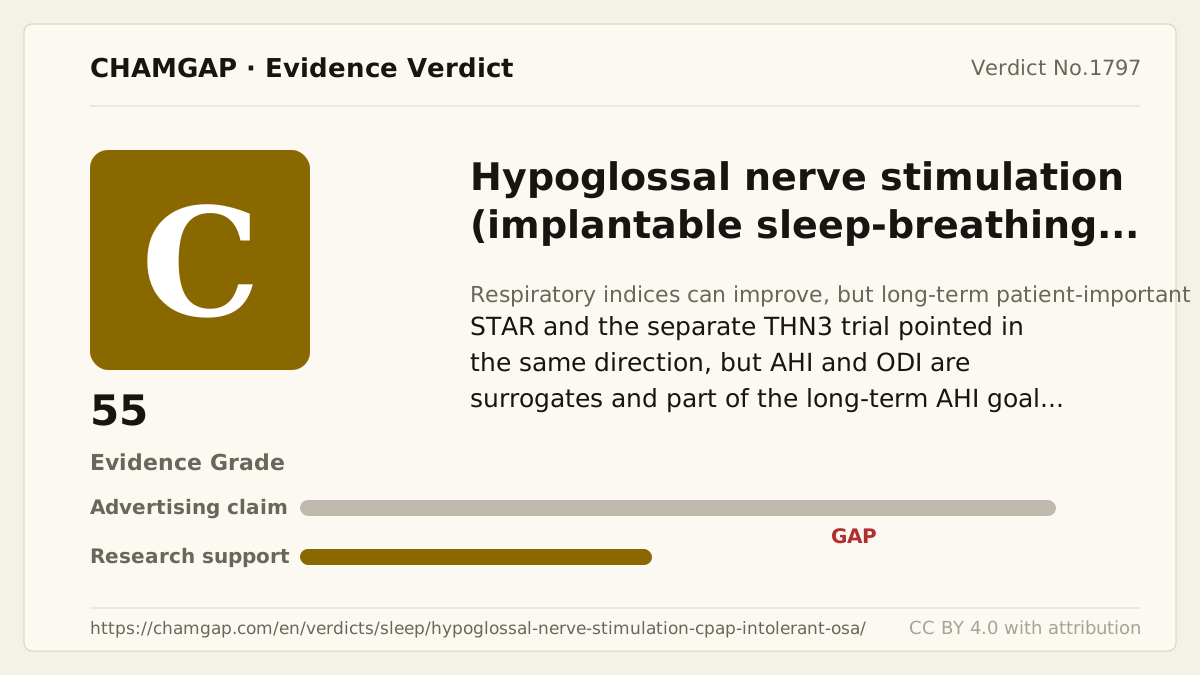
research showsA separate randomized delayed-activation THN3 trial pointed in the same direction as STAR, supporting R2. AHI and ODI remain surrogates, and the long-term AHI response missed the prespecified 50% performance goal. STAR was a 126-person single-arm cohort followed by randomized withdrawal of 46 responders, 23 per group. The S and I0 ceilings yield C with 54 points.
ads claimMarketing can expand a lower AHI into cure, cardiovascular protection, or normalized sleep for every CPAP-intolerant patient. The verified core is respiratory-index improvement and some daytime symptom improvement in selected patients.
Useful facts when choosing a product
- An implanted pulse generator and electrode stimulate the hypoglossal nerve during sleep to move the tongue forward. This operating fact is separate from long-term clinical efficacy.
- STAR was a 126-person implanted single-arm cohort; its randomized component was a short withdrawal substudy in 46 twelve-month responders.
- AHI counts apneas and hypopneas per hour of sleep and ODI counts oxygen-desaturation events; both are physiologic surrogates for patient-important events.
Chamgap Semantic Classification Code
Candidate index · review held
P.hypoglossal-nerve-stimulation.sublingual.respiratory-indices-and-daytime-function-in-cpap-intolerant-obstructive-sleep-apnea.improve.activeProcedures, devices and tests > Hypoglossal nerve stimulation > Sublingual > respiratory indices and daytime function in CPAP-intolerant obstructive sleep apnea > Improvement claim > Active comparator
An automated migration candidate, not an issued permanent code; exact claim scope remains under review. This machine-generated migration candidate helps retrieval but is not a permanent assignment. The original verdict ID and URL remain authoritative.
What the research actually shows
The separate THN3 trial implanted all participants and randomized them 2:1 to activation at month 1 or delayed activation at month 4. Of 138 randomized participants, the actual four-month analyses included 134 for AHI, 88 and 46 by arm, and 131 for ODI, 85 and 46 by arm. Short-term comparisons succeeded, but the long-term co-primary AHI performance endpoint failed. STAR primarily consisted of a 126-person implanted single-arm cohort; only the first 46 twelve-month responders were randomized 23 to 23 to maintenance or withdrawal. AHI in the withdrawal group worsened from 7.6 to 25.8 events per hour. These separate studies support R2 because they point in the same direction. Chamgap CPAP evidence also differs by endpoint: verdict 1179, which is F with 9 points, concerns recurrent cardiovascular prevention; verdict 1212, which is B with 72 points, concerns daytime sleepiness; and verdict 1764, which is C with 56 points, concerns blood pressure. The nonsurgical alternative is verdict 1786, which is C with 54 points, for a mandibular advancement device. The endpoint, not the device name, determines the grade.
Why this is classified as C (54)
The axis profile is B, S, R2, I0, E+, and B1. The separate THN3 trial and STAR point in the same direction, supporting R2, but surrogate S and manufacturer-only I0 retain the C ceiling. The failed long-term AHI co-primary goal supports C with 54 points.
Counterpoint. For patients who pass anatomic, weight, and AHI selection and cannot tolerate CPAP, stimulation can be a reasonable specialist option. Preoperative and postoperative sleep testing plus device programming are required.
Rejudgment record. Cross-check applied — Applied the AHI and ODI surrogate ceiling and incorporated the failed long-term THN3 AHI performance goal plus STAR's single-arm cohort and selected-responder withdrawal structure
| Endpoint | S | Surrogate marker - laboratory or imaging measures |
| Replication | R2 | Independently replicated across trials |
| Independence | I0 | Evidence comes only from manufacturer studies |
| Effect size | E+ | Meets the clinically important threshold |
Stored derived and displayed grades match; this is not a current recalculation or validity check (C).
Sub-claim grades by effect
This ingredient is marketed for several effects. A single overall grade blends strong and weak claims together, so each effect is graded separately here. The overall grade reflects the strongest disconfirming or core claim.
| Effect (sub-claim) | Grade | Basis |
|---|---|---|
| Reduction in AHI and improvement in response rate | C | The short-term randomized comparison was positive, but AHI is a surrogate and the long-term goal failed. |
| Reduction in ODI and improvement in response rate | C | Short- and long-term signals were positive, but ODI is a surrogate. |
| Improvement in daytime sleepiness and quality of life | C | Direct patient-reported signals exist, but evidence is unmasked, small, and manufacturer-centered. |
Cross-check — AI research and Codex final gate
Evidence Table
| Study | Design | Sample | Funding | Endpoint | Result | Weight |
|---|---|---|---|---|---|---|
| Schwartz AR et al. 2023 | Twenty-center postimplant 2:1 randomized delayed-activation controlled trial | 138 randomized; four-month primary analyses included 134 for AHI (88/46) and 131 for ODI (85/46) | Manufacturer funding from ImThera Medical and LivaNova, with sponsor participation in design, conduct, and analysis | Four-month AHI and ODI response rates and month-12/15 performance goals | Short-term AHI and ODI comparisons succeeded; long-term AHI response of 42.5% failed the 50% goal, while ODI response of 60.4% succeeded. | Pivotal randomized confirmatory trial |
| Strollo PJ Jr et al. 2014 | Prospective single-arm implant cohort with a randomized responder-withdrawal substudy | 126-person implanted cohort; only 46 twelve-month responders randomized 23/23 in withdrawal analysis | Manufacturer funding from Inspire Medical Systems | Twelve-month AHI and ODI plus change during responder withdrawal | Cohort indices improved and AHI in selected responders assigned to withdrawal worsened from 7.6 to 25.8 events per hour, but this was not a parallel randomized comparison in the general population. | Supportive evidence with selected-responder design |
Receipt — 2 References
All 2 cited sources were verified for existence at the original page (as of 2026-07-24).
Final verification and publication gate: Codex · Evidence date: 2026-07-24 · Corrections: none
Cite this verdict
[Chamgap] Hypoglossal nerve stimulation x CPAP-intolerant obstructive sleep apnea — Evidence Grade C·54. 2 cited sources checked. Source: https://chamgap.com/en/verdicts/sleep/hypoglossal-nerve-stimulation-cpap-intolerant-osa/ · CC BY 4.0CC BY 4.0 — free to use with attribution; do not distort grades, numbers, or verdict meaning.
What this document does and does not do
Chamgap is an information source. It reports what research has and has not confirmed; it does not tell readers what to take or buy. That decision belongs to readers and, when needed, medical or legal professionals. This verdict reflects literature available up to the search date and may change as new research appears. Nothing here is medical advice.