
Hydroxyzine,
does it really help with Improved sleep onset and sleep maintenance in adults with insomnia?
research showsShort-term hydroxyzine treatment for adult insomnia is rated C. A 2023 systematic review found only five studies and 207 hydroxyzine-treated participants, with mixed results across 25-, 50-, and 100-mg doses for sleep onset, maintenance, and quality. One of the more interpretable placebo-controlled trials treated only 35 patients with cirrhosis and minimal hepatic encephalopathy for ten days, making it indirect for typical adult insomnia. The 2017 AASM guideline did not directly test and reject hydroxyzine; it recommended against diphenhydramine, another sedating first-generation antihistamine, for sleep-onset and sleep-maintenance insomnia. Therefore, the evidence does not justify D, which would require a large direct null trial, but the small, short-term, and conflicting evidence ceiling under rule ①-ⓒ prevents a grade above C.
ads claimPrescribing anecdotes can recast hydroxyzine as a nonaddictive sleeping pill that safely maintains sleep all night. Insomnia is an off-label use in many jurisdictions, and direct evidence is limited to small, short studies. A lower dependence risk than benzodiazepines does not establish long-term efficacy, preservation of next-day function, or safety in older adults.
Useful facts when choosing a product
- Hydroxyzine is a sedating first-generation H1 antihistamine available by prescription and is commonly used off label for adult insomnia. Doses from 25 to 100 mg appear in the literature, but the optimal insomnia dose and long-term dose response are not established.
- Most efficacy evidence concerns a single dose or treatment lasting days to a few weeks. Structured cognitive behavioral therapy for insomnia remains the preferred treatment for chronic insomnia, and persistent symptoms require evaluation for sleep apnea, depression, anxiety, medicines, and other causes.
- Next-day drowsiness, impaired attention and driving, dry mouth, constipation, blurred vision, urinary retention, and confusion can occur. Older adults should avoid hydroxyzine under the Beers Criteria because of strong anticholinergic burden and fall risk.
- Hydroxyzine can prolong the QT interval and carries a conditional risk of torsade de pointes. It should be avoided with congenital long QT, bradycardia, low potassium or magnesium, or other QT-prolonging drugs, while alcohol and other sedatives can amplify impairment.
Chamgap Semantic Classification Code
Candidate index · review held
UNK.hydroxyzine.oral.sleep-onset-and-sleep-maintenance-with-insomnia.improve.MULTIUnknown > Hydroxyzine > Oral > sleep onset and sleep maintenance with insomnia > Improvement claim > Multiple: primary unresolved
An automated migration candidate, not an issued permanent code; exact claim scope remains under review. This machine-generated migration candidate helps retrieval but is not a permanent assignment. The original verdict ID and URL remain authoritative.
What the research actually shows
Burgazli 2023 searched through October 2022 and included four randomized trials and one open-label study, totaling 207 adults who received hydroxyzine 25 to 100 mg. Effects on sleep onset, maintenance, and quality were mixed, and four of five studies did not adequately report safety outcomes. Spahr 2007 randomized 35 patients with cirrhosis and minimal hepatic encephalopathy to hydroxyzine 25 mg or placebo for ten days. Subjective improvement occurred in 40% versus 0%, and a 30% or greater increase in actigraphic sleep efficiency occurred in 65% versus 25%, but the special population and very short pilot design create major indirectness. The 2017 AASM guideline did not issue a hydroxyzine-specific recommendation and weakly advised against diphenhydramine for sleep-onset and sleep-maintenance insomnia in adults.
Why this is classified as C (44)
The direct evidence consists of small, short trials totaling 207 hydroxyzine-treated participants, results are mixed, and the leading positive randomized trial is a ten-day study in 35 patients with cirrhosis and minimal hepatic encephalopathy. The genuine positive sleep signal prevents D, but the lack of multiple independent trials establishing consistent clinically meaningful benefit places the verdict near the bottom of C with 44 points.
Counterpoint. A short course may provide practical sedation for selected patients whose difficulty sleeping accompanies anxiety or itching. Repeated use still requires review of next-day function, anticholinergic burden, QT risk, and insomnia treatments with stronger evidence.
Rejudgment record. Cross-check applied — ①-ⓒ Evidence is weak because it is small, single-manufacturer, short-term, or conflicting → maximum C. The direct hydroxyzine evidence comprises five studies and 207 treated participants, with mixed results and a leading positive ten-day pilot in a special population, so this ceiling applies.
Sub-claim grades by effect
This ingredient is marketed for several effects. A single overall grade blends strong and weak claims together, so each effect is graded separately here. The overall grade reflects the strongest disconfirming or core claim.
| Effect (sub-claim) | Grade | Basis |
|---|---|---|
| Improved sleep onset in adult insomnia | C | Positive and null findings are mixed across small short-term studies, and a stable clinically meaningful effect size has not been established. |
| Improved sleep maintenance in adult insomnia | C | A positive actigraphy pilot exists, but it studied only 35 patients with cirrhosis and has low directness. |
| Improved overall sleep quality in adult insomnia | C | The systematic review found mixed results, and no long-term active-comparator randomized trial exists. |
Cross-check — AI research and Codex final gate
Evidence Table
| Study | Design | Sample | Funding | Endpoint | Result | Weight |
|---|---|---|---|---|---|---|
| Burgazli CR et al. 2023 | Systematic review of adult sleep studies | Five studies and 207 adults treated with hydroxyzine 25 to 100 mg | US Veterans Affairs and academic investigators; no manufacturer support reported | Sleep onset, sleep maintenance, overall sleep quality, and adverse events | Efficacy was mixed, four of five studies did not report safety outcomes, and the review called for long-term active-comparator trials. | Key direct synthesis with major limitations |
| Spahr L et al. 2007 | Randomized double-blind placebo-controlled pilot trial | 35 patients with cirrhosis, minimal hepatic encephalopathy, and longstanding sleep difficulty | Academic pilot rather than a commercial confirmatory insomnia trial | Subjective sleep improvement and wrist-actigraphy sleep efficiency over ten days | Subjective improvement was 40% versus 0%, and a 30% or greater increase in sleep efficiency occurred in 65% versus 25%, but this was a ten-day special-population study. | Positive direct trial limited by size, duration, and indirectness |
| Sateia MJ et al. 2017 AASM guideline | Systematic evidence assessment and clinical guideline for chronic-insomnia pharmacotherapy | Drug-specific randomized evidence; no separate hydroxyzine recommendation evidence | American Academy of Sleep Medicine | Sleep onset, sleep maintenance, and safety in adult chronic insomnia | Recommended against diphenhydramine for sleep-onset and sleep-maintenance insomnia but did not directly determine hydroxyzine to be ineffective. | Class context rather than direct evidence for D |
Receipt — 5 References
All 5 cited sources were verified for existence at the original page (as of 2026-07-24).
Final verification and publication gate: Codex · Evidence date: 2026-07-24 · Corrections: none
Cite this verdict
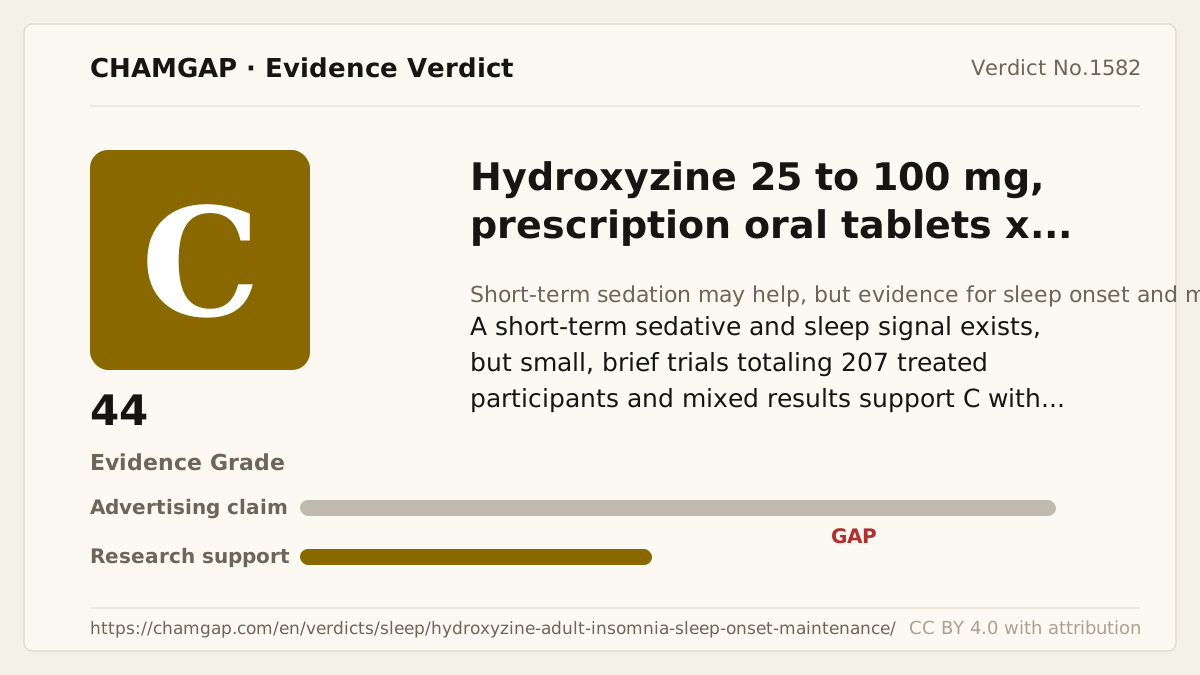
[Chamgap] Hydroxyzine x improved sleep onset and maintenance in adult insomnia — Evidence Grade C·44. 5 cited sources checked. Source: https://chamgap.com/en/verdicts/sleep/hydroxyzine-adult-insomnia-sleep-onset-maintenance/ · CC BY 4.0CC BY 4.0 — free to use with attribution; do not distort grades, numbers, or verdict meaning.
What this document does and does not do
Chamgap is an information source. It reports what research has and has not confirmed; it does not tell readers what to take or buy. That decision belongs to readers and, when needed, medical or legal professionals. This verdict reflects literature available up to the search date and may change as new research appears. Nothing here is medical advice.