
Two fresh green kiwifruits,
does it really help with Improved sleep onset, sleep duration, and sleep efficiency when adults with sleep difficulty eat two fruits one hour before bedtime?
research showsThe claim that two fresh green kiwifruits one hour before bedtime improve sleep is rated D. The main evidence is an uncontrolled self-comparison in which 24 participants ate two fruits nightly for four weeks. Signals included 35.4% shorter sleep-onset latency, 13.4% longer total sleep time, and 5.41% higher sleep efficiency, but there was no control group to separate the intervention from natural variation, expectation, regression to the mean, or concurrent behavior changes. A 2023 randomized crossover study in 24 men tested single acute exposures; the fresh-fruit sleep-onset rating was only borderline and it did not confirm the four-week claim for onset, duration, and efficiency. This is therefore a small, uncontrolled, largely self-reported low-quality signal, giving D with 31 points. Kiwifruit allergy and oral or gastrointestinal discomfort from an acidic fruit remain separate from efficacy.
ads claimMarketing can present kiwifruit serotonin, conversion to melatonin, or a urinary metabolite change as proof of restorative sleep. A food constituent or metabolite is not a clinical treatment outcome, and a before-after signal in 24 selected adults cannot yet be generalized to all adults with sleep difficulty.
Useful facts when choosing a product
- The pivotal study used two fresh green kiwifruits about one hour before bedtime every night for four weeks; this is not an established therapeutic dose for insomnia.
- Green kiwifruit is an ordinary food, so cultivar, fruit size, ripeness, and storage can alter sugar, acid, and bioactive-compound content.
- Kiwifruit allergy can range from oral itching and lip swelling to rare breathing difficulty or systemic reactions, and cross-reactivity can occur with latex or birch pollen allergy.
- As an acidic fruit, kiwifruit can aggravate reflux, oral irritation, or abdominal discomfort. Persistent insomnia, snoring, apneas, or daytime sleepiness calls for evaluation of the cause rather than relying on a food experiment.
Chamgap Semantic Classification Code
Candidate index · review held
F.fresh-green-kiwifruit.food.sleep-onset-sleep-duration-and-sleep-efficiency-when-adults-with-sleep-difficulty-eat-two-fruits-before-bedtime.improve.UNKFoods and beverages > Fresh green kiwifruit > Food consumption > sleep onset, sleep duration, and sleep efficiency when adults with sleep difficulty eat two fruits before bedtime > Improvement claim > Unknown
An automated migration candidate, not an issued permanent code; exact claim scope remains under review. This machine-generated migration candidate helps retrieval but is not a permanent assignment. The original verdict ID and URL remain authoritative.
What the research actually shows
Lin and colleagues enrolled 24 adults aged 20 to 55 years with self-reported sleep problems, including 22 women and two men, and asked them to eat two kiwifruits one hour before bedtime nightly for four weeks. With no control group, subjective PSQI, sleep-onset latency, and wake after sleep onset decreased by 42.4%, 35.4%, and 28.9%, while total sleep time and sleep efficiency increased by 13.4% and 5.41%. Kanon and colleagues used a randomized single-blind crossover in 24 men, average age 29, comparing two fresh fruits, an equivalent amount of dried fruit, and water. Dried fruit improved selected morning sleepiness and alertness outcomes; ease of getting to sleep after fresh fruit was borderline in good sleepers at p=0.053. It did not establish that fresh fruit improves onset, duration, and efficiency over four weeks.
Why this is classified as D (31)
The four-week study in 24 participants reported positive signals for sleep onset, duration, and efficiency, but it was an uncontrolled self-comparison vulnerable to self-report bias and natural variation. A 24-participant acute randomized crossover study did not confirm the stated long-term regimen. The absence of a reliable controlled long-term trial gives D with 31 points. Allergy and discomfort from acidity are safety issues independent of efficacy.
Counterpoint. People without allergy or troublesome reflux can eat kiwifruit as part of a balanced diet, but personal improvement does not confirm a treatment effect. Cognitive behavioral therapy and evaluation for sleep apnea, depression, anxiety, medicines, caffeine, and other causes take priority in chronic insomnia.
Rejudgment record. New verdict — Recorded the positive onset, duration, and efficiency signals from the 24-participant four-week self-controlled study, but assigned D for low-quality human evidence because of the uncontrolled small-sample design, reliance on self-report, and failure of the 2023 acute randomized crossover study to confirm the stated long-term effect
Sub-claim grades by effect
This ingredient is marketed for several effects. A single overall grade blends strong and weak claims together, so each effect is graded separately here. The overall grade reflects the strongest disconfirming or core claim.
| Effect (sub-claim) | Grade | Basis |
|---|---|---|
| Improved sleep onset from two fresh green kiwifruits before bedtime | D | The uncontrolled 24-participant before-after study was positive, but the fresh-fruit onset signal in an acute controlled study was borderline, leaving causality unconfirmed. |
| Improved total sleep time from two fresh green kiwifruits before bedtime | D | The reported 13.4% increase relies on one uncontrolled four-week before-after comparison without independent replication. |
| Improved sleep efficiency from two fresh green kiwifruits before bedtime | D | The 5.41% increase was a signal from a small uncontrolled study, with no confirmatory long-term randomized trial. |
Cross-check — AI research and Codex final gate
Evidence Table
| Study | Design | Sample | Funding | Endpoint | Result | Weight |
|---|---|---|---|---|---|---|
| Lin HH et al. 2011 | Four-week free-living self-controlled uncontrolled before-after study | 24 adults with sleep problems; 22 women and two men | Indexed as non-United States government research support; detailed funding was not stated in the abstract | PSQI, three-day sleep diary, and actigraphy measures of sleep-onset latency, total sleep time, efficiency, and wake after sleep onset | After four weeks, sleep-onset latency decreased 35.4%, total sleep time increased 13.4%, and efficiency increased 5.41%, but there was no control group. | Pivotal positive signal; uncontrolled and small, with very limited causal inference |
| Kanon AP et al. 2023 | Acute randomized single-blind three-condition crossover study | 24 healthy men: 12 good sleepers and 12 poor sleepers | New Zealand public research support with in-kind support from Zespri International and Alpha Group Holdings | Subjective and objective sleep, mood, and urinary serotonin and melatonin metabolites | Ease of getting to sleep after fresh fruit was borderline in good sleepers, while significant selected findings mainly concerned morning alertness after dried fruit and metabolites. | Controlled acute study; not an independent replication of the claimed four-week effect |
Receipt — 2 References
All 2 cited sources were verified for existence at the original page (as of 2026-07-22).
Final verification and publication gate: Codex · Evidence date: 2026-07-22 · Corrections: none
Cite this verdict
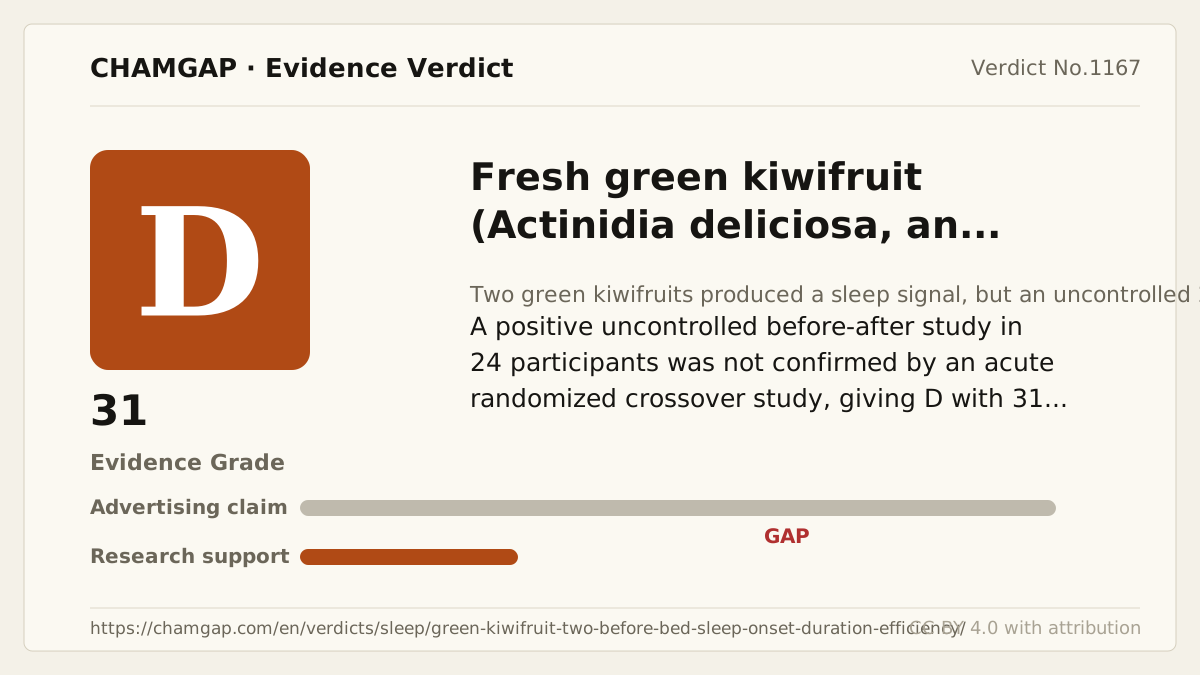
[Chamgap] Two fresh green kiwifruits x improved sleep onset, duration, and efficiency in adults with sleep difficulty — Evidence Grade D·31. 2 cited sources checked. Source: https://chamgap.com/en/verdicts/sleep/green-kiwifruit-two-before-bed-sleep-onset-duration-efficiency/ · CC BY 4.0CC BY 4.0 — free to use with attribution; do not distort grades, numbers, or verdict meaning.
What this document does and does not do
Chamgap is an information source. It reports what research has and has not confirmed; it does not tell readers what to take or buy. That decision belongs to readers and, when needed, medical or legal professionals. This verdict reflects literature available up to the search date and may change as new research appears. Nothing here is medical advice.