
Gabapentin,
does it really help with Relief of nocturnal leg discomfort, periodic movements, and sleep disturbance in adults with restless legs syndrome?
research showsGabapentin is rated C because direct human trials support improvement in sensory and motor symptoms and sleep in adult restless legs syndrome. The pivotal double-blind crossover trial enrolled only 24 people but improved symptom scales, periodic limb movements during sleep, and sleep architecture, and the 2025 AASM guideline strongly recommends gabapentin. The gabapentin-specific evidence base, however, comprises only two randomized trials and four observational studies, centers on symptoms and sleep, and contains no hard endpoints such as falls, hospitalization, or sustained daily function. A guideline recommendation does not by itself justify B, so rule ① and parity with rotigotine for RLS at C58 cap this verdict at C with 55 points. Somnolence, dizziness, edema, and withdrawal risk are recorded separately under safety.
ads claimPromotion can expand a first-line recommendation into definitive treatment for every nocturnal leg symptom and chronic insomnia. The evidence fits diagnosed RLS symptoms, periodic movements, and sleep, not peripheral arterial disease, neuropathy, nocturnal cramps, or unexplained insomnia.
Useful facts when choosing a product
- Gabapentin is a prescription gabapentinoid that binds the alpha-2-delta auxiliary subunit of voltage-gated calcium channels, and use of immediate-release products such as Neurontin for RLS is off label.
- Gabapentin enacarbil is a prodrug designed for different absorption and pharmacokinetics; its dose cannot be exchanged one-for-one with immediate-release gabapentin and its trial results should not be transferred without qualification.
- Iron status, medicines and substances that worsen symptoms, caffeine, alcohol, and sleep apnea should be assessed in RLS, and dosing must be individualized by the prescriber for kidney function and sedation risk.
- Somnolence, dizziness, ataxia, and peripheral edema can occur, while opioids, alcohol, and other central nervous system depressants can increase sedation and respiratory-depression risk. Long-term treatment should not be stopped abruptly and should be tapered under prescriber guidance.
Chamgap Semantic Classification Code
Candidate index · review held
M.gabapentin.UNK.nocturnal-leg-discomfort-periodic-movements-and-sleep-disturbance-with-restless-legs-syndrome.relieve.placeboMedicinal interventions > Gabapentin > Unknown > nocturnal leg discomfort, periodic movements, and sleep disturbance with restless legs syndrome > Symptom-relief claim > Placebo
An automated migration candidate, not an issued permanent code; exact claim scope remains under review. This machine-generated migration candidate helps retrieval but is not a permanent assignment. The original verdict ID and URL remain authoritative.
What the research actually shows
Garcia-Borreguero and colleagues randomized 22 people with primary RLS and two with iron-deficiency-associated RLS to gabapentin or placebo for six weeks, followed by a one-week washout and crossover. The mean effective dose was 1,855 mg/day, and all clinical scales, the periodic-limb-movement index, total sleep time, sleep efficiency, and slow-wave sleep improved versus placebo. The acute sleep-laboratory study by Saletu in 2010 also found that gabapentin 300 mg improved sleep efficiency, latency, and subjective sleep and reduced periodic movements by 35%, but it was not a long-term parallel-group trial. The 2025 AASM guideline identified two randomized trials and four observational studies of gabapentin and issued a strong recommendation while rating certainty moderate because of imprecision. This indication-specific evidence is distinct from the negative evidence for gabapentin in sciatica.
Why this is classified as C (55)
A 24-person crossover trial improved symptoms, periodic movements, and sleep architecture, and the 2025 AASM guideline strongly recommended gabapentin on the basis of two randomized trials and four observational studies, establishing credible positive human evidence. Direct randomized samples remain small, endpoints are limited to symptoms, sleep, and periodic movements, and no large independent long-term clinical-outcome trial exists. Rule ① therefore supports C with 55 points. Somnolence, dizziness, edema, and discontinuation risk are safety issues independent of efficacy.
Counterpoint. Gabapentin can be a practical prescription option when painful sensations predominate or avoiding dopamine-agonist augmentation matters. Iron deficiency and aggravating factors still require attention, together with driving, fall, and respiratory-depression risks.
Rejudgment record. New verdict — Accepted the small double-blind gabapentin trials and strong 2025 AASM recommendation as positive, but applied the rule ① ceiling of C because randomized samples are small, endpoints are limited to symptoms, sleep, and periodic limb movements, and no hard clinical outcome trial exists
Sub-claim grades by effect
This ingredient is marketed for several effects. A single overall grade blends strong and weak claims together, so each effect is graded separately here. The overall grade reflects the strongest disconfirming or core claim.
| Effect (sub-claim) | Grade | Basis |
|---|---|---|
| Reduction of nocturnal leg discomfort and sensory symptoms in adult RLS | C | A small double-blind crossover trial and the AASM review are positive, but no large independent long-term trial exists. |
| Reduction of periodic limb movements during sleep in adult RLS | C | A reduction in the polysomnographic periodic-movement index was reported, but the sample was very small and the measure is a surrogate rather than a clinical event. |
| Improvement of RLS-related sleep disturbance in adults | C | Signals for total sleep time, sleep efficiency, and slow-wave sleep are positive, but direct replication for long-term function and quality of life is limited. |
Cross-check — AI research and Codex final gate
Evidence Table
| Study | Design | Sample | Funding | Endpoint | Result | Weight |
|---|---|---|---|---|---|---|
| Garcia-Borreguero D et al. 2002 | Randomized double-blind placebo-controlled crossover trial | 24 patients with RLS; six weeks per treatment and a one-week washout | Limited reporting; single small academic trial | RLS scales, CGI, pain VAS, PSQI, and overnight polysomnographic periodic movements and sleep architecture | Sensory and motor symptoms and the periodic-movement index decreased, while total sleep time, sleep efficiency, and slow-wave sleep improved versus placebo. | Key direct positive evidence with a very small sample |
| Winkelman JW et al. 2025 AASM guideline | Systematic evidence review and clinical practice guideline | Two gabapentin randomized trials and four observational studies | American Academy of Sleep Medicine | RLS severity, sleep quality, and withdrawal due to adverse events | A clinically meaningful moderate effect on disease severity supported a strong recommendation for adult RLS, with moderate certainty because of imprecision. | Guideline corroboration, kept separate from the efficacy grade |
Receipt — 2 References
All 2 cited sources were verified for existence at the original page (as of 2026-07-22).
Final verification and publication gate: Codex · Evidence date: 2026-07-22 · Corrections: none
Cite this verdict
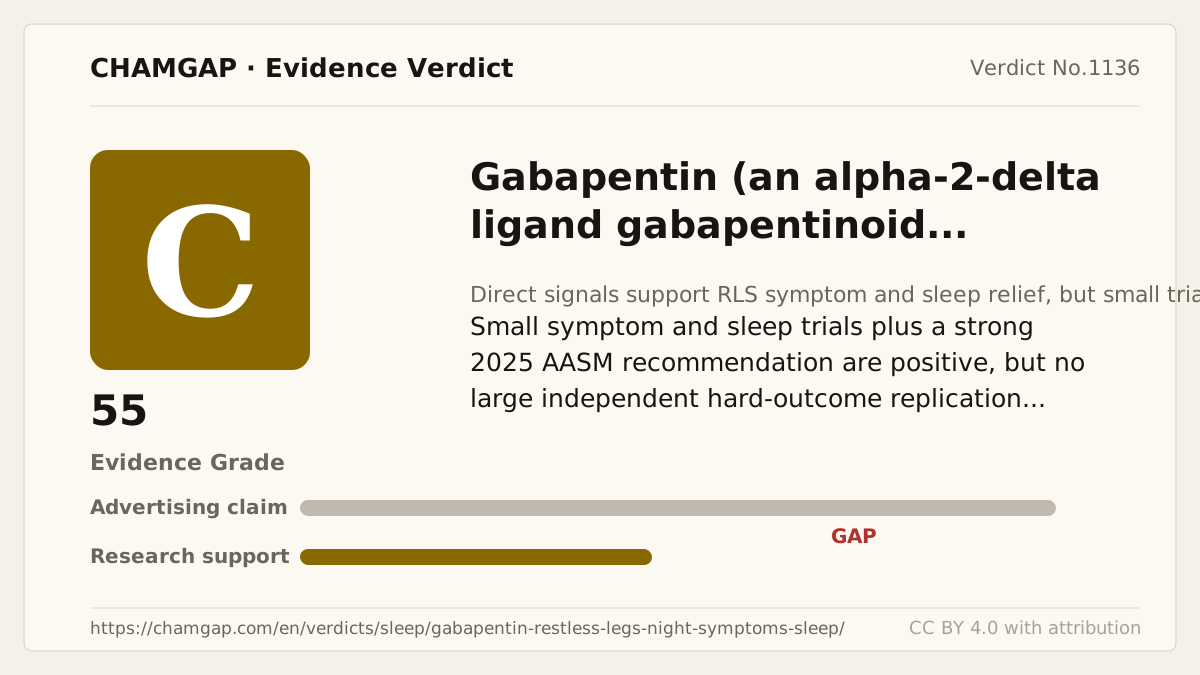
[Chamgap] Gabapentin x relief of nocturnal symptoms, periodic movements, and sleep disturbance in adult restless legs syndrome — Evidence Grade C·55. 2 cited sources checked. Source: https://chamgap.com/en/verdicts/sleep/gabapentin-restless-legs-night-symptoms-sleep/ · CC BY 4.0CC BY 4.0 — free to use with attribution; do not distort grades, numbers, or verdict meaning.
What this document does and does not do
Chamgap is an information source. It reports what research has and has not confirmed; it does not tell readers what to take or buy. That decision belongs to readers and, when needed, medical or legal professionals. This verdict reflects literature available up to the search date and may change as new research appears. Nothing here is medical advice.