
Ferrous sulfate,
does it really help with Relief of nighttime symptoms in restless legs syndrome with ferritin at or below 75 ng/mL?
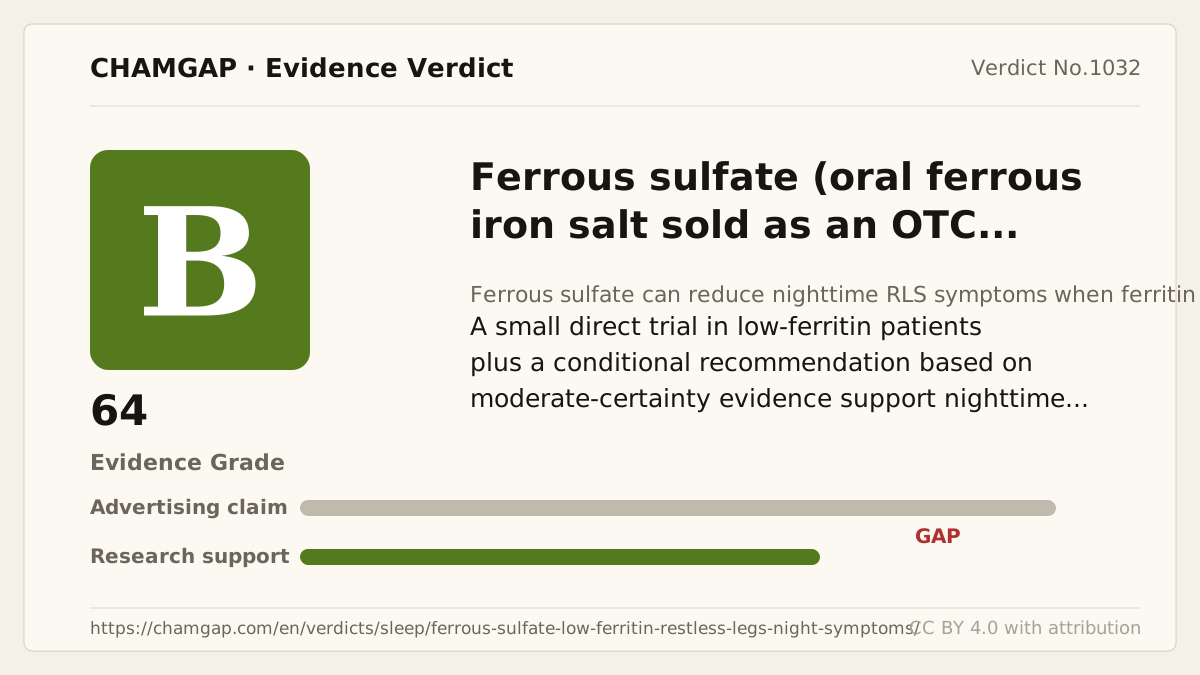
research showsFerrous sulfate is rated B because it can relieve nighttime symptoms in restless legs syndrome when ferritin is low. In the pivotal 12-week double-blind trial, the International Restless Legs Scale score fell by 10.3 points with ferrous sulfate versus 1.14 points with placebo among 18 analyzed participants. The 2025 AASM guideline and evidence review conditionally recommend oral ferrous sulfate for adults with appropriate iron status and rate certainty as moderate. Direct oral trials are nevertheless very small, a separate trial with higher baseline ferritin was negative, and improvement in sleep quality is not established. Unlike the A for iron-deficiency anemia in verdict 421, symptom efficacy in RLS is therefore a conditional B with 64 points. Constipation, nausea, abdominal pain, dark stools, iron excess, and accidental childhood poisoning are separated under safety.
ads claimIron should not be expanded into a treatment for every case of RLS or insomnia. The best-matched population has RLS plus ferritin at or below 75 ng/mL or low transferrin saturation confirmed by testing. The evidence concerns symptom relief, not guaranteed remission or longer sleep, and long-term supplementation should not proceed without checking iron indices and the cause of deficiency.
Useful facts when choosing a product
- Ferrous sulfate is a ferrous iron salt, and products differ in the amount of ferrous sulfate and elemental iron per tablet. The elemental-iron amount and dosing frequency on the label must be checked.
- Food, antacids, and calcium can reduce absorption, while vitamin C can increase it. Timing with meals and other products should balance prescribing or pharmacy advice against gastrointestinal tolerance.
- Constipation, nausea, abdominal pain, and dark stools are common. Severe abdominal pain, vomiting, suspected blood in stool, or persistent intolerance warrants clinical assessment.
- Iron overdose can be fatal, especially in children, so products require locked storage. People with iron-overload disorders or repeated transfusions should not supplement without testing and medical guidance.
Chamgap Semantic Classification Code
Candidate index · review held
UNK.ferrous-sulfate.oral.nighttime-symptoms-in-restless-legs-syndrome-with-ferritin-at-or-below-75-ng-ml.relieve.placeboUnknown > Ferrous sulfate > Oral > nighttime symptoms in restless legs syndrome with ferritin at or below 75 ng/mL > Symptom-relief claim > Placebo
An automated migration candidate, not an issued permanent code; exact claim scope remains under review. This machine-generated migration candidate helps retrieval but is not a permanent assignment. The original verdict ID and URL remain authoritative.
What the research actually shows
Wang in 2009 assigned adults with RLS and low or low-normal ferritin to ferrous sulfate 325 mg twice daily or placebo for 12 weeks; among 18 analyzed participants, IRLS scores fell by 10.3 versus 1.14 points. Davis in 2000 tested the same dose for 12 weeks but found no efficacy difference in a small sample with higher baseline ferritin. The 2025 AASM evidence review identified two oral iron randomized trials with 46 participants; its IRLS effect estimate was a 9.2-point benefit from one 18-participant trial and certainty was limited to moderate by imprecision. The 2019 Cochrane review pooled 10 oral and intravenous iron trials with 428 participants and found improved RLS severity, but formulations and populations were mixed and subjective sleep quality did not clearly improve. The A for iron-deficiency anemia in verdict 421 and the C for non-deficient fatigue in verdict 50 concern different outcomes.
Why this is classified as B (64)
In low-ferritin RLS, ferrous sulfate has direct support from a small double-blind trial showing an IRLS reduction of 10.3 versus 1.14 points and from the 2025 AASM conditional recommendation based on moderate-certainty evidence. Yet all direct oral randomized evidence comprises only 46 participants, the central estimate comes from one 18-participant trial, a higher-ferritin trial was negative, and objective sleep improvement is unconfirmed. Parity with B grades for pregabalin in verdict 924 and pramipexole in verdict 992 supports B with 64 points while keeping the low-ferritin restriction explicit. The A for correction of iron-deficiency anemia is not transferred to RLS symptoms, and gastrointestinal effects, iron excess, and childhood poisoning are separate safety issues.
Counterpoint. If iron does not adequately control symptoms or ferritin is normal or high, clinicians should evaluate other causes, exacerbating medicines, sleep apnea, and kidney disease. Raising iron stores does not guarantee symptom response, and evidence for intravenous iron cannot simply be substituted for oral ferrous sulfate.
Rejudgment record. Cross-verification incorporated — Prioritized direct placebo-controlled IRLS improvement in patients near the ferritin-at-or-below-75 threshold and the 2025 AASM conditional recommendation with moderate certainty, while accounting for very small oral-trial samples, a negative higher-ferritin trial, uncertain sleep quality, and non-transferability of the A grade for iron-deficiency anemia in verdict 421
Sub-claim grades by effect
This ingredient is marketed for several effects. A single overall grade blends strong and weak claims together, so each effect is graded separately here. The overall grade reflects the strongest disconfirming or core claim.
| Effect (sub-claim) | Grade | Basis |
|---|---|---|
| Relief of nighttime RLS symptoms in adults with ferritin at or below 75 ng/mL | B | A large IRLS reduction in a small direct placebo-controlled trial and an AASM conditional recommendation with moderate certainty provide support. |
| Clinically important reduction in RLS severity with low ferritin | B | The roughly 9-point placebo-adjusted difference is clinically large but depends on an 18-participant analysis. |
| Improvement in sleep quality in low-ferritin RLS | C | Subjective sleep-quality data are limited, and the Cochrane synthesis did not show a clear difference. |
Cross-check — AI research and Codex final gate
Evidence Table
| Study | Design | Sample | Funding | Endpoint | Result | Weight |
|---|---|---|---|---|---|---|
| Wang J et al. 2009 | Twelve-week randomized double-blind placebo-controlled trial | 22 randomized and 18 analyzed | Academic study with no industry sponsorship stated in the abstract | IRLS score, quality of life, and ferritin | IRLS fell by 10.3 points with ferrous sulfate versus 1.14 with placebo, P=0.01; the quality-of-life difference was not significant at P=0.07. | Pivotal direct positive trial, but very small |
| Davis BJ et al. 2000 | Twelve-week randomized double-blind placebo-controlled pilot trial | 28 randomized with fewer complete datasets | Limited reporting | RLS symptom scores and ferritin | No significant symptom difference was found, and baseline ferritin was relatively high at approximately 100 to 135 ng/mL across groups. | Limits generalization to iron-replete patients |
| Winkelman JW et al. 2025 AASM systematic review | GRADE-based systematic review and meta-analysis | Two oral-iron randomized trials with 46 participants; one IRLS analysis with 18 | Funded by the American Academy of Sleep Medicine | IRLS severity, quality of life, and adverse events | The IRLS mean difference was -9.2 points, 95% CI -15.2 to -3.2, favoring ferrous sulfate; certainty was moderate because of imprecision. | Key synthesis supporting the guideline |
| Trotti LM, Becker LA. 2019 | Cochrane systematic review of randomized trials | 10 trials and 428 participants; 7 trials and 345 participants for severity | Cochrane and academic work with mixed sponsorship among included trials | RLS severity, quality of life, and subjective sleep quality | Iron overall improved severity by a mean 3.78 points versus placebo, but oral and intravenous formulations were mixed and sleep-quality improvement was unclear. | Supportive synthesis limited by mixed formulations |
Receipt — 6 References
All 6 cited sources were verified for existence at the original page (as of 2026-07-21).
Final verification and publication gate: Codex · Evidence date: 2026-07-21 · Corrections: none
Cite this verdict
[Chamgap] Ferrous sulfate x relief of nighttime restless legs symptoms with low ferritin — Evidence Grade B·64. 6 cited sources checked. Source: https://chamgap.com/en/verdicts/sleep/ferrous-sulfate-low-ferritin-restless-legs-night-symptoms/ · CC BY 4.0CC BY 4.0 — free to use with attribution; do not distort grades, numbers, or verdict meaning.
What this document does and does not do
Chamgap is an information source. It reports what research has and has not confirmed; it does not tell readers what to take or buy. That decision belongs to readers and, when needed, medical or legal professionals. This verdict reflects literature available up to the search date and may change as new research appears. Nothing here is medical advice.