
Ferric carboxymaltose,
does it really help with Improved nighttime symptoms and sleep in adults with restless legs syndrome and iron deficiency?
research showsIntravenous ferric carboxymaltose is rated B specifically for reducing nighttime symptom severity in adults with restless legs syndrome and appropriate iron status. The AASM synthesis found a mean 7.4-point IRLS reduction versus control across five randomized trials with moderate certainty and issued a strong recommendation. IRLS directly measures the nighttime symptoms being treated, so a patient-reported scale is not a surrogate outcome. The evidence is stronger than for oral iron B64, making B with 64 points coherent. PSQI sleep improvement was negative and disease-specific quality of life remains uncertain, so this B rating does not extend to those outcomes.
ads claimPromotion may imply that restoring iron produces immediate, uninterrupted sleep and prevents recurrence. The evidence instead supports a possible reduction in subjective RLS severity after several weeks in selected iron-deficient patients, while sleep quality and duration of benefit are much less certain.
Useful facts when choosing a product
- Ferric carboxymaltose is a prescription intravenous iron complex. In RLS, ferritin and transferrin saturation should be measured accurately in the morning, while anemia status, the cause of iron deficiency, and other exacerbating factors are also evaluated.
- RLS trials used regimens including a single 1,000-mg dose or 1,500 mg total. A medical facility must select the dose from body weight, hemoglobin, iron status, and the product label; this is not a self-administered treatment.
- A symptom response may take several weeks rather than occur immediately. If symptoms recur, the need for retreatment should be based on reassessment of symptoms, ferritin, and transferrin saturation; treatment should not be given with iron overload.
- Patients should be observed for hypersensitivity and blood-pressure changes during administration, and extravasation must be avoided. Serum phosphate should be checked with repeated treatment or risk factors, and extravasation can leave long-lasting brown skin staining.
Chamgap Semantic Classification Code
Candidate index · review held
M.ferric-carboxymaltose.intravenous.nighttime-symptoms-and-sleep-with-restless-legs-syndrome-and-iron-deficiency.improve.placeboMedicinal interventions > Ferric carboxymaltose > Intravenous > nighttime symptoms and sleep with restless legs syndrome and iron deficiency > Improvement claim > Placebo
An automated migration candidate, not an issued permanent code; exact claim scope remains under review. This machine-generated migration candidate helps retrieval but is not a permanent assignment. The original verdict ID and URL remain authoritative.
What the research actually shows
The 2025 AASM systematic review pooled five randomized trials by Allen 2011, Bae 2021 and 2023, Cho 2018, and Trenkwalder 2017. It reported a mean IRLS difference of -7.4 points (95% CI -11.9 to -2.9) in 237 participants, with moderate-to-high certainty by outcome. By contrast, PSQI sleep quality across three trials with 111 participants was -4.2 points (95% CI -8.8 to 0.3), including no effect, with very low certainty. Trenkwalder enrolled 110 nonanemic iron-deficient patients using ferritin below 75 or ferritin 75 to 300 with transferrin saturation below 20%; a single 1,000-mg dose missed the four-week primary endpoint but differed by -4.66 points at week 12. Bae 2021 enrolled only 29 patients with RLS and iron-deficiency anemia and reported improved six-week IRLS and sleep quality after 1,500 mg. The AASM good-practice statement advises considering iron when ferritin is 75 ng/mL or lower or transferrin saturation is below 20%, with intravenous iron when ferritin is 75 to 100 ng/mL.
Why this is classified as B (64)
A mean 7.4-point IRLS benefit across five randomized trials, moderate certainty, and a strong AASM recommendation support reduced nighttime symptoms. IRLS is a direct patient outcome and treatment target, so patient reporting does not invoke a surrogate-outcome ceiling. The missed four-week primary endpoint in the pivotal trial remains a limitation, but pooled evidence is consistent and stronger than for oral iron B64, supporting B with 64 points only for nighttime symptoms. Negative PSQI sleep evidence and uncertain disease-specific quality of life remain excluded, while hypophosphatemia, infusion reactions, and skin staining are separate safety issues.
Counterpoint. This can be a non-dopaminergic option when nighttime RLS discomfort and iron deficiency are both clear. Even when symptoms improve, the cause of iron deficiency and follow-up tests remain necessary, and sleep apnea, medicines, caffeine, and other sleep-disrupting factors require separate management.
Rejudgment record. Consistency recalibration (rule 1 clarification) — Treated IRLS nighttime symptoms as a direct patient outcome and treatment target rather than a surrogate; a 7.4-point benefit across five trials with moderate certainty, a strong AASM recommendation, and evidence stronger than oral iron B64 support B restricted to nighttime symptoms, while PSQI sleep and quality-of-life outcomes remain excluded
Sub-claim grades by effect
This ingredient is marketed for several effects. A single overall grade blends strong and weak claims together, so each effect is graded separately here. The overall grade reflects the strongest disconfirming or core claim.
| Effect (sub-claim) | Grade | Basis |
|---|---|---|
| Reduced nighttime RLS symptom severity in iron-deficient adults | B | IRLS nighttime symptoms are a treatment target and improved by a mean 7.4 points across five trials, with a strong AASM recommendation and moderate certainty. |
| Improved sleep quality in iron-deficient adults with RLS | C | PSQI was -4.2 points (95% CI -8.8 to 0.3) in three trials with 111 participants, including no effect, with very low certainty. |
| Improved disease-specific quality of life in iron-deficient adults with RLS | C | The mean difference was +11.1 points in three trials with 136 participants, but the 95% CI of -0.3 to 22.5 included no effect. |
Cross-check — AI research and Codex final gate
Evidence Table
| Study | Design | Sample | Funding | Endpoint | Result | Weight |
|---|---|---|---|---|---|---|
| Winkelman JW et al. 2025 AASM systematic review | Systematic review, meta-analysis, and GRADE assessment | Five randomized trials with 237 participants for IRLS and three trials with 111 participants for PSQI | American Academy of Sleep Medicine | RLS severity, quality of life, sleep quality, and adverse-event withdrawal | The IRLS mean difference was -7.4 points (95% CI -11.9 to -2.9); PSQI was -4.2 points (95% CI -8.8 to 0.3), including no effect, with very low certainty. | Key synthesis establishing both symptom benefit and the sleep limitation |
| Trenkwalder C et al.; FCM-RLS Study Investigators. 2017 | Multinational randomized double-blind placebo-controlled trial | 110 patients with moderate-to-severe RLS and nonanemic iron deficiency; 59 FCM and 51 placebo | Sponsored by Vifor Pharma with three employee coauthors | Four-week change in IRLS as the primary endpoint and 12-week change as a secondary endpoint | The four-week difference of -2.5 points (95% CI -5.93 to 1.02, P=.163) was negative; the 12-week difference of -4.66 (-8.59 to -0.73, P=.021) was significant. | Pivotal direct randomized evidence with a negative primary endpoint |
| Bae H et al. 2021 | Randomized double-blind placebo-controlled trial followed by responder follow-up | 29 patients with RLS and iron-deficiency anemia; 15 FCM and 14 placebo | Funding not stated in the PubMed abstract | Six-week change in IRLS and sleep quality, with 52-week responder follow-up | At six weeks, change from baseline in IRLS was -13.47 with FCM versus +1.36 with placebo, and sleep quality improved, but only 29 participants were enrolled. | Small positive direct randomized trial |
| Winkelman JW et al. 2025 AASM guideline | GRADE-based clinical practice guideline | Not applicable; five FCM randomized trials in the accompanying review | American Academy of Sleep Medicine | Recommendation for intravenous FCM in adults with RLS and appropriate iron status | Issued a strong recommendation for intravenous FCM with moderate certainty of evidence. | Clinical-applicability evidence, not an efficacy trial itself |
Receipt — 4 References
All 4 cited sources were verified for existence at the original page (as of 2026-07-23).
Final verification and publication gate: Codex · Evidence date: 2026-07-23 · Corrections: none
Cite this verdict
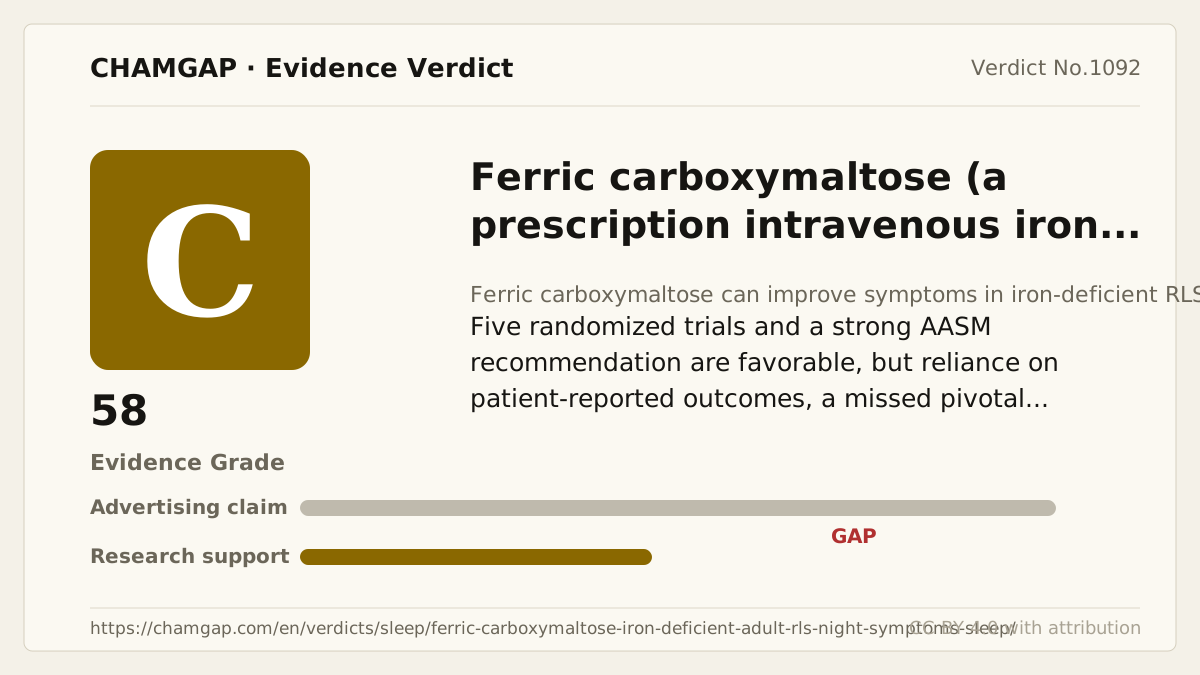
[Chamgap] Ferric carboxymaltose x improved nighttime symptoms and sleep in adults with iron-deficient restless legs syndrome — Evidence Grade B·64. 4 cited sources checked. Source: https://chamgap.com/en/verdicts/sleep/ferric-carboxymaltose-iron-deficient-adult-rls-night-symptoms-sleep/ · CC BY 4.0CC BY 4.0 — free to use with attribution; do not distort grades, numbers, or verdict meaning.
What this document does and does not do
Chamgap is an information source. It reports what research has and has not confirmed; it does not tell readers what to take or buy. That decision belongs to readers and, when needed, medical or legal professionals. This verdict reflects literature available up to the search date and may change as new research appears. Nothing here is medical advice.