
External nasal dilator strip,
does it really help with Reduced snoring with nasal congestion and reduced snoring and apnea-hypopnea index in obstructive sleep apnea?
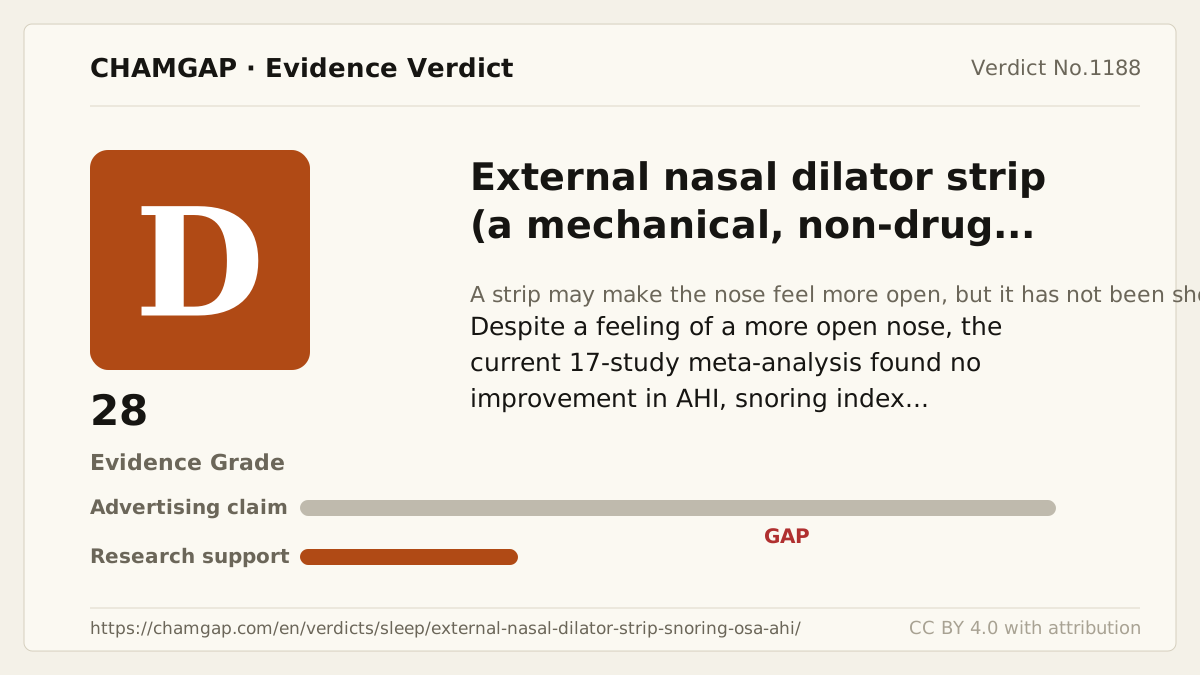
research showsExternal nasal dilator strips for snoring with congestion and for reducing snoring or apnea-hypopnea index in obstructive sleep apnea are rated D. A current 2026 systematic review and meta-analysis synthesized 17 studies and 496 participants using internal or external dilators and found no significant difference from control in AHI, apnea or hypopnea index, snoring index, oxygen saturation, or sleep architecture. Across four studies and 120 participants directly comparing AHI, the mean difference was 7.63 events per hour (95% CI -7.02 to 22.28), not an improvement, with 92.8% heterogeneity. A 2016 review included nine external-strip studies among 14 with quantitative sleep data; 12 studies found no AHI change and the external-strip improvement in snoring index was minimal. Subjective nasal openness can improve, but null core OSA outcomes and pooled snoring results give D with 28 points. Adhesive-related skin irritation and epidermal injury during removal require caution.
ads claimMarketing depicts a physically widened nasal entrance as if the entire airway remains open and snoring or sleep apnea stops. Obstructive sleep apnea commonly involves collapse in the pharynx during sleep, so reducing nasal resistance is not the same as reducing AHI.
Useful facts when choosing a product
- An external nasal dilator strip is a disposable mechanical product placed across the sides of the nasal bridge; elastic supports pull the nasal walls and valve outward.
- It may improve the sensation of nasal openness or peak nasal inspiratory flow, but it does not splint the pharynx like positive airway pressure or a mandibular advancement device and cannot replace obstructive-sleep-apnea treatment.
- Applying it to clean, dry skin and moistening it before slow removal may reduce skin injury. Use should stop if redness, itching, blistering, or epidermal stripping occurs.
- Loud snoring, witnessed pauses or gasping, morning headaches, or daytime sleepiness warrant sleep-apnea evaluation regardless of any response to the strip.
Chamgap Semantic Classification Code
Candidate index · review held
UNK.external-nasal-dilator-strip.intranasal.snoring-with-nasal-congestion-and-reduced-snoring-and-apnea-hypopnea-index-in-obstructive-sleep-apnea.reduce.UNKUnknown > External nasal dilator strip > Intranasal > snoring with nasal congestion and reduced snoring and apnea-hypopnea index in obstructive sleep apnea > Reduction claim > Unknown
An automated migration candidate, not an issued permanent code; exact claim scope remains under review. This machine-generated migration candidate helps retrieval but is not a permanent assignment. The original verdict ID and URL remain authoritative.
What the research actually shows
Alotaibi and colleagues included 17 studies and 496 participants from database inception through January 2024. Designs included seven crossover studies, five pre-post studies, and five randomized trials, with a median study size of 16.5. Controlled analyses found no meaningful improvement in AHI across four studies and 120 participants, apnea or hypopnea indices across two studies each, snoring index, sleep time and architecture, or oxygenation. Camacho and colleagues synthesized 14 studies with quantitative sleep testing in 2016, including nine external strips and five internal dilators. External strips produced only a small snoring-index change under inconsistent definitions, and most studies found no AHI change. Subjective nasal patency must be separated from snoring and OSA efficacy.
Why this is classified as D (28)
The current synthesis of 17 studies and 496 participants found no improvement in AHI, snoring index, oxygen saturation, or sleep architecture, and the direct AHI comparison had a null mean difference of 7.63 events per hour. The 2016 review with nine external-strip studies likewise found null AHI and minimal heterogeneous snoring change, giving D with 28 points.
Counterpoint. A brief symptom trial may be reasonable when nasal congestion is the main complaint, but persistent snoring or apnea signals require diagnosis and established obstructive-sleep-apnea treatment.
Rejudgment record. New verdict — Applied D for null core objective outcomes because the 2026 meta-analysis of 17 internal- or external-dilator studies and 496 participants found no significant effect on AHI, apnea, hypopnea, snoring index, oxygenation, or sleep architecture, while the 2016 quantitative sleep review containing nine external-strip studies found no AHI change in most studies and only minimal external-strip snoring change
Sub-claim grades by effect
This ingredient is marketed for several effects. A single overall grade blends strong and weak claims together, so each effect is graded separately here. The overall grade reflects the strongest disconfirming or core claim.
| Effect (sub-claim) | Grade | Basis |
|---|---|---|
| Reduced snoring when nasal congestion is present | D | Perceived nasal patency may improve, but the current pooled snoring index was nonsignificant and the earlier external-strip effect was small and heterogeneous. |
| Reduced snoring in obstructive sleep apnea | D | Synthesized evidence including obstructive-sleep-apnea and primary-snoring populations did not confirm a meaningful reduction in objective snoring index. |
| Reduced apnea-hypopnea index in obstructive sleep apnea | D | Across four controlled studies and 120 participants, the AHI mean difference was a nonsignificant 7.63 events per hour; the earlier review found no change in 12 of 14 studies. |
Cross-check — AI research and Codex final gate
Evidence Table
| Study | Design | Sample | Funding | Endpoint | Result | Weight |
|---|---|---|---|---|---|---|
| Alotaibi S et al. 2026 | Systematic review and meta-analysis of internal and external nasal dilators | 17 studies and 496 participants; four controlled AHI studies and 120 participants | The article reported no funding source | AHI, apnea, hypopnea and snoring indices, sleep architecture, oxygen saturation, and nasal resistance | All core objective outcomes were nonsignificant; the AHI mean difference was 7.63 events per hour (95% CI -7.02 to 22.28), with I-squared of 92.8%. | Current key synthesis with mixed internal and external devices |
| Camacho M et al. 2016 | Systematic review and meta-analysis of nasal dilators for snoring and obstructive sleep apnea | 14 studies with quantitative sleep testing; nine external-strip and five internal-dilator studies | No separate external funding was stated in the article | AHI, apnea index, lowest oxygen saturation, snoring index, and daytime sleepiness | Twelve of 14 studies found no AHI change, and the external-strip reduction in snoring index was small under heterogeneous measurement methods. | Direct external-strip subgroup evidence with low study quality |
Receipt — 2 References
All 2 cited sources were verified for existence at the original page (as of 2026-07-23).
Final verification and publication gate: Codex · Evidence date: 2026-07-23 · Corrections: none
Cite this verdict
[Chamgap] External nasal dilator strip x snoring and obstructive-sleep-apnea AHI reduction — Evidence Grade D·28. 2 cited sources checked. Source: https://chamgap.com/en/verdicts/sleep/external-nasal-dilator-strip-snoring-osa-ahi/ · CC BY 4.0CC BY 4.0 — free to use with attribution; do not distort grades, numbers, or verdict meaning.
What this document does and does not do
Chamgap is an information source. It reports what research has and has not confirmed; it does not tell readers what to take or buy. That decision belongs to readers and, when needed, medical or legal professionals. This verdict reflects literature available up to the search date and may change as new research appears. Nothing here is medical advice.