
Evening exercise,
does it really help with Worsened sleep onset, duration, or efficiency?
research showsThe grade is D with 28 points. In a randomized crossover trial of 16 healthy young adults, a 60-minute run ending two or four hours before bedtime did not worsen sleep. Sleep was measured by wrist accelerometry, not self-report, and the four-hour condition improved wake after sleep onset and sleep efficiency. Authors of a 23-study review also reported no overall worsening, but its pooled interval and heterogeneity were not directly verified.
ads claimA blanket ban on night exercise is unsupported. Moderate exercise ending at least two hours before bed must be separated from very vigorous exercise ending within one hour.
Useful facts when choosing a product
- The core protocol was a 60-minute outdoor run at 60% predicted maximal heart rate ending two or four hours before bed.
- Sleep was measured by wrist accelerometry, not polysomnography.
- Acute increases in heart rate and temperature are physiological measurements, not proof of sleep disruption.
Chamgap Semantic Classification Code
Candidate index · review held
X.of-moderate-evening-exercise-ending-before-bedtime.behavioral.worsened-sleep-onset-duration-or-efficiency.assess.UNKBehaviors, exposures and policies > of moderate evening exercise ending before bedtime > Behavioral delivery > Worsened sleep onset, duration, or efficiency > Association or change assessment > Unknown
An automated migration candidate, not an issued permanent code; exact claim scope remains under review. This machine-generated migration candidate helps retrieval but is not a permanent assignment. The original verdict ID and URL remain authoritative.
What the research actually shows
Saidi et al. randomized 16 healthy adults, mean age 22.3 years, across no-exercise and two evening-running conditions. Outdoor running lasted 60 minutes at 60% predicted maximal heart rate and ended four or two hours before habitual bedtime. Wrist accelerometry, not polysomnography, measured sleep under free-living conditions. Registration and funding were not confirmed. Stutz et al. reviewed 23 controlled trials involving 275 participants and reported no external funding.
Why this is classified as D (28)
Controlled evidence did not support broad harm, but studies were small and acute, and pooled precision and heterogeneity were unavailable, giving D with 28 points.
Counterpoint. Very vigorous exercise within one hour of bed remains a possible exception reported by review authors.
Rejudgment record. Cross-check applied — Exercise timing and intensity, objective sleep measurement, repeated controlled findings, and the near-bedtime vigorous exception were separated
| Endpoint | P | Symptom or function itself is the target - including patient reports and performance tests |
| Replication | RX | Repeatedly refuted in the same indication |
| Independence | I1 | Mixed funding sources |
| Effect size | E0 | Null |
| Precision | CX | No pooled confidence interval could be confirmed |
Stored derived and displayed grades match; this is not a current recalculation or validity check (D).
Sub-claim grades by effect
This ingredient is marketed for several effects. A single overall grade blends strong and weak claims together, so each effect is graded separately here. The overall grade reflects the strongest disconfirming or core claim.
| Effect (sub-claim) | Grade | Basis |
|---|---|---|
| Moderate exercise ending two to four hours before bed worsens sleep | D | The crossover trial and review did not support harm. |
| Very vigorous exercise within one hour of bed is always harmless | ? | Limited evidence leaves possible worsening. |
Cross-check — AI research and Codex final gate
Evidence Table
| Study | Design | Sample | Funding | Endpoint | Result | Weight |
|---|---|---|---|---|---|---|
| Saidi et al. 2020 | Randomized crossover trial | 16 enrolled and analyzed | Funding source not confirmed | Wrist-accelerometer sleep efficiency, WASO, and sleep duration | No worsening at two hours; improved WASO P<0.01 and sleep efficiency P<0.02 at four hours | Direct timing and intensity comparison |
| Stutz et al. 2019 | Systematic review and meta-analysis | 23 studies; 275 participants | No external funding | Objective and subjective sleep after evening exercise | Authors did not support overall worsening; possible exception for vigorous exercise within one hour | Supporting review with pooled precision not directly verified |
Receipt — 2 References
Of 2 cited sources, 1 had limited original-page access (blocked or summary-only) and were verified via index/summary, marked partial; the rest were verified at the original page. As of 2026-08-04.
Final verification and publication gate: Codex · Evidence date: 2026-08-04 · Corrections: none
Cite this verdict
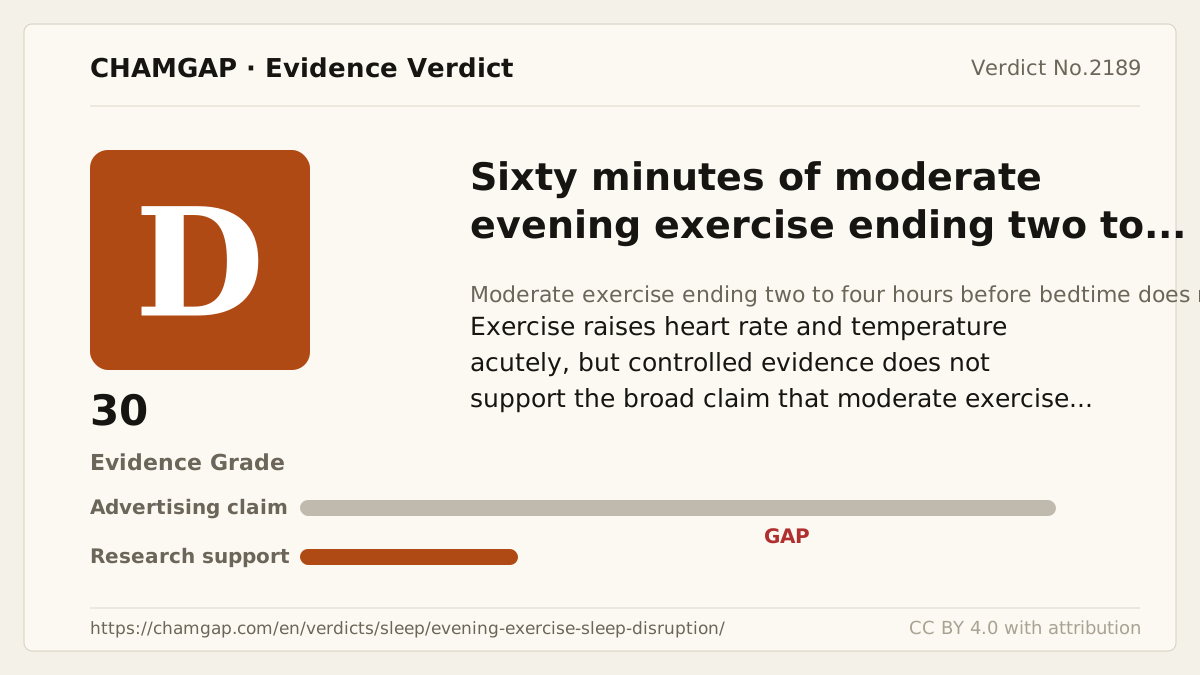
[Chamgap] Evening exercise x sleep disruption — Evidence Grade D·28. 2 cited sources checked. Source: https://chamgap.com/en/verdicts/sleep/evening-exercise-sleep-disruption/ · CC BY 4.0CC BY 4.0 — free to use with attribution; do not distort grades, numbers, or verdict meaning.
What this document does and does not do
Chamgap is an information source. It reports what research has and has not confirmed; it does not tell readers what to take or buy. That decision belongs to readers and, when needed, medical or legal professionals. This verdict reflects literature available up to the search date and may change as new research appears. Nothing here is medical advice.