
Eszopiclone,
does it really help with Shorter sleep onset, improved sleep maintenance, and increased total sleep time in chronic insomnia?
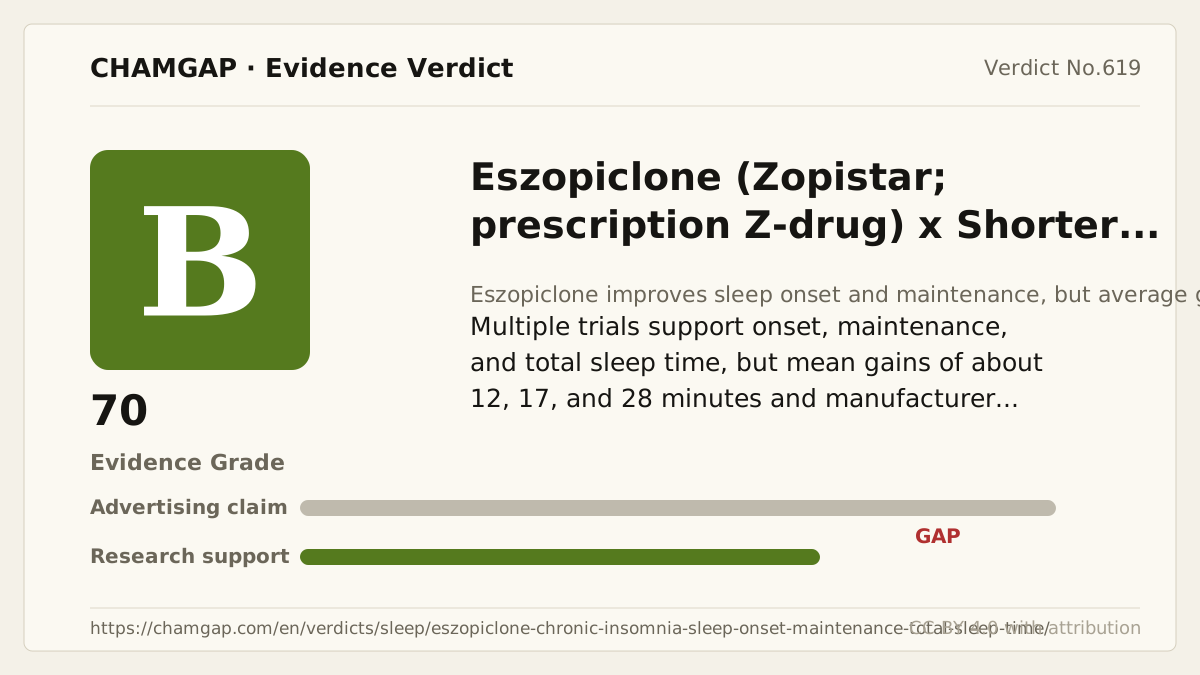
research showsThe claim that eszopiclone improves sleep onset, maintenance, and total sleep time in chronic insomnia is rated B. Across 14 randomized trials and 4,732 participants in a Cochrane review, people fell asleep about 12 minutes faster, spent about 17 fewer minutes awake after sleep onset, and slept about 28 minutes longer than with placebo. Multiple placebo-controlled trials and an AASM guideline support efficacy, but the average benefit is smaller than consumer expectations of complete restorative sleep and source trials are concentrated in the manufacturer's development program. Dependence and discontinuation, unpleasant taste, next-day function, and complex sleep behaviors are separate safety issues. Eszopiclone is different from zolpidem in verdict 584 and lemborexant in verdict 599.
ads claimMarketing can expand average changes of tens of minutes into complete normalization of deep natural sleep, guaranteed next-day refreshment, and dependence-free long-term use. Trials show average improvement in insomnia symptoms, not restorative sleep or long-term freedom from risk for every patient.
Useful facts when choosing a product
- Eszopiclone is a prescription Z-drug for adult sleep-onset and sleep-maintenance insomnia, and the starting and maximum doses of products such as Zopistar must follow the prescription with adjustments for age, liver function, and interacting drugs.
- It should be taken immediately before bed only when at least seven to eight hours remain for sleep; insufficient sleep time, higher doses, or other central nervous system depressants increase next-day driving and judgment impairment.
- Unpleasant or metallic taste, dry mouth, dizziness, and somnolence are common, while tolerance, dependence, withdrawal, or rebound insomnia make unsupervised dose escalation, prolonged use, and abrupt discontinuation inappropriate.
- Sleepwalking, sleep driving, cooking, phone calls, and other complex sleep behaviors can rarely cause serious injury or death and require immediate discontinuation and contact with a clinician.
Chamgap Semantic Classification Code
Candidate index · review held
M.eszopiclone.UNK.shorter-sleep-onset-improved-sleep-maintenance-and-increased-total-sleep-time-in-chronic-insomnia.increase.placeboMedicinal interventions > Eszopiclone > Unknown > Shorter sleep onset, improved sleep maintenance, and increased total sleep time in chronic insomnia > Increase claim > Placebo
An automated migration candidate, not an issued permanent code; exact claim scope remains under review. This machine-generated migration candidate helps retrieval but is not a permanent assignment. The original verdict ID and URL remain authoritative.
What the research actually shows
The Cochrane review by Rösner and colleagues confirmed improvement in onset, maintenance, and total sleep time across 14 placebo-controlled trials, while unpleasant taste increased by an 18-percentage-point risk difference and somnolence by 4 points; evidence for next-day function and rebound was low certainty. The six-month double-blind trial by Krystal and colleagues in 788 participants found sustained participant-reported improvement in latency, awakenings, total sleep time, and sleep quality with 3 mg, but it belonged to the Sepracor development program and relied mainly on patient reports. The 2017 AASM guideline weakly recommended eszopiclone for adult sleep-onset and sleep-maintenance insomnia based on 2-mg and 3-mg trials, with downgrading for imprecision and publication bias. Eszopiclone shares the Z-drug class with zolpidem in verdict 584 but is a distinct molecule, while lemborexant in verdict 599 is an orexin antagonist with a different mechanism.
Why this is classified as B (70)
Moderate-certainty synthesis of 14 randomized trials and 4,732 participants, a six-month trial, and AASM guidance repeatedly support sleep-onset, maintenance, and total-sleep-time efficacy. Mean benefits were modest at about 12, 17, and 28 minutes, and manufacturer concentration, subjective outcomes, and low-certainty next-day and discontinuation evidence yield B with 70 points. Dependence, dysgeusia, next-day impairment, and complex sleep behaviors remain separate safety warnings.
Counterpoint. Cognitive behavioral therapy is first-line for chronic insomnia, while eszopiclone can be selected when medication is needed with defined goals and periodic reassessment. Sleep apnea, depression or anxiety, pain, medicines, and alcohol should be assessed as contributing causes.
Rejudgment record. New verdict — Accepted repeated improvements in sleep onset, wake after sleep onset, and total sleep time across 14 placebo-controlled trials, a six-month trial, and AASM guidance, while accounting for modest average effects, concentration in manufacturer development programs, subjective outcomes, and lower-certainty next-day and discontinuation evidence
Sub-claim grades by effect
This ingredient is marketed for several effects. A single overall grade blends strong and weak claims together, so each effect is graded separately here. The overall grade reflects the strongest disconfirming or core claim.
| Effect (sub-claim) | Grade | Basis |
|---|---|---|
| Shorter sleep onset, improved maintenance, and increased total sleep time in chronic insomnia | B | A moderate-certainty synthesis of 14 trials and guidelines repeatedly support efficacy, but mean effects are modest at about 12, 17, and 28 minutes. |
| Sustained efficacy through six months | C | A large placebo-controlled trial was positive, but manufacturer-program concentration and subjective outcomes prevent independent long-term confirmation. |
| Restful sleep without dependence, dysgeusia, or next-day impairment | F | Unpleasant taste and somnolence increased versus placebo, while labeling documents dependence potential, next-day impairment, and complex sleep behaviors, refuting a risk-free claim. |
| Complete normalization of natural restorative sleep | C | Average symptom and sleep-time improvements exist, but no direct clinical endpoint establishes complete normalization of restorative sleep. |
Cross-check — AI research and Codex final gate
Evidence Table
| Study | Design | Sample | Funding | Endpoint | Result | Weight |
|---|---|---|---|---|---|---|
| Rösner S et al. 2018 Cochrane review | Systematic review and meta-analysis of randomized placebo-controlled trials | Fourteen randomized trials and 4,732 participants | Cochrane and NIHR support; many included-trial investigators received Sepracor support or employment | Participant-reported sleep onset, wake after sleep onset, total sleep time, and adverse events | Versus placebo, sleep onset improved by 11.94 minutes, wake after sleep onset by 17.02 minutes, and total sleep time by 27.70 minutes. | Key moderate-certainty synthesis |
| Krystal AD et al. 2003 | Multicenter randomized double-blind six-month placebo-controlled trial | 788 adults with chronic primary insomnia; 593 assigned to eszopiclone and 195 to placebo | Sepracor development program with author conflicts of interest | Participant-reported sleep latency, awakenings, total sleep time, sleep quality, and next-day function | Sleep improvements with 3 mg persisted for six months, and unpleasant taste and headache were common. | Direct longer-term trial with manufacturer concentration and subjective outcomes |
| Sateia MJ et al. 2017 AASM guideline | Systematic evidence review and clinical practice guideline | At least six randomized trials of eszopiclone 2 mg and 3 mg | American Academy of Sleep Medicine | Sleep onset, total sleep time, sleep efficiency and quality, and sleep maintenance | Issued a weak recommendation for eszopiclone in adult sleep-onset and sleep-maintenance insomnia. | Guideline synthesis accounting for publication bias and imprecision |
Receipt — 5 References
All 5 cited sources were verified for existence at the original page (as of 2026-07-19).
Final verification and publication gate: Codex · Evidence date: 2026-07-19 · Corrections: none
Cite this verdict
[Chamgap] Eszopiclone x improved sleep onset, maintenance, and total sleep time in chronic insomnia — Evidence Grade B·70. 5 cited sources checked. Source: https://chamgap.com/en/verdicts/sleep/eszopiclone-chronic-insomnia-sleep-onset-maintenance-total-sleep-time/ · CC BY 4.0CC BY 4.0 — free to use with attribution; do not distort grades, numbers, or verdict meaning.
What this document does and does not do
Chamgap is an information source. It reports what research has and has not confirmed; it does not tell readers what to take or buy. That decision belongs to readers and, when needed, medical or legal professionals. This verdict reflects literature available up to the search date and may change as new research appears. Nothing here is medical advice.