
Electroacupuncture,
does it really help with Improved sleep onset, sleep maintenance, and insomnia severity in adults with chronic insomnia?
research showsElectroacupuncture is rated D for chronic insomnia in adults. In a 150-participant trial at four Korean hospitals, it improved ISI and sleep-diary outcomes versus usual care, but at the prespecified week-4 endpoint it did not significantly outperform sham on any outcome except diary-derived sleep efficiency. ISI differed from sham at weeks 8 and 12, but these were follow-up signals from one small trial. Cochrane judged acupuncture evidence insufficiently rigorous because of high risk of bias, heterogeneity, and publication bias, and European guidance did not recommend it on very-low-quality evidence. Small samples, subjective outcomes, and low certainty yield 31 points.
ads claimMarketing may claim that electrical stimulation resets sleep circuits or treats the cause of insomnia without medicines. The pivotal evidence is short-term and subjective, and electroacupuncture did not beat sham on its prespecified primary comparison.
Useful facts when choosing a product
- Electroacupuncture passes a weak current between inserted needles. It is distinct from manual acupuncture, auricular acupressure, and home electrical-stimulation devices.
- The main trial used ten sessions over four weeks; a standardized maintenance regimen or permanent benefit has not been established.
- Cognitive behavioral therapy for insomnia is first-line treatment for chronic insomnia, alongside assessment for sleep apnea, mood disorders, pain, medicines, caffeine, and other causes.
- Common harms are needling pain, bruising, and minor bleeding. Sterile technique reduces infection risk, and deep thoracic needling can very rarely cause pneumothorax.
Chamgap Semantic Classification Code
Candidate index · review held
K.electroacupuncture.UNK.sleep-onset-sleep-maintenance-and-insomnia-severity-with-chronic-insomnia.improve.MULTIFolk and alternative interventions > Electroacupuncture > Unknown > sleep onset, sleep maintenance, and insomnia severity with chronic insomnia > Improvement claim > Multiple: primary unresolved
An automated migration candidate, not an issued permanent code; exact claim scope remains under review. This machine-generated migration candidate helps retrieval but is not a permanent assignment. The original verdict ID and URL remain authoritative.
What the research actually shows
Lee and colleagues randomized 150 adults with DSM-5 insomnia disorder to electroacupuncture, sham electroacupuncture, or usual care for ten sessions over four weeks. Week-4 ISI and PSQI favored electroacupuncture over usual care but not over sham, apart from diary-derived sleep efficiency; ISI favored electroacupuncture at weeks 8 and 12. The Cochrane review by Cheuk and colleagues included 33 trials of needle acupuncture, electroacupuncture, acupressure, and related methods, but high risk of bias, heterogeneity, small imprecise effects, and publication bias made conclusions uncertain. European guidance prioritizes CBT-I and does not recommend acupuncture.
Why this is classified as D (31)
Usual-care improvement and later sham signals are acknowledged, but the week-4 sham primary comparison in a 150-person trial was neutral, objective sleep evidence and independent replication are limited, and reviews and guidance rate certainty poorly. This yields D with 31 points.
Counterpoint. It may be chosen as an adjunct by patients wishing to avoid medication adverse effects, but it should not replace CBT-I or be presented as guaranteed objective sleep normalization.
Rejudgment record. New verdict — Applied boundary rule ②: accepted improvement versus usual care and ISI signals versus sham at weeks 8 and 12 in a Korean 150-person multicenter trial, but weighed the nonsignificant prespecified week-4 electroacupuncture-versus-sham ISI comparison, predominantly subjective outcomes, small sample, and low-certainty conclusions from Cochrane and guidelines
Sub-claim grades by effect
This ingredient is marketed for several effects. A single overall grade blends strong and weak claims together, so each effect is graded separately here. The overall grade reflects the strongest disconfirming or core claim.
| Effect (sub-claim) | Grade | Basis |
|---|---|---|
| Shorter sleep-onset latency | D | Diary signals exist, but consistent week-4 superiority over sham and objective replication are lacking. |
| Improved sleep maintenance | D | Week-4 sleep efficiency favored electroacupuncture over sham, but it was a subjective diary result from one small trial. |
| Improved Insomnia Severity Index score | D | The week-4 sham comparison was nonsignificant, with differences appearing only at follow-up weeks 8 and 12. |
Cross-check — AI research and Codex final gate
Evidence Table
| Study | Design | Sample | Funding | Endpoint | Result | Weight |
|---|---|---|---|---|---|---|
| Lee B et al. 2020 | Multicenter randomized assessor-blinded electroacupuncture, sham, and usual-care trial | 150 adults with DSM-5 insomnia disorder | Korea Institute of Oriental Medicine funding | Week-4 ISI, PSQI, sleep diary, and follow-up at weeks 8 and 12 | It improved outcomes versus usual care, but at week 4 only sleep efficiency differed from sham; ISI differed at weeks 8 and 12. | Key direct sham-controlled evidence with mixed results |
| Cheuk DKL et al. 2012 Cochrane review | Systematic review of randomized trials of acupuncture for insomnia | 33 trials and 2,293 participants | Academic Cochrane review | Sleep quality, latency, duration, wakefulness, ISI, and PSQI | All trials had high risk of bias, with heterogeneity and publication bias making evidence insufficient to support or refute acupuncture. | Low-certainty synthesis |
| Riemann D et al. 2017 European guideline | Evidence-based European guideline for adult insomnia | Body of evidence for adult insomnia | European Sleep Research Society | Insomnia symptoms and treatment benefits and harms | Weakly recommended against complementary treatments including acupuncture on very-low-quality evidence. | Major guideline limitation |
Receipt — 3 References
All 3 cited sources were verified for existence at the original page (as of 2026-07-23).
Final verification and publication gate: Codex · Evidence date: 2026-07-23 · Corrections: none
Cite this verdict
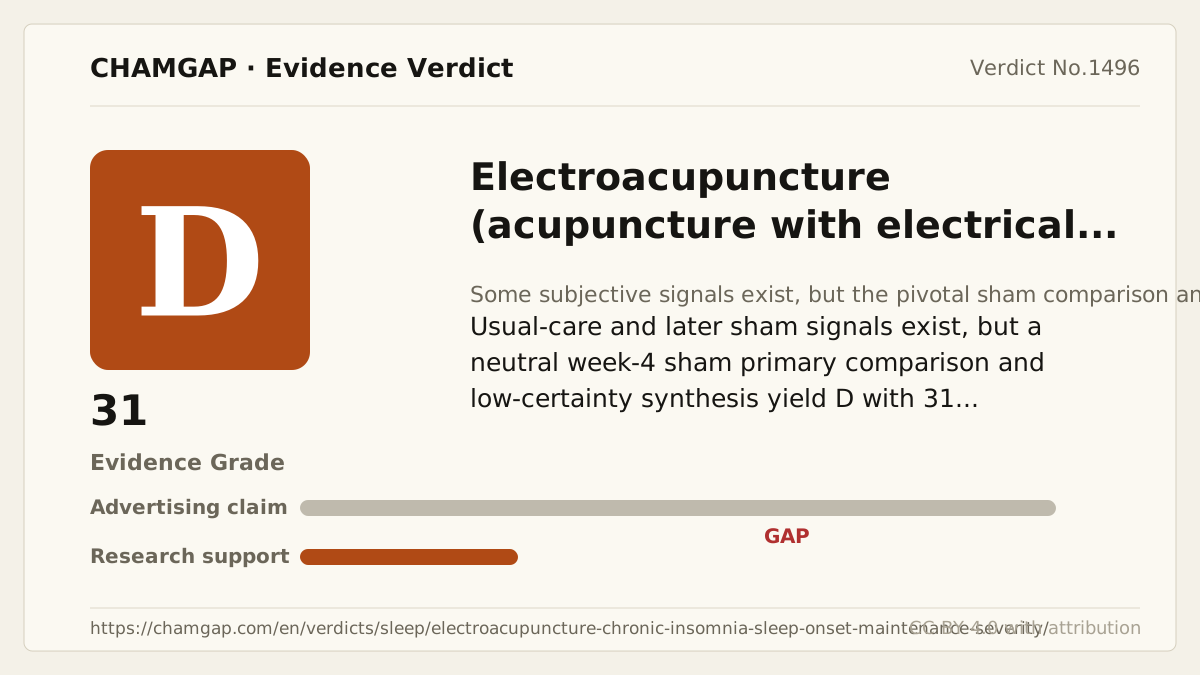
[Chamgap] Electroacupuncture x sleep onset, maintenance, and severity in chronic insomnia — Evidence Grade D·31. 3 cited sources checked. Source: https://chamgap.com/en/verdicts/sleep/electroacupuncture-chronic-insomnia-sleep-onset-maintenance-severity/ · CC BY 4.0CC BY 4.0 — free to use with attribution; do not distort grades, numbers, or verdict meaning.
What this document does and does not do
Chamgap is an information source. It reports what research has and has not confirmed; it does not tell readers what to take or buy. That decision belongs to readers and, when needed, medical or legal professionals. This verdict reflects literature available up to the search date and may change as new research appears. Nothing here is medical advice.