
Early complementary-food introduction,
does it really help with Longer nighttime sleep, fewer night wakings, and fewer parent-perceived infant sleep problems?
research showsThe grade is C with 50 points. In the prespecified secondary sleep analysis of the 1,303-infant EAT randomized trial, nighttime sleep at 6 months was 16.6 minutes longer and wakings were 2.01 versus 1.74 per night with early introduction. Across three years, however, the average gain was only 7.3 minutes nightly, and every sleep outcome was reported by parents who knew allocation. The registered food-allergy primary outcome of the parent trial failed in intention-to-treat analysis, so this small secondary result does not establish a marked sleep benefit.
ads claimThis was not merely starting ordinary solids a little earlier. It was a structured six-allergen introduction regimen with continued breastfeeding. Korean complementary-feeding guidance or sleep consultants should not convert it into a promise that feeding early makes babies sleep through the night. Verdict 2234 is D with 28 points and verdict 2235 is D with 30 points; both concern modified baby-led weaning from around 6 months and are distinct from allergenic-food introduction from 3 months here.
Useful facts when choosing a product
- The intervention added complementary foods from 3 months while breastfeeding continued; it did not replace breastfeeding.
- Only 223 early-introduction infants, 42% of those evaluable for adherence, fully met the six-food regimen.
- Soon after 6 months, solid-food quantities were essentially the same in both groups, with no anthropometric difference at age 1 year.
- The modified baby-led approach in verdicts 2234 and 2235 starts around 6 months and is not the same program as this 3-month allergenic-food introduction.
Chamgap Semantic Classification Code
Candidate index · review held
F.complementary-feeding-program-starting-at-about-while-breastfeeding-continued.food.longer-nighttime-sleep-fewer-night-wakings-and-fewer-parent-perceived-infant-sleep-problems.assess.UNKFoods and beverages > complementary-feeding program starting at about while breastfeeding continued > Food consumption > Longer nighttime sleep, fewer night wakings, and fewer parent-perceived infant sleep problems > Association or change assessment > Unknown
An automated migration candidate, not an issued permanent code; exact claim scope remains under review. This machine-generated migration candidate helps retrieval but is not a permanent assignment. The original verdict ID and URL remain authoritative.
What the research actually shows
ISRCTN14254740 randomized 1,303 exclusively breastfed 3-month-old infants: 652 to early introduction and 651 to standard introduction. The early group continued breastfeeding, began nonallergenic foods, then sequentially introduced cow's milk, peanut, egg, sesame, white fish, and wheat, aiming for each food twice weekly by 5 months. Mean age of solids introduction was 16.2 versus 23.1 weeks. Controls followed then-current UK advice to breastfeed exclusively until about 6 months and avoid food before then. The registered primary outcome was challenge-proven allergy to one or more of the six foods at ages 1 to 3 years, and the registered comparator matched the paper. That primary outcome failed in intention-to-treat analysis: 7.1% versus 5.6%, P=.32. The sleep paper describes the Brief Infant Sleep Questionnaire, collected 15 times, as an a priori secondary analysis. Whether sleep was a preregistered outcome could not be confirmed. The final questionnaire was completed by 1,225 participants, or 94%, and mixed-effects models with multiple imputation were used. Parents knew assignment and no actigraphy was used; the investigators acknowledged that actigraphy could have reduced expectation-related reporting bias. A smaller bedtime rice-cereal trial used a different age, food, and delivery method, so it is neither replication nor a directly conflicting test of this intervention.
Why this is classified as C (50)
A large publicly funded randomized trial found positive sleep results, but these came from a secondary analysis after the registered allergy primary outcome failed, and the magnitude was small. All sleep outcomes were reported by parents aware of allocation despite objective measurement being possible, resulting in C with 50 points.
Counterpoint. A small mean difference may matter to some severely sleep-deprived families, but it does not support a promise of large improvement.
Rejudgment record. Cross-check applied — Comparison of the ISRCTN record, parent food-allergy report, and sleep secondary analysis, separating sleep duration, wakings, and parent-perceived problems while assessing absolute magnitude and reporting bias
| Endpoint | P | Symptom or function itself is the target - including patient reports and performance tests |
| Replication | R1 | Single confirmatory trial |
| Independence | I2 | Decisive evidence is publicly or non-profit funded |
| Effect size | E~ | Statistically positive but below the threshold |
Stored derived and displayed grades match; this is not a current recalculation or validity check (C).
Sub-claim grades by effect
This ingredient is marketed for several effects. A single overall grade blends strong and weak claims together, so each effect is graded separately here. The overall grade reflects the strongest disconfirming or core claim.
| Effect (sub-claim) | Grade | Basis |
|---|---|---|
| Longer nighttime sleep | C | The gain was 16.6 minutes at 6 months and 7.3 minutes on average, statistically positive but small. |
| Fewer night wakings | C | Wakings were 2.01 versus 1.74 at 6 months and 9.1% fewer over follow-up. |
| Fewer parent-perceived serious sleep problems | C | The odds difference was positive but based on reports by parents aware of allocation. |
Cross-check — AI research and Codex final gate
Evidence Table
| Study | Design | Sample | Funding | Endpoint | Result | Weight |
|---|---|---|---|---|---|---|
| Perkin et al. 2018 EAT sleep secondary analysis | Prespecified secondary sleep analysis of a large randomized trial | 1,303 randomized; 1,225 (94%) completed the 3-year questionnaire | UK Food Standards Agency contracts T07051 and FS101178, Medical Research Council grant MC_G1001205, Davis Foundation; skin work supported by UK NIHR and Flohr award NIHRCS/01/2008/009 | Parent-reported nighttime sleep duration, night wakings, and sleep problems from 3 months to 3 years | At 6 months, +16.6 minutes and 2.01 vs 1.74 wakings; over follow-up, +7.3 minutes and 9.1% fewer wakings | Decisive but secondary and parent-reported evidence |
| Perkin et al. 2016 parent EAT trial | Registered primary analysis of the randomized trial | 1,303 randomized; 595 versus 567 in primary analysis | UK Food Standards Agency T07051, Medical Research Council MC_G1001205, Davis Foundation, and UK NIHR support | Challenge-proven allergy to one or more of six foods at ages 1 to 3 years | Primary ITT result failed at 7.1% vs 5.6%, P=.32; no growth, hospitalization, or emergency-visit difference | Registration-outcome and safety cross-check |
Receipt — 4 References
All 4 cited sources were verified for existence at the original page (as of 2026-08-08).
Final verification and publication gate: Codex · Evidence date: 2026-08-08 · Corrections: none
Cite this verdict
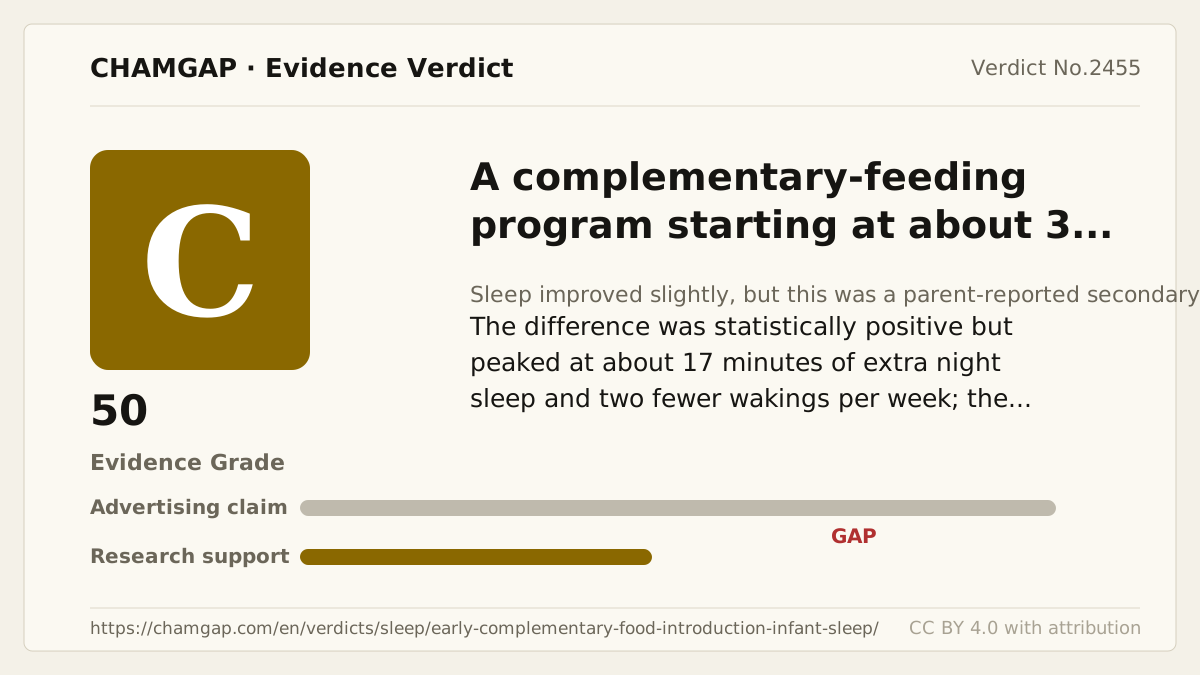
[Chamgap] Early complementary-food introduction x improved infant sleep — Evidence Grade C·50. 4 cited sources checked. Source: https://chamgap.com/en/verdicts/sleep/early-complementary-food-introduction-infant-sleep/ · CC BY 4.0CC BY 4.0 — free to use with attribution; do not distort grades, numbers, or verdict meaning.
What this document does and does not do
Chamgap is an information source. It reports what research has and has not confirmed; it does not tell readers what to take or buy. That decision belongs to readers and, when needed, medical or legal professionals. This verdict reflects literature available up to the search date and may change as new research appears. Nothing here is medical advice.