
Dawn-simulation sunrise alarm,
does it really help with Improved sleep inertia, post-waking sleepiness, and alert performance in adults with difficulty waking?
research showsDawn-simulation alarms are rated D because extremely small positive sleep-inertia signals are inconsistent. A randomized crossover trial of eight people in 2014 reported better subjective alertness, addition performance, and reaction time. A 16-person laboratory study also reported some alertness and cognitive benefits but only as a conference abstract. In contrast, a 23-person middle-aged and older-adult crossover trial found no significant subjective or objective alertness effect. No key GRADE-rated meta-analysis exists, and small samples, differing protocols, and inconsistent endpoints support D.
ads claimNatural waking can be expanded into elimination of sleep inertia, improved objective cognition, and better sleep duration and efficiency. Bright-light therapy for nonseasonal depression has a different efficacy axis from this pre-awakening ramped-light device.
Useful facts when choosing a product
- A sunrise alarm gradually raises light intensity for tens of minutes before a set waking time to simulate dawn.
- Illuminance, spectrum, ramp curve, and exposure duration differed across studies and commercial products are not established as equivalent.
- Light can cause glare, headache, migraine, or reduced sleep time, and photosensitive conditions or photosensitizing medicines require caution.
- Completed studies are mainly single-session or short laboratory crossover experiments, with inadequate evidence for long-term sleep duration or efficiency.
Chamgap Semantic Classification Code
Candidate index · review held
P.dawn-simulation-sunrise-alarm.device.sleep-inertia-post-waking-sleepiness-and-alert-performance-with-difficulty-waking.improve.UNKProcedures, devices and tests > Dawn-simulation sunrise alarm > Device delivered > sleep inertia, post-waking sleepiness, and alert performance with difficulty waking > Improvement claim > Unknown
An automated migration candidate, not an issued permanent code; exact claim scope remains under review. This machine-generated migration candidate helps retrieval but is not a permanent assignment. The original verdict ID and URL remain authoritative.
What the research actually shows
Thompson 2014 randomized eight adults with difficulty waking to dawn simulation during the final 30 minutes of sleep and a control condition in crossover order. Alertness was higher, additions were 69.5 versus 66.9, and reaction time was 0.81 versus 0.86 seconds, but only eight people were studied. Yang 2018 reported better alertness, mood, and selected cognitive outcomes in a 16-person three-condition sleep-restriction crossover experiment published as an abstract. Gabel 2020 studied 23 middle-aged and older adults over two laboratory nights; dawn light reduced sleep by 33% but did not improve subjective or objective alertness.
Why this is classified as D (32)
An eight-person trial and a 16-person abstract provided positive subjective and performance signals, but a 23-person trial was null for subjective and objective alertness. No key GRADE synthesis exists, and very small inconsistent evidence gives D with 32 points.
Counterpoint. Cause of waking difficulty, clock time, dose, and chronotype may modify response.
Rejudgment record. New verdict — Applied D because evidence consists of exploratory crossover trials with 8 to 23 participants, subjective-heavy endpoints, inconsistent positive and null findings, and no key GRADE meta-analysis
Sub-claim grades by effect
This ingredient is marketed for several effects. A single overall grade blends strong and weak claims together, so each effect is graded separately here. The overall grade reflects the strongest disconfirming or core claim.
| Effect (sub-claim) | Grade | Basis |
|---|---|---|
| Reduced sleep inertia and post-waking sleepiness | D | Extremely small subjective positive signals coexist with a null trial. |
| Improved cognitive performance after waking | D | Signals come from an eight-person trial and a 16-person abstract without independent confirmation. |
| Improved total sleep time or sleep efficiency | D | No direct improvement evidence exists, and one trial found less sleep on the dawn-simulation night. |
Cross-check — AI research and Codex final gate
Evidence Table
| Study | Design | Sample | Funding | Endpoint | Result | Weight |
|---|---|---|---|---|---|---|
| Thompson A et al. 2014 | Random-order crossover trial | Eight adults with difficulty waking | Limited funding information | Subjective alertness, addition, reaction time, and cycling performance | Alertness, additions, and reaction time were positive, while cycling performance had p=0.07. | Extremely small direct positive trial |
| Gabel V et al. 2020 | Laboratory crossover clinical trial | 23 middle-aged and older adults | Academic research | Subjective and objective alertness, balance, cardiovascular measures, and cortisol | Sleep was reduced by 33%, but subjective and objective alertness did not improve. | Direct trial establishing inconsistency |
Receipt — 2 References
All 2 cited sources were verified for existence at the original page (as of 2026-07-23).
Final verification and publication gate: Codex · Evidence date: 2026-07-23 · Corrections: none
Cite this verdict
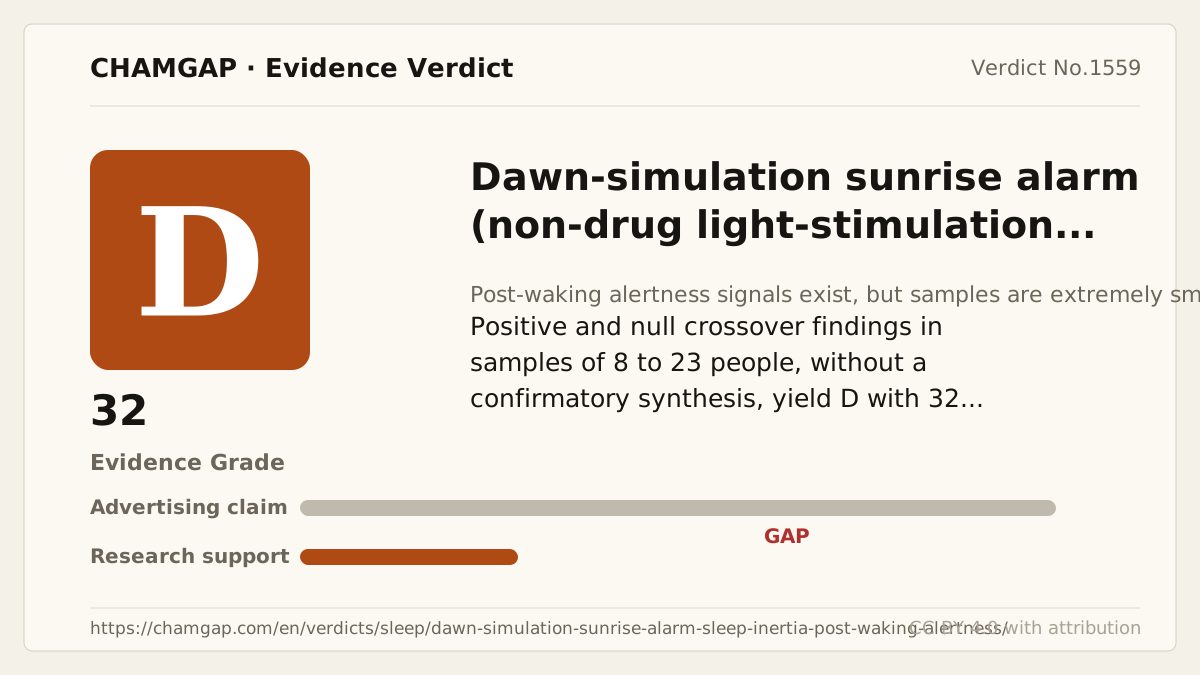
[Chamgap] Dawn-simulation sunrise alarm x improved sleep inertia, post-waking sleepiness, and alert performance — Evidence Grade D·32. 2 cited sources checked. Source: https://chamgap.com/en/verdicts/sleep/dawn-simulation-sunrise-alarm-sleep-inertia-post-waking-alertness/ · CC BY 4.0CC BY 4.0 — free to use with attribution; do not distort grades, numbers, or verdict meaning.
What this document does and does not do
Chamgap is an information source. It reports what research has and has not confirmed; it does not tell readers what to take or buy. That decision belongs to readers and, when needed, medical or legal professionals. This verdict reflects literature available up to the search date and may change as new research appears. Nothing here is medical advice.