
Continuous pink noise,
does it really help with Improved sleep onset, sleep maintenance, and deep sleep in adults?
research showsContinuous pink noise is rated D because consistent improvement in adult sleep onset, maintenance, or deep sleep has not been established. A 2021 systematic review of 38 articles on continuous white and similar broadband noise found results ranging from improvement to disruption and rated the evidence very low quality. In a 2026 sleep-laboratory study of 25 adults, pink noise masked some traffic-noise effects but 50-dBA pink noise alone reduced REM sleep by about 19 minutes. Brief closed-loop pulses synchronized to sleep stage are a different intervention from continuous playback.
ads claimMarketing says pink noise synchronizes brain waves, induces sleep immediately, prevents awakenings, and increases slow-wave sleep. This often transfers findings from brief sleep-stage-targeted closed-loop stimulation to all-night continuous audio.
Useful facts when choosing a product
- Pink noise is broadband sound with decreasing energy at higher frequencies; continuous all-night playback differs from brief closed-loop acoustic stimulation synchronized to brain-wave phase.
- If used, select the lowest comfortable volume, place the speaker away from the head, and consider a timer because prolonged louder exposure can affect hearing and sleep.
- Persistent insomnia, snoring, apneas, or excessive daytime sleepiness warrant evaluation and cognitive behavioral therapy for insomnia rather than reliance on a sound machine.
Chamgap Semantic Classification Code
Candidate index · review held
P.continuous-pink-noise-audio-or-sound-machine.device.sleep-onset-sleep-maintenance-and-deep-sleep.improve.UNKProcedures, devices and tests > Continuous pink-noise audio or sound machine > Device delivered > sleep onset, sleep maintenance, and deep sleep > Improvement claim > Unknown
An automated migration candidate, not an issued permanent code; exact claim scope remains under review. This machine-generated migration candidate helps retrieval but is not a permanent assignment. The original verdict ID and URL remain authoritative.
What the research actually shows
Riedy 2021 systematically reviewed continuous broadband noise and sleep, finding positive, null, and adverse results with high risk of bias and a need for objective studies before promotion. Basner 2026 compared traffic noise, pink noise, and earplugs in a 25-adult polysomnographic crossover experiment; earplugs were the most consistent protection, while 50-dBA pink noise alone reduced REM sleep by about 19 minutes.
Why this is classified as D (30)
The continuous-broadband-noise review found very low-quality evidence with positive, null, and adverse results. Pink-noise-specific objective studies remain tiny and include a REM-reduction signal, so onset, maintenance, and slow-wave-sleep claims remain unestablished, giving D with 30 points.
Counterpoint. Low-level masking of intermittent environmental noise may be practical for some users. Stopping is reasonable if it does not help, increases awakenings, or worsens daytime sleepiness.
Rejudgment record. New verdict — Applied rule ② and grade D because continuous broadband-noise studies are highly heterogeneous and biased with positive, null, and sleep-disruptive findings, while pink-noise-specific objective evidence remains very small
Sub-claim grades by effect
This ingredient is marketed for several effects. A single overall grade blends strong and weak claims together, so each effect is graded separately here. The overall grade reflects the strongest disconfirming or core claim.
| Effect (sub-claim) | Grade | Basis |
|---|---|---|
| Improved sleep onset in adults | D | Pink-noise-specific objective evidence is sparse and broadband-noise studies alternate between positive and null results. |
| Improved sleep maintenance in adults | D | There is a signal for masking environmental noise, but universal maintenance benefit in quiet settings is not established. |
| Increased deep or slow-wave sleep in adults | D | Continuous-playback evidence is inconsistent, closed-loop pulse studies cannot be transferred, and a REM-reduction signal exists. |
Cross-check — AI research and Codex final gate
Evidence Table
| Study | Design | Sample | Funding | Endpoint | Result | Weight |
|---|---|---|---|---|---|---|
| Riedy SM et al. 2021 | Systematic review of continuous broadband noise and sleep | Thirty-eight included articles | United States federal research support reported | Subjective and objective sleep outcomes | Findings ranged from improved to disrupted sleep, and GRADE evidence quality was very low. | Key evidence of heterogeneity and uncertainty |
| Basner M et al. 2026 | Randomized polysomnographic sleep-laboratory crossover trial | Twenty-five healthy adults | United States Department of Transportation and academic support | Sleep architecture, arousals, and REM during environmental noise | Pink noise masked some traffic noise, but 50 dBA alone reduced REM by about 19 minutes and earplugs were more consistent. | Small objective efficacy and safety signal |
Receipt — 2 References
All 2 cited sources were verified for existence at the original page (as of 2026-07-23).
Final verification and publication gate: Codex · Evidence date: 2026-07-23 · Corrections: none
Cite this verdict
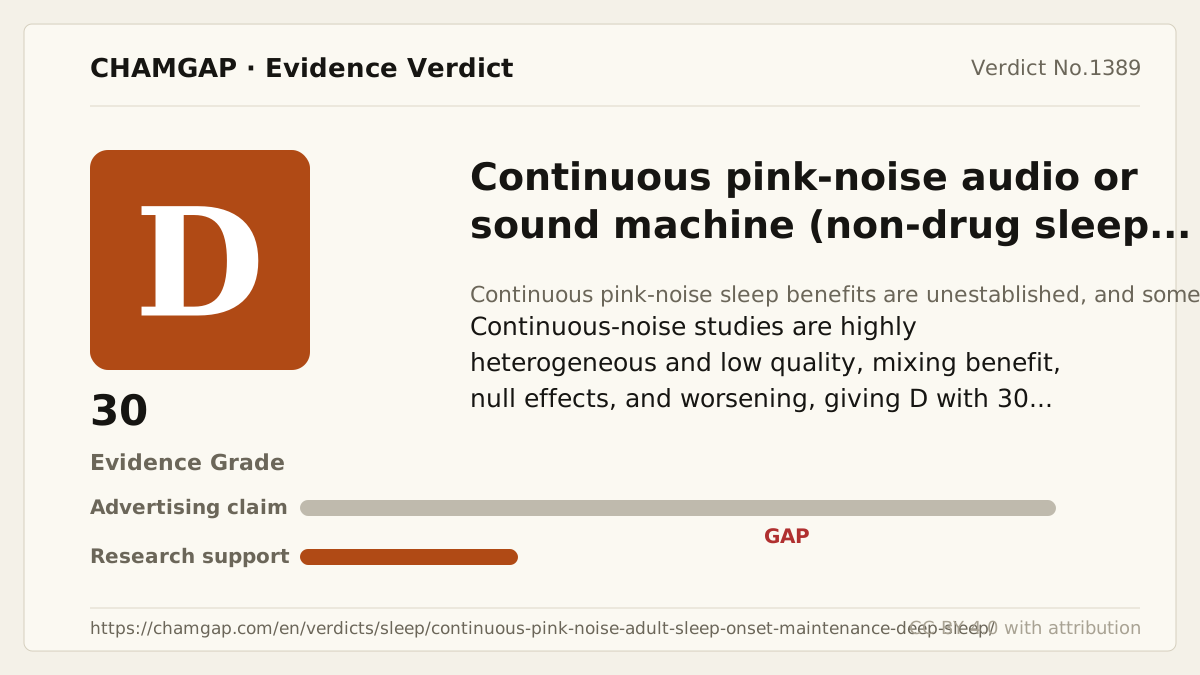
[Chamgap] Continuous pink noise x improved sleep onset, maintenance, and deep sleep in adults — Evidence Grade D·30. 2 cited sources checked. Source: https://chamgap.com/en/verdicts/sleep/continuous-pink-noise-adult-sleep-onset-maintenance-deep-sleep/ · CC BY 4.0CC BY 4.0 — free to use with attribution; do not distort grades, numbers, or verdict meaning.
What this document does and does not do
Chamgap is an information source. It reports what research has and has not confirmed; it does not tell readers what to take or buy. That decision belongs to readers and, when needed, medical or legal professionals. This verdict reflects literature available up to the search date and may change as new research appears. Nothing here is medical advice.