
Closed-loop pink-noise pulses timed to the rising phase of EEG slow waves during sleep,
does it really help with Improved next-day declarative-memory consolidation and stimulation-window slow-wave activity in older adults?
research showsGrade C. In a randomized crossover night involving 13 healthy adults aged 60 to 84, overnight paired-word recall improved by 9.2 versus 3.1 words with active versus sham stimulation. Whole-night NREM slow-wave activity did not differ, and the positive physiological effect was confined to short stimulation windows. This was not ordinary continuous pink noise played from a speaker.
ads claimMarketing can turn a precisely EEG-timed intervention into the much broader claim that continuous pink noise improves deep sleep and memory. The study required real-time phase detection and brief pulses.
Useful facts when choosing a product
- The intervention used brief EEG-timed pulses, not continuous playback.
- Each condition was tested for one night.
- No consumer speaker or app was evaluated.
Chamgap Semantic Classification Code
Permanent code issued
P.phase-locked-acoustic-stimulation.device.paired-word-recall.improve.shamProcedures, devices and tests > Closed-loop pink-noise pulses timed to the rising phase of EEG slow waves during sleep > Device delivered > Improved next-day declarative-memory consolidation and stimulation-window slow-wave activity in older adults > Improvement claim > Sham
Codex retrospectively verified the principal intervention, delivery, population, endpoint, and comparator from the existing reviewed verdict and issued a permanent semantic code. Secondary outcomes on the page are not transferred as separate claims. The code identifies the intervention and claim; it never contains the evidence grade, score, or safety result.
Exact Claim Classification
These independent facets prevent evidence from different forms, routes, populations, effects, and comparators from being mixed.
| Intervention class | P · Procedure, surgery, device, or test |
|---|---|
| Canonical ingredient or intervention | Closed-loop pink-noise pulses timed to the rising phase of EEG slow waves during sleep |
| Source or part used | Plant source not applicable; specified device or procedure |
| Formulation or processing | Closed-loop pink-noise pulses timed to the rising phase of EEG slow waves during sleep |
| Route | Device delivered |
| Dose | Closed-loop pink-noise pulses timed to the rising phase of EEG slow waves during sleep |
| Duration | One night per condition |
| Population | 13 healthy adults aged 60-84, one night per condition |
| Effect or condition | Improved next-day declarative-memory consolidation and stimulation-window slow-wave activity in older adults |
| Primary endpoint | Whole-night and stimulation-window NREM slow-wave activity plus overnight paired-word recall |
| Comparator | Sham |
| Duplicate-detection key | phase-locked-acoustic-stimulation|device|13 healthy adults aged 60-84, one night per condition|paired-word-recall|One night per condition |
What the research actually shows
Thirteen adults aged 60 to 84 received active and sham nights in random order. Whole-night NREM slow-wave activity was 121.7 versus 124.4 μV²/Hz, P=.80; activity during stimulation windows rose by about 8%, P=.002. Overnight paired-word improvement was 9.2 versus 3.1 words, P=.02.
Why this is classified as C (54)
Positive memory and stimulation-window effects are offset by a null whole-night measure, surrogate or functional outcomes, n=13, one-night exposure, and no independent confirmation, giving C with 54 points.
Counterpoint. The crossover design controlled inter-individual variability well.
Rejudgment record. Codex full-text cross-check — Accepted an at-least-moderate memory effect and public funding while accounting for surrogate or functional outcomes, n=13, one-night exposure, lack of independent confirmation, and null whole-night SWA
| Endpoint | S | Surrogate marker - laboratory or imaging measures |
| Replication | R1 | Single confirmatory trial |
| Independence | I2 | Decisive evidence is publicly or non-profit funded |
| Effect size | E+ | Meets the clinically important threshold |
| Precision | C0 | The confidence interval leaves room for benefit |
Stored derived and displayed grades match; this is not a current recalculation or validity check (C).
Sub-claim grades by effect
This ingredient is marketed for several effects. A single overall grade blends strong and weak claims together, so each effect is graded separately here. The overall grade reflects the strongest disconfirming or core claim.
| Effect (sub-claim) | Grade | Basis |
|---|---|---|
| Improved next-day paired-word memory | C | Positive in one small crossover trial. |
| Increased whole-night deep sleep | D | Whole-night NREM slow-wave activity was null, P=.80. |
Cross-check — AI research and Codex final gate
Evidence Table
| Study | Design | Sample | Funding | Endpoint | Result | Weight |
|---|---|---|---|---|---|---|
| Papalambros NA et al. 2017 | Randomized STIM-versus-sham crossover sleep-laboratory trial | 13 healthy adults aged 60-84, one night per condition | Public NIA, NSF, and NINDS support; related patent applications disclosed | Whole-night and stimulation-window NREM slow-wave activity plus overnight paired-word recall | Whole-night SWA P=.80; stimulation-window SWA about +8%, P=.002; recall improvement +9.2 vs +3.1 words, P=.02 | Small physiological proof-of-concept trial |
Receipt — 1 References
All 1 cited sources were verified for existence at the original page (as of 2026-09-07).
Final verification and publication gate: Codex · Evidence date: 2026-09-07 · Corrections: none
Cite this verdict
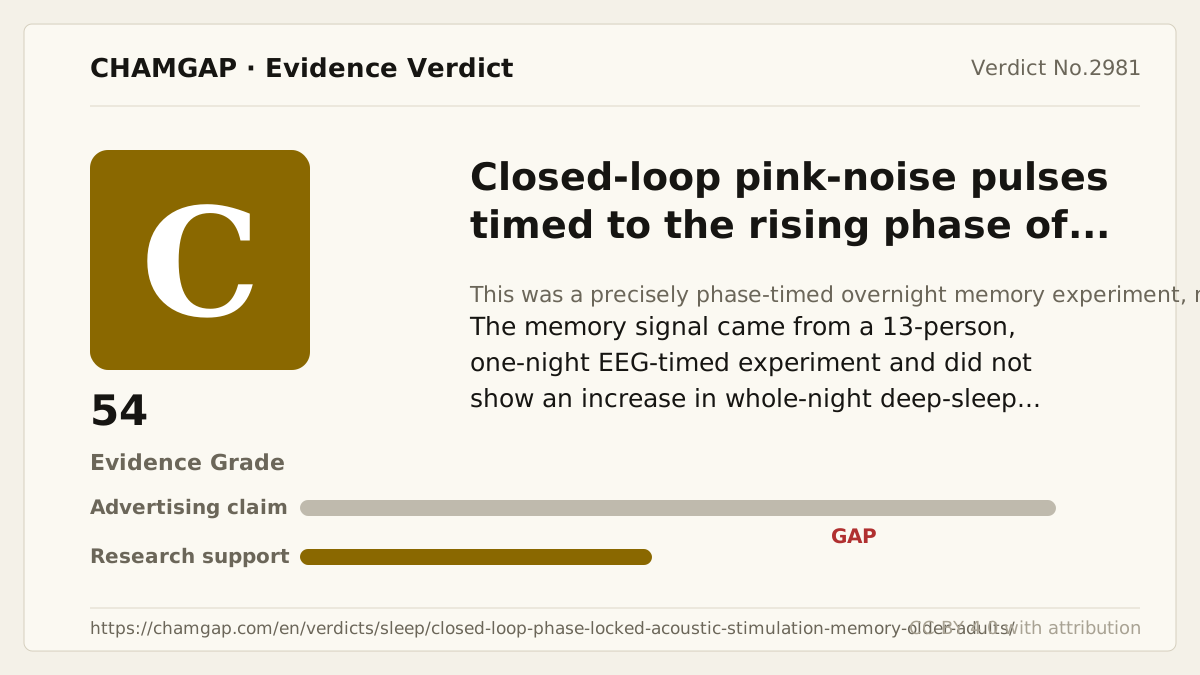
[Chamgap] Closed-Loop Phase-Locked Acoustic Stimulation for Next-Day Memory in Older Adults — Evidence Grade C·54. 1 cited sources checked. Source: https://chamgap.com/en/verdicts/sleep/closed-loop-phase-locked-acoustic-stimulation-memory-older-adults/ · CC BY 4.0CC BY 4.0 — free to use with attribution; do not distort grades, numbers, or verdict meaning.
What this document does and does not do
Chamgap is an information source. It reports what research has and has not confirmed; it does not tell readers what to take or buy. That decision belongs to readers and, when needed, medical or legal professionals. This verdict reflects literature available up to the search date and may change as new research appears. Nothing here is medical advice.