
CBT-I for late-life insomnia,
does it really help with Prevention of incident and recurrent major depressive disorder over three years?
research showsThe grade is C with 56 points. In a single-site trial of 291 participants, major depression occurred in 19/156 (12.2%) with CBT-I versus 35/135 (25.9%) with sleep education, HR 0.51 (95% CI 0.29-0.88). However, 24-month retention was 73.1% versus 86.7%, and follow-up was extended from 24 to 36 months after lower-than-expected event incidence was observed.
ads claimImproved sleep cannot be substituted for depression prevention evidence. This trial directly counted diagnosed major depressive episodes.
Useful facts when choosing a product
- CBT-I combines stimulus control, sleep restriction, and cognitive restructuring.
- The active control covered sleep hygiene, aging, and lifestyle.
- Participants were adults 60 or older with insomnia and no current major depression.
Chamgap Semantic Classification Code
Candidate index · review held
X.of-clinician-delivered-cbt-i.behavioral.incident-and-recurrent-major-depressive-disorder-over.prevent.activeBehaviors, exposures and policies > of clinician-delivered CBT-I > Behavioral delivery > incident and recurrent major depressive disorder over > Occurrence-prevention claim > Active comparator
An automated migration candidate, not an issued permanent code; exact claim scope remains under review. This machine-generated migration candidate helps retrieval but is not a permanent assignment. The original verdict ID and URL remain authoritative.
What the research actually shows
The assessor-masked single-site trial compared clinician CBT-I with active sleep education and used NIH/NIA funding; no conflicts were reported. Verdict 1506 is C with 58 points and concerns sleep symptoms, whereas this verdict directly concerns diagnosed major depression.
Why this is classified as C (56)
A publicly funded trial reduced diagnosed depression, but differential attrition and outcome-informed follow-up extension cap the grade at C with 56 points.
Counterpoint. This does not replace acute treatment for major depression or crisis care.
Rejudgment record. Cross-check applied — Cross-checked the primary outcome, event counts, differential attrition, follow-up extension, and funding against the JAMA Psychiatry article and NCT01641263
| Endpoint | H | Hard endpoint - actual events such as death |
| Replication | R1 | Single confirmatory trial |
| Independence | I2 | Decisive evidence is publicly or non-profit funded |
| Effect size | E+ | Meets the clinically important threshold |
Stored derived and displayed grades match; this is not a current recalculation or validity check (C).
Sub-claim grades by effect
This ingredient is marketed for several effects. A single overall grade blends strong and weak claims together, so each effect is graded separately here. The overall grade reflects the strongest disconfirming or core claim.
| Effect (sub-claim) | Grade | Basis |
|---|---|---|
| CBT-I for late-life insomnia prevents incident and recurrent major depression | C | The HR was 0.51, but differential attrition and outcome-informed follow-up extension limit confidence. |
Cross-check — AI research and Codex final gate
Evidence Table
| Study | Design | Sample | Funding | Endpoint | Result | Weight |
|---|---|---|---|---|---|---|
| Irwin MR et al. 2022 | Single-site assessor-masked active-control randomized trial | 291 randomized, 156/135; 114/117 retained at 24 months and 81/77 completed 36 months | NIH/NIA grant R01 AG026364; no conflicts reported | Incident or recurrent major depressive disorder by structured interview and DSM-5 | 19/156 (12.2%) versus 35/135 (25.9%); HR 0.51 (95% CI 0.29-0.88), P=.02 | Pivotal single publicly funded trial |
Receipt — 1 References
All 1 cited sources were verified for existence at the original page (as of 2026-08-14).
Final verification and publication gate: Codex · Evidence date: 2026-08-14 · Corrections: none
Cite this verdict
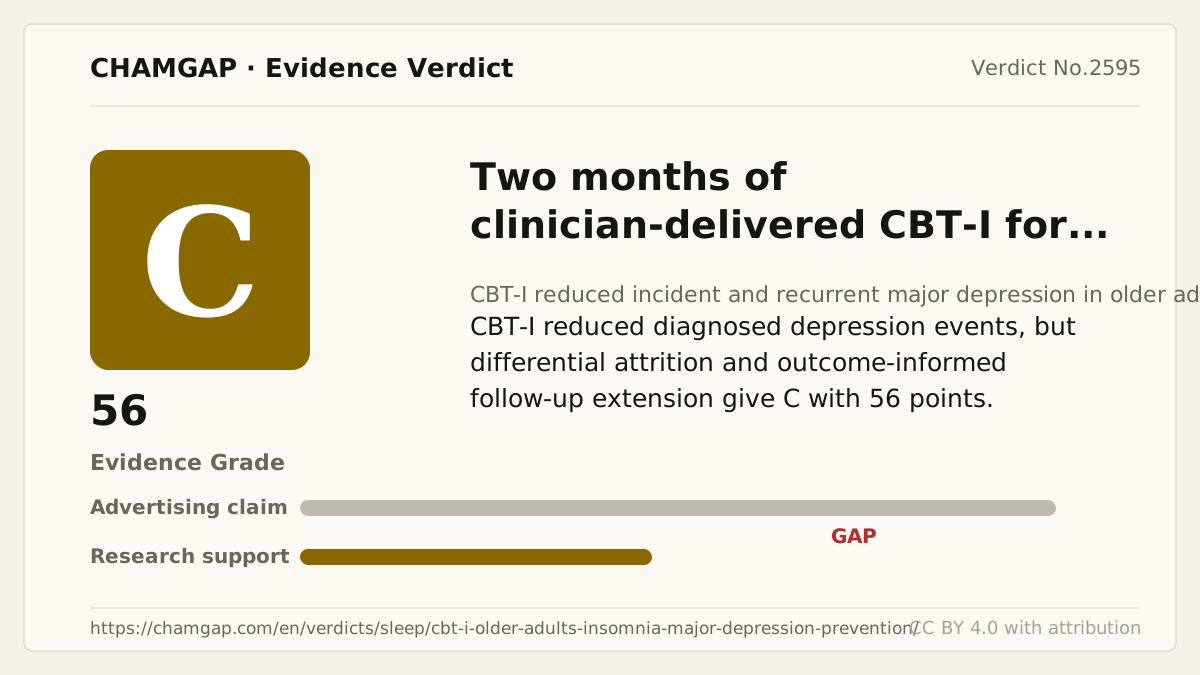
[Chamgap] CBT-I for late-life insomnia x prevention of major depressive disorder — Evidence Grade C·56. 1 cited sources checked. Source: https://chamgap.com/en/verdicts/sleep/cbt-i-older-adults-insomnia-major-depression-prevention/ · CC BY 4.0CC BY 4.0 — free to use with attribution; do not distort grades, numbers, or verdict meaning.
What this document does and does not do
Chamgap is an information source. It reports what research has and has not confirmed; it does not tell readers what to take or buy. That decision belongs to readers and, when needed, medical or legal professionals. This verdict reflects literature available up to the search date and may change as new research appears. Nothing here is medical advice.