
Cognitive behavioral therapy for insomnia,
does it really help with Improvement in sleep onset, nighttime awakenings, sleep efficiency, and insomnia severity in adults with chronic insomnia?
research showsCBT-I is rated high C because multiple randomized trials and meta-analyses show improvements in sleep onset, nighttime awakenings, sleep efficiency, and insomnia severity, and the AASM strongly recommends it. The 2021 AASM systematic review evaluated 66 studies and found clinically meaningful benefits of multicomponent CBT-I, including effects that can persist after treatment. The principal outcomes, however, were sleep diaries, the Insomnia Severity Index, and subjective sleep-onset latency and wake time. Hard outcomes such as accidents or mortality were not established by this verdict, so rule ① limits the grade to C with 58 points.
ads claimClaims may expand the evidence into complete sleep restoration within days, correction of every sleep disorder, or equivalence between fully automated programs and clinician-led CBT-I. Direct support concerns symptoms and sleep-diary outcomes in adults with chronic insomnia; other sleep disorders and hard outcomes require separate evidence.
Useful facts when choosing a product
- CBT-I is a structured treatment that combines sleep restriction or compression, stimulus control, cognitive restructuring, relaxation, and sleep education.
- Clinician-led in-person and remote care, as well as automated or coach-supported digital programs, have been studied, but their delivery and human support are not equivalent.
- The initial sleep-restriction phase can temporarily shorten sleep and increase daytime sleepiness, fatigue, and impaired concentration.
- Marked sleepiness, safety-sensitive driving or work, mania or seizure risk, and untreated sleep apnea can require separate safety assessment when adjusting the sleep window.
Chamgap Semantic Classification Code
Candidate index · review held
X.cognitive-behavioral-therapy.behavioral.sleep-onset-nighttime-awakenings-sleep-efficiency-and-insomnia-severity-with-chronic-insomnia.improve.UNKBehaviors, exposures and policies > Cognitive behavioral therapy > Behavioral delivery > sleep onset, nighttime awakenings, sleep efficiency, and insomnia severity with chronic insomnia > Improvement claim > Unknown
An automated migration candidate, not an issued permanent code; exact claim scope remains under review. This machine-generated migration candidate helps retrieval but is not a permanent assignment. The original verdict ID and URL remain authoritative.
What the research actually shows
The Edinger et al. AASM review evaluated 66 studies of multicomponent CBT-I, stimulus control, sleep restriction, relaxation therapy, and sleep hygiene. Multicomponent CBT-I produced clinically meaningful benefits in insomnia response or remission and in sleep-diary measures including sleep-onset latency, wake after sleep onset, and sleep efficiency. The companion guideline issued a strong recommendation for multicomponent CBT-I and conditional recommendations for several single-component therapies. This evidence concerns a structured psychological treatment, not sensory or device interventions such as white noise, pink noise, binaural beats, eye masks, earplugs, or electroacupuncture.
Why this is classified as C (58)
The AASM review of 66 studies, its strong guideline recommendation, and consistent randomized evidence for symptom and sleep-diary improvement received substantial weight. The principal endpoints remain the Insomnia Severity Index, sleep diaries, and subjective latency or wake time, while accidents and mortality were not evaluated, so rule ① caps the grade at C with 58 points.
Counterpoint. The evidence is direct for chronic-insomnia symptoms but does not establish treatment of other causes such as obstructive sleep apnea, restless legs syndrome, or circadian rhythm disorders.
Rejudgment record. New verdict — Accepted the AASM systematic review of 66 studies, the strong recommendation for multicomponent CBT-I, and randomized improvements in sleep onset, nighttime wakefulness, sleep efficiency, and insomnia severity, but applied boundary rule ① because sleep diaries and symptom scales dominate the outcomes
Sub-claim grades by effect
This ingredient is marketed for several effects. A single overall grade blends strong and weak claims together, so each effect is graded separately here. The overall grade reflects the strongest disconfirming or core claim.
| Effect (sub-claim) | Grade | Basis |
|---|---|---|
| Improved sleep-onset latency and nighttime wakefulness | C | Multiple randomized trials and meta-analyses show consistent sleep-diary improvement, but the outcomes are subjective. |
| Improved sleep efficiency | C | Clinically meaningful benefit was found for a core sleep-diary endpoint of multicomponent CBT-I. |
| Reduced insomnia severity | C | Validated symptom scales such as the Insomnia Severity Index and response or remission outcomes provide strong support. |
Cross-check — AI research and Codex final gate
Evidence Table
| Study | Design | Sample | Funding | Endpoint | Result | Weight |
|---|---|---|---|---|---|---|
| Edinger JD et al. 2021 AASM systematic review | Systematic review, meta-analysis, and GRADE assessment | 66 studies | American Academy of Sleep Medicine | Insomnia response and remission, sleep-onset latency, wake after sleep onset, sleep efficiency, and sleep quality | Multicomponent CBT-I produced clinically meaningful improvement across several key symptom and sleep-diary outcomes. | Primary evidence synthesis |
| Edinger JD et al. 2021 AASM clinical practice guideline | Evidence-based clinical practice guideline | Based on the 66-study systematic review | American Academy of Sleep Medicine | Benefits and harms of behavioral and psychological treatments for adult chronic insomnia | Issued a strong recommendation for multicomponent CBT-I and a conditional recommendation against sleep hygiene alone. | Strong guideline support |
Receipt — 2 References
All 2 cited sources were verified for existence at the original page (as of 2026-07-23).
Final verification and publication gate: Codex · Evidence date: 2026-07-23 · Corrections: none
Cite this verdict
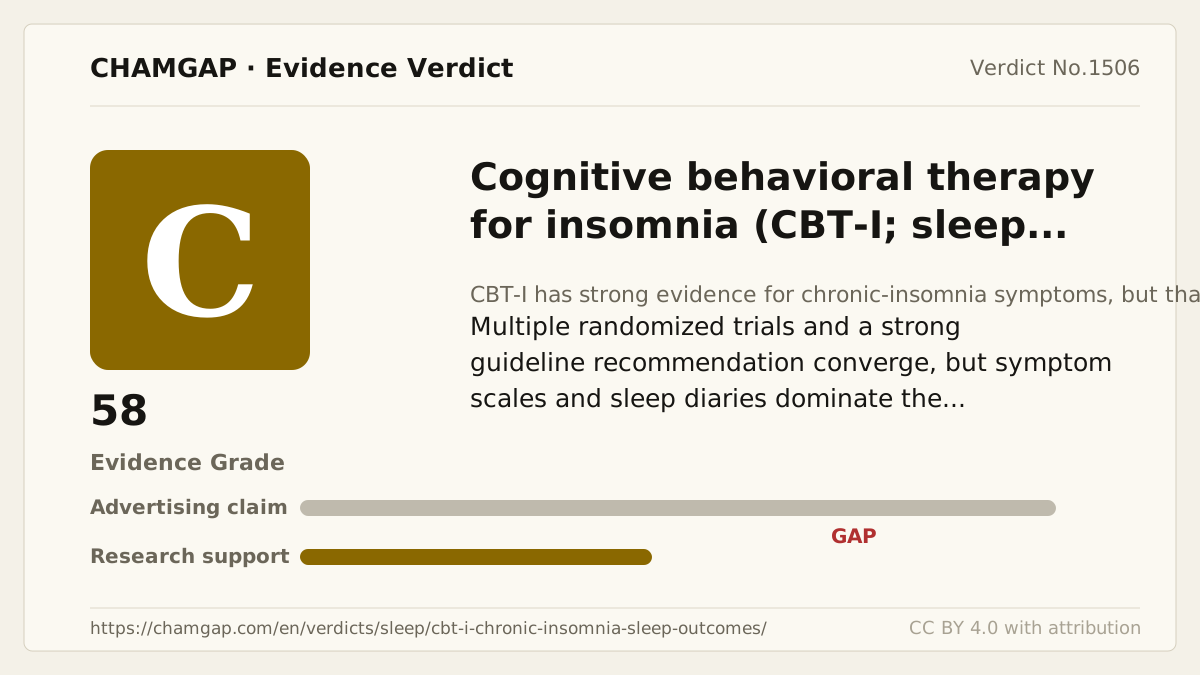
[Chamgap] Cognitive behavioral therapy for insomnia x improved sleep outcomes in adults with chronic insomnia — Evidence Grade C·58. 2 cited sources checked. Source: https://chamgap.com/en/verdicts/sleep/cbt-i-chronic-insomnia-sleep-outcomes/ · CC BY 4.0CC BY 4.0 — free to use with attribution; do not distort grades, numbers, or verdict meaning.
What this document does and does not do
Chamgap is an information source. It reports what research has and has not confirmed; it does not tell readers what to take or buy. That decision belongs to readers and, when needed, medical or legal professionals. This verdict reflects literature available up to the search date and may change as new research appears. Nothing here is medical advice.