
Brotizolam 0.25 mg,
does it really help with Short-term reduction of sleep-onset time and nighttime awakenings and increased sleep duration in adults with severe insomnia?
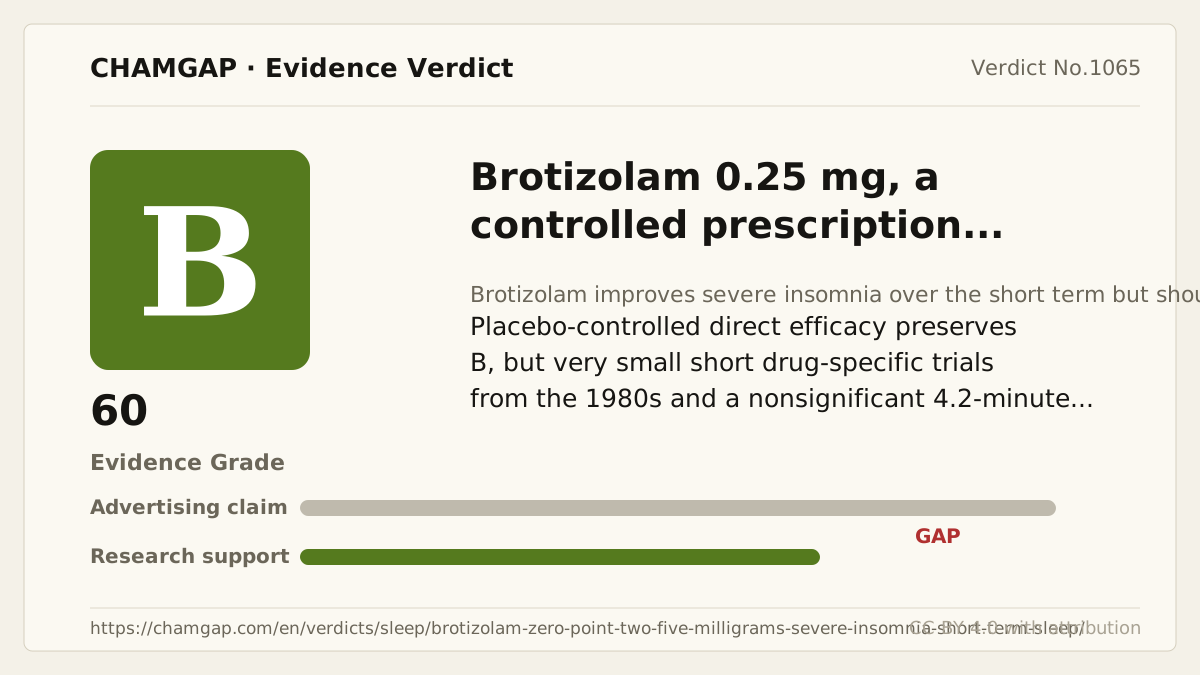
research showsBrotizolam 0.25 mg is rated B because it shortens sleep onset, reduces nighttime awakenings, and increases sleep duration over the short term in adults with insomnia. A 1983 placebo-controlled sleep-laboratory study found reductions in polysomnographic sleep latency, awakenings, and wake time during sleep together with increased total sleep time. A double-blind crossover trial of 39 general-practice patients also found less awakening and longer sleep than with placebo. Drug-specific evidence depends on very small, short trials from the 1980s and the 39-participant crossover trial, while the objective sleep-latency reduction of 4.2 minutes in a benzodiazepine class meta-analysis was not significant. Placebo-controlled direct efficacy preserves B rather than C, but the limitations place it at the bottom of the band, B with 60 points. Dependence, tolerance, withdrawal, next-day sedation, cognitive impairment, and falls remain separate safety concerns.
ads claimMarketing or prescribing inertia can expand rapid sedation into restorative sleep, long-term insomnia therapy, or sustained effectiveness with daily use. The evidence supports sleep-continuity improvement over days to a few weeks, not treatment of the underlying cause or long-term functional recovery.
Useful facts when choosing a product
- Brotizolam 0.25 mg is a rapid-acting controlled prescription hypnotic generally taken immediately before bed, with enough time available for a full night of sleep.
- Its role is short-term treatment of severe insomnia that substantially impairs daily function, generally using the lowest effective dose for days to no more than two to four weeks including tapering and avoiding prolonged continuous use.
- Alcohol, opioids, and other hypnotic or sedating medicines can amplify respiratory depression and excessive sedation, and driving or operating machinery may remain impaired the next day.
- Repeated use can cause tolerance and dependence, while abrupt discontinuation can trigger rebound insomnia, anxiety, and withdrawal. Older adults require particular caution because of confusion, falls, and fractures.
Chamgap Semantic Classification Code
Candidate index · review held
M.brotizolam.UNK.short-term-reduction-of-sleep-onset-time-and-nighttime-awakenings-and-increased-sleep-duration-with-severe-insomnia.reduce.placeboMedicinal interventions > Brotizolam > Unknown > Short-term reduction of sleep-onset time and nighttime awakenings and increased sleep duration with severe insomnia > Reduction claim > Placebo
An automated migration candidate, not an issued permanent code; exact claim scope remains under review. This machine-generated migration candidate helps retrieval but is not a permanent assignment. The original verdict ID and URL remain authoritative.
What the research actually shows
Roehrs and colleagues gave brotizolam 0.25 or 0.50 mg for one to three days to patients reporting disturbed sleep and found reduced polysomnographic sleep latency, awakenings, and wake time during sleep together with increased total sleep time. Uzzan and colleagues used a double-blind crossover design in 39 patients aged 18 to 70 years with insomnia and found better sleep ratings, fewer nighttime awakenings, and longer sleep with 0.25 mg than placebo. The review by Langley and Clissold summarized short-term efficacy of 0.125 to 0.5 mg as similar to several active hypnotics. The Holbrook benzodiazepine meta-analysis included 45 randomized trials and 2,672 participants, confirming increased sleep duration but more daytime drowsiness, dizziness, and memory impairment; most trials lasted 14 days or less.
Why this is classified as B (60)
Placebo-controlled polysomnography and a 39-participant double-blind crossover trial showed concordant improvement in sleep onset, awakenings, and total sleep time, preserving B rather than C. Drug-specific evidence nevertheless depends on very small, short trials from the 1980s, and the class meta-analysis found a nonsignificant objective sleep-latency reduction of 4.2 minutes, resulting in the bottom of the B band with 60 points. Dependence, withdrawal, next-day sedation, cognitive impairment, and falls are separate from efficacy.
Counterpoint. It may help when severe insomnia requires immediate short-term relief. Evaluation should simultaneously address sleep apnea, depression or anxiety, pain, medicines, and alcohol, while cognitive behavioral therapy remains the priority for chronic insomnia.
Rejudgment record. Cross-verification incorporated — Retained B rather than C because placebo-controlled polysomnography and a 39-participant double-blind crossover trial showed direct short-term efficacy; drug-specific evidence depends on very small, short trials from the 1980s and the class meta-analysis found a nonsignificant objective sleep-latency reduction of 4.2 minutes, supporting the bottom-of-band score of 60
Sub-claim grades by effect
This ingredient is marketed for several effects. A single overall grade blends strong and weak claims together, so each effect is graded separately here. The overall grade reflects the strongest disconfirming or core claim.
| Effect (sub-claim) | Grade | Basis |
|---|---|---|
| Short-term reduction of sleep-onset time in adults with severe insomnia | B | Drug-specific polysomnography showed a reduction, but the sample was small, effects were more consistent at 0.50 mg, and the objective class effect was modest. |
| Short-term reduction of nighttime awakenings in adults with severe insomnia | B | Objective and subjective placebo-controlled data agree in direction, but the trials are old and short-term. |
| Short-term increase in total sleep time in adults with severe insomnia | B | Brotizolam trials and a benzodiazepine meta-analysis support the effect, but long-term persistence is unproven. |
Cross-check — AI research and Codex final gate
Evidence Table
| Study | Design | Sample | Funding | Endpoint | Result | Weight |
|---|---|---|---|---|---|---|
| Roehrs et al. 1983 | Short-term placebo-controlled sleep-laboratory dose study | Small sample of patients with disturbed sleep; exact number not reported in the PubMed abstract | Inadequately reported; early product-evaluation era | Polysomnographic sleep latency, number of awakenings, wake during sleep, and total sleep time | Doses of 0.25 and 0.50 mg reduced sleep latency and awakenings and increased total sleep time, with more consistent effects at 0.50 mg. | Objective direct short-term evidence |
| Uzzan et al. 1983 | Double-blind placebo-controlled crossover trial in general practice | 39 patients with insomnia aged 18 to 70 years | Inadequately reported; early product-evaluation era | Subjective sleep quality, nighttime awakenings, sleep duration, and next-day well-being | Brotizolam 0.25 mg produced better sleep, fewer awakenings, and longer sleep than placebo, with no difference in next-day well-being. | Dose-specific direct symptom evidence |
| Holbrook et al. 2000 | Systematic review and meta-analysis of benzodiazepine randomized trials for insomnia | 45 randomized trials and 2,672 participants | Public and academic study; manufacturers were asked for unpublished trial reports | Objective and subjective sleep latency, total sleep duration, and adverse effects | Total sleep duration increased significantly and subjective latency fell by 14.3 minutes, while the objective 4.2-minute reduction was not significant; the adverse-effect odds ratio was 1.8. | Class-consistency and effect-size context |
Receipt — 4 References
All 4 cited sources were verified for existence at the original page (as of 2026-07-21).
Final verification and publication gate: Codex · Evidence date: 2026-07-21 · Corrections: none
Cite this verdict
[Chamgap] Brotizolam 0.25 mg x short-term sleep improvement in adults with severe insomnia — Evidence Grade B·60. 4 cited sources checked. Source: https://chamgap.com/en/verdicts/sleep/brotizolam-zero-point-two-five-milligrams-severe-insomnia-short-term-sleep/ · CC BY 4.0CC BY 4.0 — free to use with attribution; do not distort grades, numbers, or verdict meaning.
What this document does and does not do
Chamgap is an information source. It reports what research has and has not confirmed; it does not tell readers what to take or buy. That decision belongs to readers and, when needed, medical or legal professionals. This verdict reflects literature available up to the search date and may change as new research appears. Nothing here is medical advice.