
Blue-light filtering spectacles,
does it really help with Shorter sleep-onset latency and better sleep quality in evening screen users?
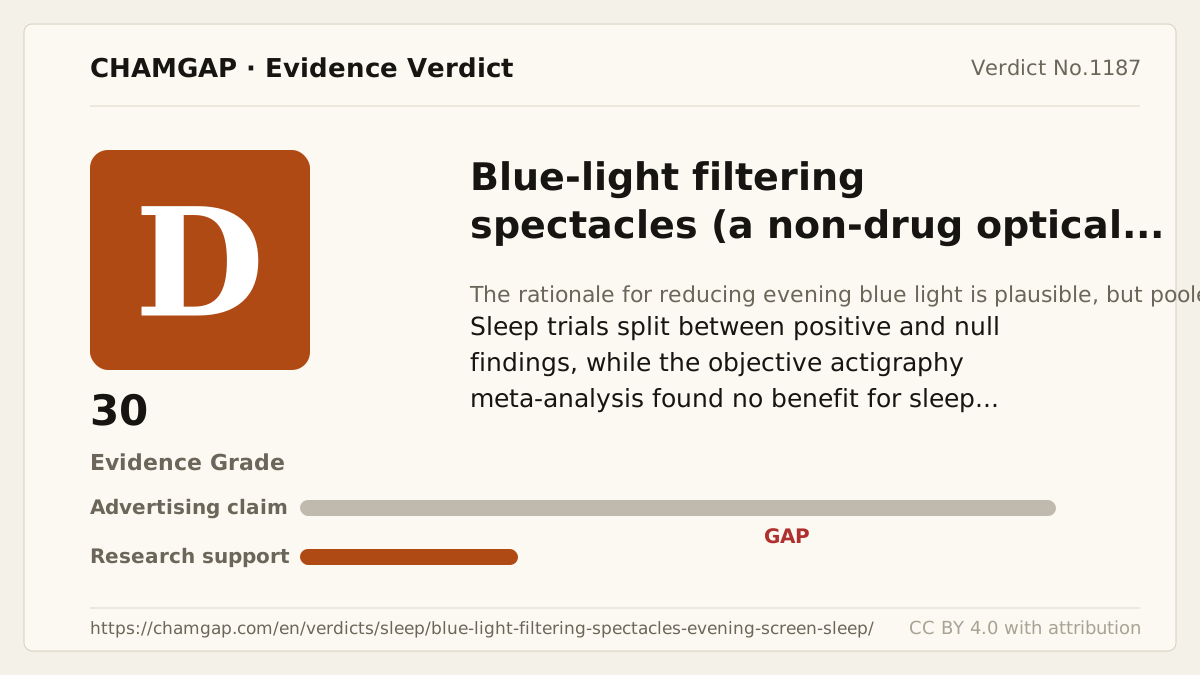
research showsBlue-light filtering spectacles for faster sleep onset and better sleep quality in evening screen users are rated D. A 2023 Cochrane review included 17 randomized trials overall, but among the six trials and 148 participants reporting sleep, three were positive and three found no difference; populations, lenses, and treatment periods varied, leaving very-low-certainty evidence. A 2025 meta-analysis restricted to objective actigraphy from three double-blind crossover trials and 49 participants found a nonsignificant sleep-onset difference of -4.86 minutes, with a 95% CI from -20.23 to 10.52. Total sleep time, sleep efficiency, and wake after sleep onset were also not different. Small individual trials have subjective positive signals, but current human syntheses do not confirm objective sleep onset or sleep-quality benefit, giving D with 30 points. The glasses are generally safe, although headache, wearing discomfort, and lower mood were reported infrequently.
ads claimMarketing connects the optical fact that a lens filters some short-wavelength visible light to normalized melatonin, immediate sleepiness, deeper sleep, and next-day vitality. Filter strength varies across lenses, while ambient light, total screen brightness, and cognitive arousal from content can remain.
Useful facts when choosing a product
- Blue-light filtering spectacles reduce part of short-wavelength visible light, but transmission spectra and filter strength vary substantially from nearly clear coatings to dark amber lenses.
- Wearing the glasses does not remove total screen brightness, ambient illumination, cognitive arousal from content, or delayed bedtime. It is not equivalent to dimming evening light and reducing screen time.
- No standard filter percentage, start time, or duration is established for sleep improvement. People who need corrective lenses should prioritize accurate vision correction and optical quality.
- The product is generally low risk, although trials infrequently reported headache, wearing discomfort, and lower mood. Persistent insomnia or severe daytime sleepiness warrants evaluation rather than relying on glasses.
Chamgap Semantic Classification Code
Candidate index · review held
P.blue-light-filtering-spectacles.UNK.shorter-sleep-onset-latency-and-better-sleep-quality-in-evening-screen-users.assess.UNKProcedures, devices and tests > Blue-light filtering spectacles > Unknown > Shorter sleep-onset latency and better sleep quality in evening screen users > Association or change assessment > Unknown
An automated migration candidate, not an issued permanent code; exact claim scope remains under review. This machine-generated migration candidate helps retrieval but is not a permanent assignment. The original verdict ID and URL remain authoritative.
What the research actually shows
The Cochrane review included 17 adult randomized trials with follow-up from less than one day to five weeks. No trial had low risk of bias across all domains, and the six trials with 148 participants reporting sleep quality mixed healthy adults with mental-health and sleep-disorder populations. Three positive and three null studies could not be meta-analyzed. Luna-Rangel and colleagues later synthesized the three double-blind crossover trials with actigraphy, totaling 49 participants. Sleep onset, total sleep time, sleep efficiency, and wake after sleep onset were all nonsignificant, and the sample remains too small for precision. Digital eye strain is a separate efficacy axis and is not a subclaim in this sleep verdict.
Why this is classified as D (30)
The six sleep trials and 148 participants in the Cochrane review split evenly between positive and null findings with very-low certainty. The 2025 objective actigraphy meta-analysis of three trials and 49 participants found no improvement in sleep onset, total sleep time, sleep efficiency, or wake after sleep onset. Null core objective endpoints plus small low-quality evidence give D with 30 points.
Counterpoint. An individual may test the glasses as one part of reducing evening light exposure, but screen time, illumination, and bedtime should be tracked, while chronic insomnia calls for cause assessment and cognitive behavioral therapy.
Rejudgment record. New verdict — Applied D because the six sleep trials and 148 participants in the 2023 Cochrane review split between three positive and three null findings with very-low certainty, while the 2025 objective actigraphy meta-analysis of three double-blind crossover trials and 49 participants found no significant effect on sleep onset, total sleep time, sleep efficiency, or wake after sleep onset
Sub-claim grades by effect
This ingredient is marketed for several effects. A single overall grade blends strong and weak claims together, so each effect is graded separately here. The overall grade reflects the strongest disconfirming or core claim.
| Effect (sub-claim) | Grade | Basis |
|---|---|---|
| Shorter sleep-onset latency in evening screen users | D | The actigraphy meta-analysis estimated a -4.86-minute difference in sleep onset, but the 95% CI from -20.23 to 10.52 was not significant. |
| Better subjective sleep quality in evening screen users | D | The six Cochrane sleep trials and 148 participants split between three positive and three null findings, with very-low certainty. |
| Improved objective sleep duration and efficiency in evening screen users | D | The three-trial crossover meta-analysis found no significant effect on total sleep time, sleep efficiency, or wake after sleep onset. |
Cross-check — AI research and Codex final gate
Evidence Table
| Study | Design | Sample | Funding | Endpoint | Result | Weight |
|---|---|---|---|---|---|---|
| Singh S et al. 2023 Cochrane review | Cochrane systematic review of randomized trials of blue-light filtering spectacle lenses | 17 randomized trials overall; six trials and 148 participants for sleep quality | Funding across included trials varied among public, unfunded, lens-provision, and some industry-supported sources | Sleep quality, visual fatigue, visual acuity, and device-related adverse events | Three of six sleep trials reported improvement and three found no difference; heterogeneity and insufficient quantitative data prevented meta-analysis, leaving very-low certainty. | Key broad synthesis with very-low certainty |
| Luna-Rangel FA et al. 2025 | Systematic review and meta-analysis of randomized crossover trials reporting actigraphy | Three double-blind crossover randomized trials and 49 participants | Grant support is indexed in PubMed; authors reported no commercial or financial conflicts | Objective sleep onset, total sleep time, sleep efficiency, and wake after sleep onset | Sleep onset was -4.86 minutes, total sleep time +8.75 minutes, sleep efficiency -0.61%, and wake after sleep onset -1.47 minutes; none was significant. | Current synthesis of objective outcomes with a small sample |
Receipt — 2 References
All 2 cited sources were verified for existence at the original page (as of 2026-07-23).
Final verification and publication gate: Codex · Evidence date: 2026-07-23 · Corrections: none
Cite this verdict
[Chamgap] Blue-light filtering spectacles x sleep onset and sleep quality in evening screen users — Evidence Grade D·30. 2 cited sources checked. Source: https://chamgap.com/en/verdicts/sleep/blue-light-filtering-spectacles-evening-screen-sleep/ · CC BY 4.0CC BY 4.0 — free to use with attribution; do not distort grades, numbers, or verdict meaning.
What this document does and does not do
Chamgap is an information source. It reports what research has and has not confirmed; it does not tell readers what to take or buy. That decision belongs to readers and, when needed, medical or legal professionals. This verdict reflects literature available up to the search date and may change as new research appears. Nothing here is medical advice.