
Bedtime music,
does it really help with Improved patient-reported sleep quality in adults with insomnia symptoms?
research showsBedtime music earns C with 56 points because it improves patient-reported sleep quality. Of 13 trials and 1,007 participants overall, the PSQI analysis included 10 trials and 708 participants, MD -2.79 points (95% CI -3.86 to -1.72), I-squared 81%, with moderate-certainty evidence.
ads claimA modest average subjective improvement should not be expanded into treatment of insomnia, guaranteed deep sleep, or longer objective sleep. Objective sleep latency, duration, and efficiency were not improved.
Useful facts when choosing a product
- Cochrane included 13 trials and 1,007 participants overall; PSQI analysis used 10 trials and 708 participants.
- PSQI has no widely validated minimally important difference, although some trials used 2.5-to-3-point benchmarks.
- Harmat provided a single three-week active audiobook comparison in 65 participants.
Chamgap Semantic Classification Code
Candidate index · review held
UNK.listening-to-prerecorded-music-at-bedtime.UNK.patient-reported-sleep-quality-with-insomnia-symptoms.improve.MULTIUnknown > Listening to prerecorded music at bedtime > Unknown > patient-reported sleep quality with insomnia symptoms > Improvement claim > Multiple: primary unresolved
An automated migration candidate, not an issued permanent code; exact claim scope remains under review. This machine-generated migration candidate helps retrieval but is not a permanent assignment. The original verdict ID and URL remain authoritative.
What the research actually shows
Harmat 2008 randomized and analyzed 94 participants: 35 music, 30 audiobook, and 29 no treatment. Three-week PSQI changed from 6.83 to 3.27 with music and 6.27 to 5.17 with audiobook, an approximate music-versus-audiobook difference of -1.90 points (95% CI -2.93 to -0.94), P=0.0004. Cochrane found MD -2.79 points (95% CI -3.86 to -1.72), I-squared 81%, with moderate certainty in 10 trials and 708 participants, but comparators were mainly no treatment or usual care.
Why this is classified as C (56)
The pooled effect exceeds commonly used benchmarks, but no widely validated PSQI threshold exists, and an unblinded patient-reported outcome plus follow-up under 12 weeks impose C with 56 points.
Counterpoint. It is a low-cost non-drug option that individuals may try for relaxation, but persistent insomnia warrants evaluation and cognitive behavioral therapy.
Rejudgment record. Cross-check applied — Repeated PSQI improvement exceeding commonly used benchmarks, limited by no widely validated threshold, unblinded patient reporting, and short trials
| Endpoint | P | Symptom or function itself is the target - including patient reports and performance tests |
| Replication | R2 | Independently replicated across trials |
| Independence | I2 | Decisive evidence is publicly or non-profit funded |
| Effect size | E+ | Meets the clinically important threshold |
Stored derived and displayed grades match; this is not a current recalculation or validity check (C).
Sub-claim grades by effect
This ingredient is marketed for several effects. A single overall grade blends strong and weak claims together, so each effect is graded separately here. The overall grade reflects the strongest disconfirming or core claim.
| Effect (sub-claim) | Grade | Basis |
|---|---|---|
| Improved patient-reported sleep quality | C | The PSQI mean difference of -2.79 exceeds commonly used benchmarks, but no widely validated threshold exists. |
| Shorter objectively measured sleep latency | D | Objective measures in three trials with 136 participants showed no clear improvement. |
| Improved objective total sleep time and sleep efficiency | D | The effect was not replicated on objective measures. |
Cross-check — AI research and Codex final gate
Evidence Table
| Study | Design | Sample | Funding | Endpoint | Result | Weight |
|---|---|---|---|---|---|---|
| Harmat L et al. 2008 | Three-arm repeated-measures randomized controlled trial | 94 randomized and 94 analyzed | Funding source not reported; conducted by university investigators | Three-week patient-reported sleep quality on PSQI | Music versus audiobook PSQI difference about -1.90 points (95% CI -2.93 to -0.94), P=0.0004 | Direct positive trial |
| Jespersen KV et al. 2022 | Cochrane systematic review and meta-analysis of randomized trials | 13 trials and 1,007 participants; PSQI 10 trials and 708; objective measures 3 trials and 136 | Four trials had national research funding, three university support, one a private foundation, and five did not report funding; no manufacturer support for the review | PSQI and objective sleep latency, total sleep time, efficiency, and interruption | PSQI MD -2.79 (95% CI -3.86 to -1.72), I-squared 81%, moderate certainty; comparators mainly no treatment or usual care | Repeated positive subjective evidence with objective disagreement |
Receipt — 4 References
All 4 cited sources were verified for existence at the original page (as of 2026-07-24).
Final verification and publication gate: Codex · Evidence date: 2026-07-24 · Corrections: none
Cite this verdict
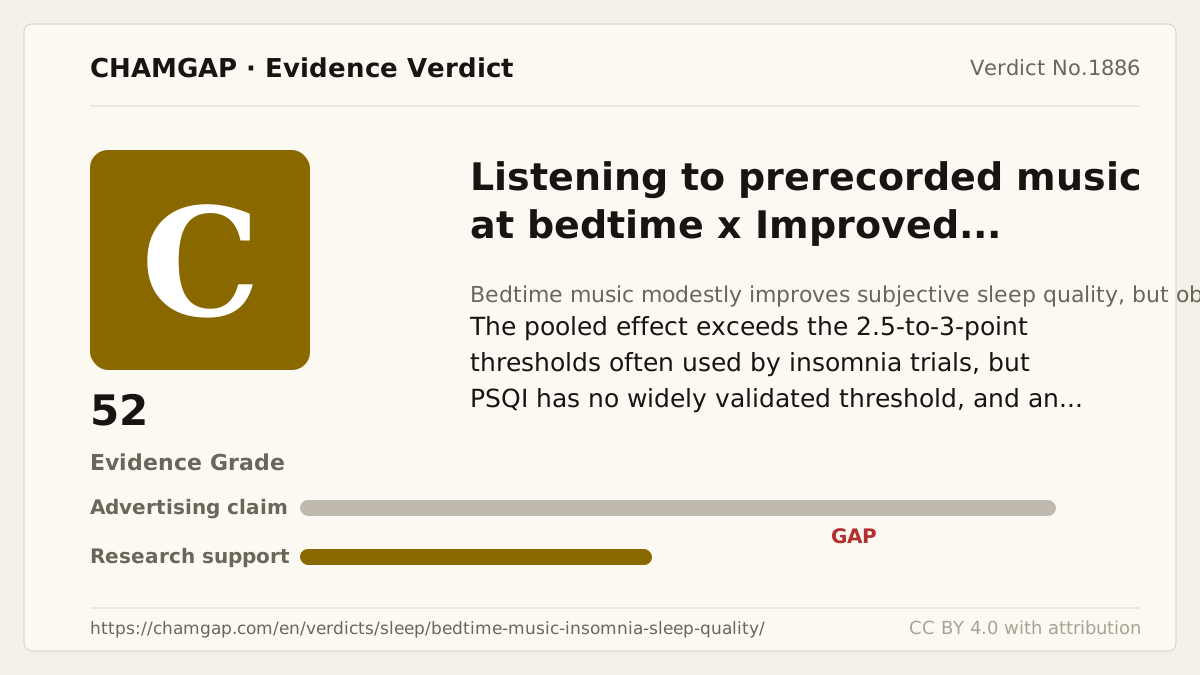
[Chamgap] Bedtime music x insomnia and sleep quality — Evidence Grade C·56. 4 cited sources checked. Source: https://chamgap.com/en/verdicts/sleep/bedtime-music-insomnia-sleep-quality/ · CC BY 4.0CC BY 4.0 — free to use with attribution; do not distort grades, numbers, or verdict meaning.
What this document does and does not do
Chamgap is an information source. It reports what research has and has not confirmed; it does not tell readers what to take or buy. That decision belongs to readers and, when needed, medical or legal professionals. This verdict reflects literature available up to the search date and may change as new research appears. Nothing here is medical advice.